Argentina is one of the most promising markets today. The country is the fourth-largest in Latin America, and its people are urban, digital, and open to gambling. Additionally, its internet and payments are among the strongest on the continent. What usually bothers new entrants is the regulatory patchwork. Fair enough. The legislation is still evolving there, province by province.
Below, I break down gambling regulations in Argentina and highlight the jurisdictions operators often choose to build a sustainable online casino business.
Is Online Gambling Legal in Argentina?
In short, yes. The current state of legislation makes Argentina a regulated gambling market.
However, there isn’t a single national online gambling law. As a federal country, Argentina leaves gambling regulation to its provinces. Each of the 23 provinces, together with the City of Buenos Aires, sets its own rules, fees, authorities, and tax regimes for online casinos.
If you’re targeting one province, you go for a local license tied to the target jurisdiction. But if you’re planning multi-province operations, get ready to stack licenses, pay several monthly fees (”canons”), and navigate legal frameworks.
Demanding? Absolutely. Yet this structure allows online casino operators to test different strategies and diversify business risks.
iGaming Regulation in Argentina by Province
National-Level Gambling Laws
At the state level, Argentina regulates gambling through data protection rules, AML/CTF measures, domain and brand authorization, indirect tax rates, and advertising standards.
iGaming operators must comply with these obligations regardless of the province in which they register an online casino business.
| National Legislative Act | What It Means for Casino Operators |
| Law-Decree No. 6,618/1957 | - Obtain a provincial gambling license before offering casino services, as unauthorized operations trigger fines, imprisonment, and asset seizure
|
| Law No. 25,326/2000 | - Collect and process personal data only for legitimate purposes, and avoid collecting unnecessary information for registration, KYC, payments, or player management
- Allow players to access their personal data in a clear format within 10 calendar days of a valid request
- Correct, update, or delete inaccurate personal data within 5 business days after a request
|
| Law No. 25,246/2000 Resolution No. 194/2023 | - Complete an AML/CFT risk assessment before launch
- Verify every online player before they can gamble, ban anonymous or false-name accounts, and collect the KYC data
- Classify players as low, medium, or high risk, and apply more stringent source-of-funds checks and monitoring for higher-risk users
- Monitor all player transactions and report suspicious activity to the UIF* within 15 calendar days and no later than 150 days after the attempted transaction. Report suspected terrorist-financing activity within 48 hours
- Appoint a Compliance Officer and retain player and transaction records for at least 10 years
|
| Law No. 24,240/1993 Decree No. 274/2019 | - Provide players with clear information on bonuses, wagering requirements, withdrawal rules, fees, account restrictions, and other data before they register or deposit
- Handle player complaints fairly and cooperate with consumer authorities operating under the framework established by the National Congress
|
| Resolution No. 446/2025 | - Display the mandatory warning ("El jugar compulsivamente es perjudicial para la salud.") and the "18+" sign in every online gaming advertisement, covering at least 10% of the ad space
- Link every promotional ad to a webpage containing the full offer terms, conditions, and operator information
- Review influencer, affiliate, and social media campaigns to ensure they comply with the same gambling advertising regulations as your own marketing
|
| Resolution No. 3,510/2013 Resolution No. 5,228/2022 | - Get a CUIT* and a Clave Fiscal* to apply for tax registration in RCOSA*
- Register through ARCA* as a taxpayer and as a collection agent for the Indirect Online Gambling Tax before launch, and keep your business, license, and domain information up to date
These requirements target local operators. Foreign operators must assess which tax and reporting obligations apply to their business model. |
| General Resolution 5791/2025 | - When applying for RCOSA registration, allocate at least 60 days for ARCA to review and approve the application, and prepare all supporting documents in advance to reduce delays
- Verify your presence in the RCOSA registry if you are a local operator or a foreign operator whose business model requires it. Foreign operators should also check whether ARCA has included them in its public list of foreign online gaming operators, as payment intermediaries use it to apply the Indirect Online Gambling Tax
- Apply the tax rate assigned by ARCA from the next fortnightly tax period (the 1st or 16th day of the month), not immediately after approval
|
| Law No. 27,346/2016 Decree No. 293/2022 | - Use geolocation (IP, SIM) and payment data to identify transactions made in Argentina, as only they are subject to the Indirect Online Gambling Tax
- Confirm the tax rate assigned by ARCA (2.5%, 5%, 7.5%, 10%, or 15%)
- Pay the tax based on the net value of deposits credited to the player’s gaming account, regardless of whether the player later wins or loses, and file tax returns every two weeks
|
| Directive No. 68/2019 | - Apply for a .bet.ar domain through NIC* only after obtaining a provincial online casino license, a CUIT, and a Clave Fiscal
- Register a .bet.ar domain to demonstrate the authorized status of your Argentina iGaming website
|
*Notes:
- UIF—Unidad de Información Financiera (Financial Intelligence Unit responsible for preventing and investigating money laundering and terrorist financing).
- CUIT—Clave Única de Identificación Tributaria (Unique Tax Identification Code assigned to individuals and legal entities for tax purposes).
- Clave Fiscal—Fiscal Key (Secure credential operators use to log in and complete registrations, filings, and other procedures with ARCA).
- RCOSA—Registro de Control Online del Sistema de Apuestas (Online Betting System Control Registry for operators in Argentina).
- ARCA (former AFIP)—Agencia de Recaudación y Control Aduanero (National Tax and Customs Authority in Argentina).
- NIC Argentina—Dirección Nacional del Registro de Dominios de Internet (Network Information Center Argentina, responsible for operating the .ar domain).
- UTE—Unión Transitoria de Empresas (Temporary Union of Companies that join forces to carry out a specific tender or business activity).
How This Impacts the Online Casino Business
Argentina's iGaming framework is still evolving, and remains less complex than in Brazil or many European jurisdictions. But even this gambling compliance requires a significant budget.
Based on the national gambling laws in Argentina, these areas may create additional costs for operators:
- Provincial licensing and legal support;
- Platform and compliance software;
- KYC, AML/CFT, and transaction-monitoring systems;
- Compliance Officer hiring;
- Database storage, security, and maintenance;
- Customer support and complaint handling;
- Advertising, affiliate, and influencer compliance monitoring;
- CUIT, Clave Fiscal, and RCOSA registration and administration;
- Tax reporting and accounting;
- Indirect Online Gambling Tax of 2.5%–15% on net deposits;
- Geolocation tracking tools;
- Domain registration and administration;
- Pre-launch operating expenses during the RCOSA review period.
At the same time, legal status can become a commercial advantage. Argentine players tend to trust locally authorized brands, so a provincial license and a .bet.ar domain can improve credibility and help attract a wider audience. A compliant local presence can also simplify cooperation with local affiliate partners and PSPs.
State of Online Casino by Province
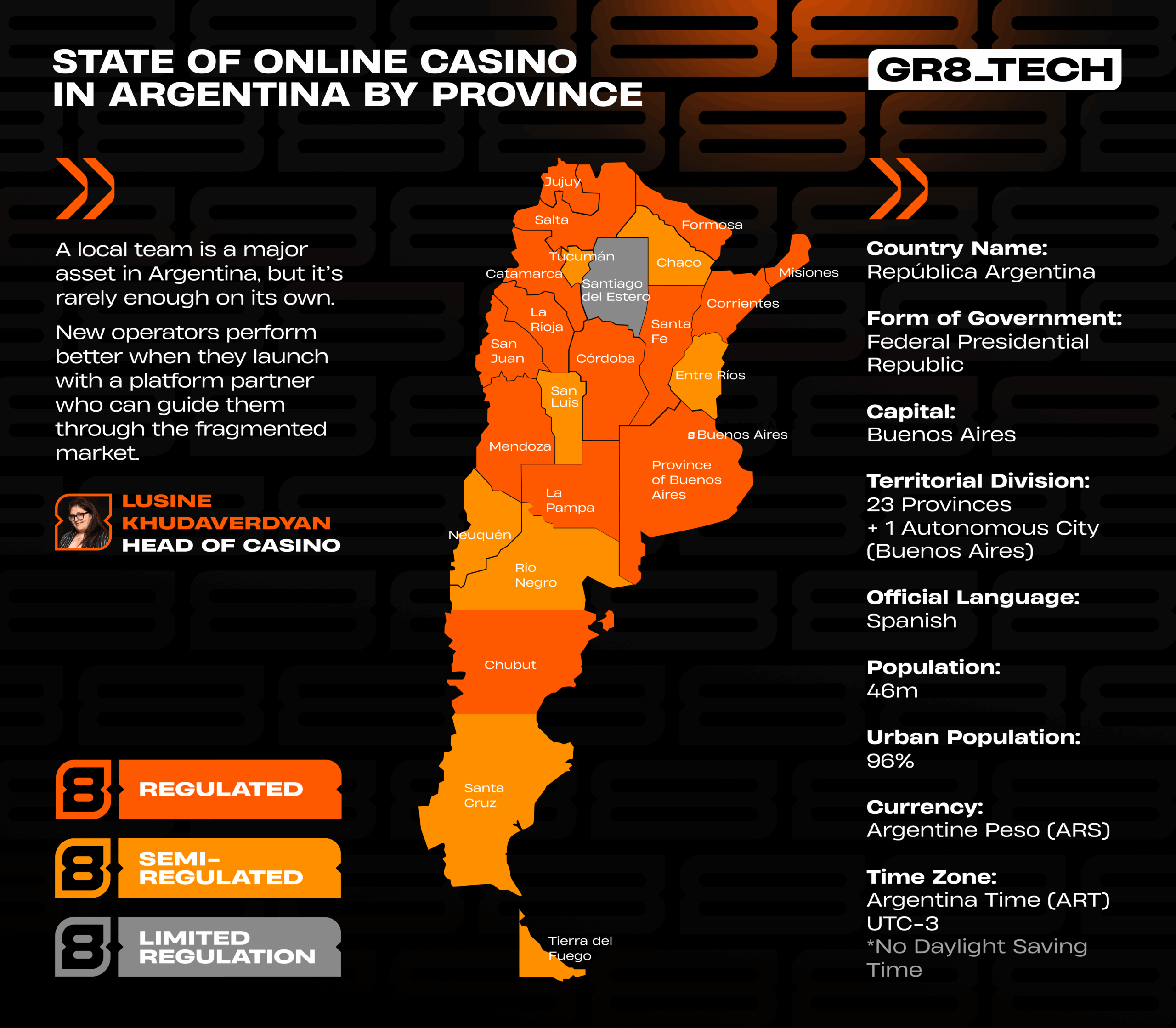
When it comes to gambling licensing, the scope of regulated casino activities, and technical requirements, legislative maturity differs significantly from province to province.
More Predictable Destinations
In my opinion, the Province of Buenos Aires, CABA, Chubut, Córdoba, La Rioja, Mendoza, San Juan, and Santa Fe ensure the safest market entry from a legal perspective.
Clear casino regulations, certified platforms, and responsible gambling measures help iGaming brands strengthen player trust and plan long-term business operations. On the other hand, the licensing process is more demanding. Some provinces use public tenders, limit the number of active operators, require a local presence, and impose higher compliance costs.
Flexible Market Entries
Catamarca, Corrientes, Formosa, Jujuy, La Pampa, Misiones, and Salta come with mid-level frameworks. Operators can offer online gambling services there, but need to clarify the law gaps directly with the regulator.
Here, operators may face fewer regulatory requirements and launch faster. However, licensing terms or technical standards can change over time, creating additional costs and compliance risks.
Jurisdictions with a Greater Risk
Chaco, Entre Ríos, Neuquén, Río Negro, San Luis, Santa Cruz, Tierra del Fuego, and Tucumán do not yet have new gambling regulations. They rely on land-based casino frameworks and general national-level online casino laws that I mentioned at the beginning. If local regulators grant licenses, it usually happens through case-by-case negotiations.
While this authorization path may appear easier and more attractive to some online operators, the current legal uncertainty demands careful planning and can create long-term risks for the casino business.
- Chaco: Predominantly a land-based casino market where only physical casinos, gaming rooms, and betting shops are explicitly regulated and must operate under Lotería Chaqueña’s monopoly;
- Entre Ríos: Another offline-first market where IAFAS oversees casinos and gaming halls and holds the exclusive mandate for online gambling legal regulations. Any non-IAFAS operation is outside the regulation today, while a dedicated iGaming bill is still under discussion and not yet in force;
- Neuquén: One more casino market with a major land-based share. The Provincial Institute (IPJA) is the regulatory body that issues licenses for casinos, bingos, raffles, and draws, charging a canon and a 3% GGR tax;
- Río Negro: Here, Lotería para Obras de Acción Social holds exclusive control over all games of chance, regulating land-based casinos, raffles, and betting while strictly sanctioning unauthorized brands;
- San Luis: Treats online gambling as a regulated activity, but the legal framework is still underdeveloped and driven more by general gambling laws (Law No. V-0866/2013) and Caja Social y Financiera authorizations than by dedicated online casino regulations;
- Santa Cruz: Runs gambling through LOAS, which holds an exclusive provincial mandate over all games of chance. A strict province-wide ban on gambling advertising makes any unlicensed digital promotion high-risk;
- Tierra del Fuego, Antártida e Islas del Atlántico Sur: Operates casinos, lotteries, quinielas, and bingo under a classic land-based law, with IPRA considering any activities outside that scope illegal. The iGaming market exists without a comprehensive rulebook;
- Tucumán: Only has an explicit responsible gambling law enforced by the Caja Popular de Ahorros that focuses on self-exclusion, venue controls, and strict health warnings.
Most Limited Gambling Market
Well, the only jurisdiction in Argentina without established provincial laws for both land-based and online casinos is Santiago del Estero. It only has a responsible gambling policy and a strict anti-illegal-gambling law that treats any unlicensed casino-style activity as a sanctionable offense.
At the same time, the province permits online bingo products. Bingo del Sol is the brand that currently holds an official license there.
PLANNING CASINO LAUNCH IN ARGENTINA?
CHECK THE GUIDE FIRST
What Provinces Operators Choose for a Start
The Autonomous City of Buenos Aires, Mendoza, Buenos Aires province, Chubut, and Córdoba are the most popular routes, especially for well-established international brands seeking sustainable market presence.
- CABA provides a predictable regulatory environment that allows operators to combine online casino and betting under one license. As of 2026, this jurisdiction leads in the number of issued licenses. The framework attracts operators with mature technology and compliance capabilities, as platforms must meet detailed requirements for certification, real-time monitoring, player verification, AML, payments, and responsible gambling. Licenses remain valid for up to 5 years and can be renewed for the same period, supporting long-term market planning. The legislation does not specify the license cost, so operators usually confirm it individually with LOTBA before finalizing their launch budget. An authorized operator may retain up to 20% of the total amount wagered. The commission is calculated on gross turnover, not on online gambling revenue or GGR.
- Mendoza regulates a broad range of online gambling activities and grants licenses for up to 10 years through a public tender, which makes it attractive for long-term investment. The province may also recognize operators licensed in other Argentine provinces based on interprovincial cooperation agreements. Operators already active in Argentina can contact IPJyC to confirm whether their current license allows a simplified entry in Mendoza. At the same time, the market imposes ongoing regulatory fees, regulatory control, and strict platform, AML, and advertising requirements.
- Buenos Aires Province provides access to Argentina's largest regulated gambling market, but entry is difficult because the law limits it to seven online gaming licensees and requires a minimum 15% of Argentine business involvement. Operators that secure a license benefit from a stable, well-defined regulatory framework, though this comes with higher compliance costs and operational complexity. The province requires continuous investment in certified technology, reporting, and regulatory compliance, while major platform upgrades take longer because they require recertification. Live dealer products also require separate IPLyC approval, which can delay time-to-market.
- Chubut fits experienced operators who can demonstrate financial stability, establish a local presence, and obtain provincial tax registration. This makes the market less accessible for new entrants but reduces competition. After licensing, operators face relatively high compliance costs due to the 15% monthly fee, continuous regulatory oversight, mandatory biometric player verification, and strict technical, payment, and RG requirements.
- Córdoba issues online operating licenses valid for up to 15 years through a public national and international tender, with a limit of up to 20. This creates more entry opportunities while preventing market concentration. Licensed operators have to address ongoing regulatory fees, platform monitoring, and strict technical and AML requirements. Advertising requires prior approval from Lotería de Córdoba, which can slow player acquisition campaigns and brand growth.
Other Licensing Routes
Brands that want to test the Argentine gaming industry at lower costs and regulatory standards usually select Misiones, Neuquén, Corrientes, Río Negro, and San Luis.
The local legislation does not clearly define license costs, duration, technical standards, or ongoing charges, so operators must verify these aspects through individual negotiations with the relevant regulator. This makes project budgets and timelines harder to predict. At the same time, the less detailed framework may give regulators greater flexibility to tailor specific requirements to an operator’s business model.
Key Criteria for Province Selection
From what I see, operators choose the licensing region for a casino launch based on the compliance complexity, permitted game types, the potential player base, business goals, and available budget.
💡 Check here what game genres and titles Argentine players expect to see in the online casino.
In Argentina, the sportsbook often drives acquisition. That's why experienced operators verify whether the provincial gambling license covers sports betting. If so, it gives them more flexibility for legal product scaling. These jurisdictions, for instance, explicitly allow that: Province of Buenos Aires, CABA, Chubut, Córdoba, La Rioja, Mendoza, San Juan, Misiones, Salta, and La Pampa.
It is worth checking if the target jurisdiction supports interprovincial agreements with Mendoza and San Juan. If so, it means you can potentially expand the online casino to these two provinces with minimal effort in the future and extend legal market presence in Argentina.
Foreign brands also clarify whether they need to register a local address for regulatory and official notices or partner with an Argentine company (UTE). If a UTE is required, it is essential to determine the minimum share for the Argentine partner. Corrientes, CABA, the Buenos Aires Province, Córdoba, La Rioja, Mendoza, and Chubut set requirements for that.
On the one hand, these jurisdictions impose additional entry costs and complicate a fully remote launch for foreign operators. On the other hand, the barriers reduce competition from smaller and purely offshore brands.
Disclaimer: The information provided here is a general regulatory overview, not professional legal advice. Online gambling laws in Argentina evolve rapidly and vary by province. Consult a qualified legal or tax professional before making any operational or investment decision.
Online Gambling Regulations and Compliance in Argentina: Key Takeaways
- Online Gambling Is Regulated in Argentina: Online gambling regulations at a national level cover AML/CFT, data protection, taxation, advertising, Spanish localization, and domain registration, while the 23 provinces and CABA establish their own licensing and responsible gambling standards;
- 8 Jurisdictions Have More Developed Online Gambling Frameworks: The Province of Buenos Aires, CABA, Chubut, Córdoba, La Rioja, Mendoza, San Juan, and Santa Fe offer clearer licensing, technical, and compliance requirements for B2C online casino operators;
- 7 Provinces Have Mid-Level Regulatory Frameworks: Catamarca, Corrientes, Formosa, Jujuy, La Pampa, Misiones, and Salta may suit operators who are ready to clarify license terms, technical obligations, and other regulatory gaps directly with local authorities;
- 8 Provinces Rely Mainly on Land-Based and National Regulations: Chaco, Entre Ríos, Neuquén, Río Negro, San Luis, Santa Cruz, Tierra del Fuego, and Tucumán allow operators to test the market but can potentially bring greater compliance risks in the future;
- Santiago del Estero Lacks a Dedicated Casino Framework: It is the only province without explicit regulation for either online or land-based casinos that currently issues licenses only for online bingo;
- 5 Jurisdictions Grant Licenses Through Public Tenders: Chubut, Córdoba, Mendoza, San Juan, and the Province of Buenos Aires establish a more competitive licensing process;
- Mendoza and San Juan Support Cross-Provincial Agreements: Operators already licensed in another Argentine province may enter these two jurisdictions through a simplified route if their current jurisdiction cooperates with Mendoza and San Juan;
- 7 Jurisdictions Set Explicit Local-Presence Requirements for Foreign Operators: Corrientes and the Buenos Aires Province require participation through a UTE with an Argentine partner, Córdoba, La Rioja, CABA, and Mendoza demand a locally registered address, and Chubut expects a local representative;
- 19 Jurisdictions Set Responsible Gambling Standards: The Province of Buenos Aires, Chubut, CABA, Corrientes, Córdoba, Tucumán, La Pampa, Río Negro, Mendoza, Misiones, Santa Cruz, Chaco, Jujuy, La Rioja, San Juan, Santiago del Estero, Catamarca, Tierra del Fuego, and Santa Fe demand self-exclusion, spending or session limits, player monitoring, age controls, warnings, and other responsible gambling features.