Argentina is one of the most attractive iGaming markets in LATAM today. Competition is lower than in Brazil; gambling turnover exceeds Colombia’s despite a smaller player base; regulations are clearer than in Chile; mobile internet is more stable than in Peru; and real-time payments are more widespread than in Paraguay. The opportunity is clear. The question is how to capture and hold it in the long run.
Below, I’ve gathered practical recommendations for operators who consider opening an online casino in Argentina—all based on GR8_TECH’s experience and successful product launches.
Checklist for Opening Online Casino in Argentina (Note: White-Label Launches Involve Fewer Steps)
Online Casino Business Opportunities in Argentina
In most LATAM iGaming markets, players enjoy interactive live dealer games and lotteries, understand Spanish, and still respond well to direct phone calls. But everything else, including economic conditions, licensing, payment habits, player expectations, and competition, varies from country to country.
Here are the market signals that shape online gambling business strategies for Argentina:
Average Salary in LATAM Markets, 2026 (Sources: Statista, Numbeo)
💡 Takeaway for operators: Argentina remains a volatile, price-sensitive geo. Local players might be more cautious with their disposable income, so low-friction deposits, bet insurance, simple bonuses, and retention mechanics (e.g., gamification, VIP loyalty programs with delayed cashback, randomizer) can outperform aggressive acquisition campaigns.
- Population: Argentina has around 46 million people, with a nearly even gender split: 50.4% female and 49.6% male. Over 96% of the population lives in urban areas, mainly in cities such as Buenos Aires, Córdoba, Rosario, Mendoza, and La Plata, and speaks Argentine Spanish.
💡 Takeaway for operators: Acquisition campaigns in Argentine Spanish that target players in major cities and tailor communication to different user groups, rather than focusing solely on men, can increase audience reach.
- iGaming Legal Status: Online casino in Argentina is regulated but decentralized: 23 provinces and Buenos Aires City set their own online gambling licensing requirements (more on that later).
💡 Takeaway for operators: Gambling has broad acceptance at both the state and player levels, so online casino operators in Argentina can focus on capturing existing demand rather than creating it from scratch.
💡 Takeaway for operators: An online casino business can serve as a strong entry point for brands looking to test the market.
- Existing B2C Brands: According to Online Gambling Quarterly, Betsson, Betano, Bet365, BetWarrior, Bplay, Stake, and Casino Magic Online lead in traffic. Most offer both a casino and a sportsbook, both adapted for desktop and mobile.
💡 Takeaway for operators: To compete with established gambling brands in Argentina, it makes sense to optimize for mobile from the start and consider adding a sportsbook after the casino gains traction.
- Player Profile: Blask Analytics suggests that Argentina’s gambling audience is mainly concentrated between 18 and 49 years old, with 25–34 as a key age group. Most players have a high school or university education and often work in retail, construction, marketing, finance, hospitality, or food services.
Argentine Player Motivations in Casino (Source: Blask)
💡 Takeaway for operators: The potential player base is large, with the most active gambling segments falling within the economically active age range and open to digital entertainment.
Internet in Argentina, 2026 (Sources: Statista, Datareportal, GSMA Intelligence, Indec)
💡 Takeaway for operators: Mobile is the primary channel for the growth of an online casino platform in Argentina, so it is worth adapting the product for the mobile web, focusing on fast load times, simplified registration, one-click deposits, and intuitive game discovery.
💡 Takeaway for operators: Instagram can drive acquisition, while TikTok, YouTube, Facebook, and WhatsApp help with community building and player reactivation.
OUTPERFORM YOUR ARGENTINE COMPETITORS
with trusted market data
How Province Choice Impacts Gambling Operations
Unlike in Brazil or Colombia, there are no single gambling regulations in Argentina. National laws establish common obligations, while each of the 23 provinces and the City of Buenos Aires regulates online gambling independently. Every jurisdiction specifies its own licensing model, taxes, technical standards, and operating requirements. Operators planning to start a gambling business in multiple provinces need a separate license for each.
State-Level Obligations
According to the national iGaming regulation in Argentina, all operators, regardless of the province, are expected to:
- Protect Player Data: Under Law No. 25,326 on Personal Data Protection, operators must collect, store, and use personal data securely, register applicable databases, and respond to data-access requests within 10 days;
- Run AML & KYC Controls: Under Law No. 25,246 and UIF Resolution No. 194/2023, operators must implement an AML/CFT prevention system, appoint a Compliance Officer, verify players, monitor transactions, train staff, and submit the required reports to the UIF;
- Register with RCOSA: Operators offering online or offline games of chance must enroll in the Registro de Control Online del Sistema de Apuestas (RCOSA), even if their servers are located outside Argentina. If an operator has no local business presence, they may need to partner with an Argentine operator first;
- Collect and Report Indirect Online Gambling Tax: Under Law No. 27,346, Argentine operators and payment intermediaries may act as collection agents for the indirect online gambling tax. ARCA’s tax guidance sets out rates ranging from 2.5% to 15% and fortnightly reporting through Form F.2067;
- Follow National Tax Obligations: Online gambling taxes in Argentina include a 21% VAT, a 25%–35% corporate income tax, and a 7% dividend tax;
- Prepare for ARCA Oversight: Under General Resolution No. 5,228/2022, ARCA has up to 60 days to review an RCOSA application and determine the applicable tax rate. ARCA also maintains a public list of foreign operators used by payment intermediaries;
- Keep Promotions Transparent: Decree No. 274/2019 specifies that in ads, operators must avoid misleading claims, bonus terms, product descriptions, and promotional messages;
- Comply with the Advertising Regulations: Under the updated Resolution No. 446/2025, online gambling services ads must include “El jugar compulsivamente es perjudicial para la salud” and an “18+” sign, with warnings taking at least 10% of the ad space;
- Use .bet.ar Domain: Operators can register a .bet.ar domain only if they hold an Argentine CUIT/Clave Fiscal and appear in the approved register of the competent regulator, following NIC Argentina's special-zone authorization procedure.
Provincial Regulations
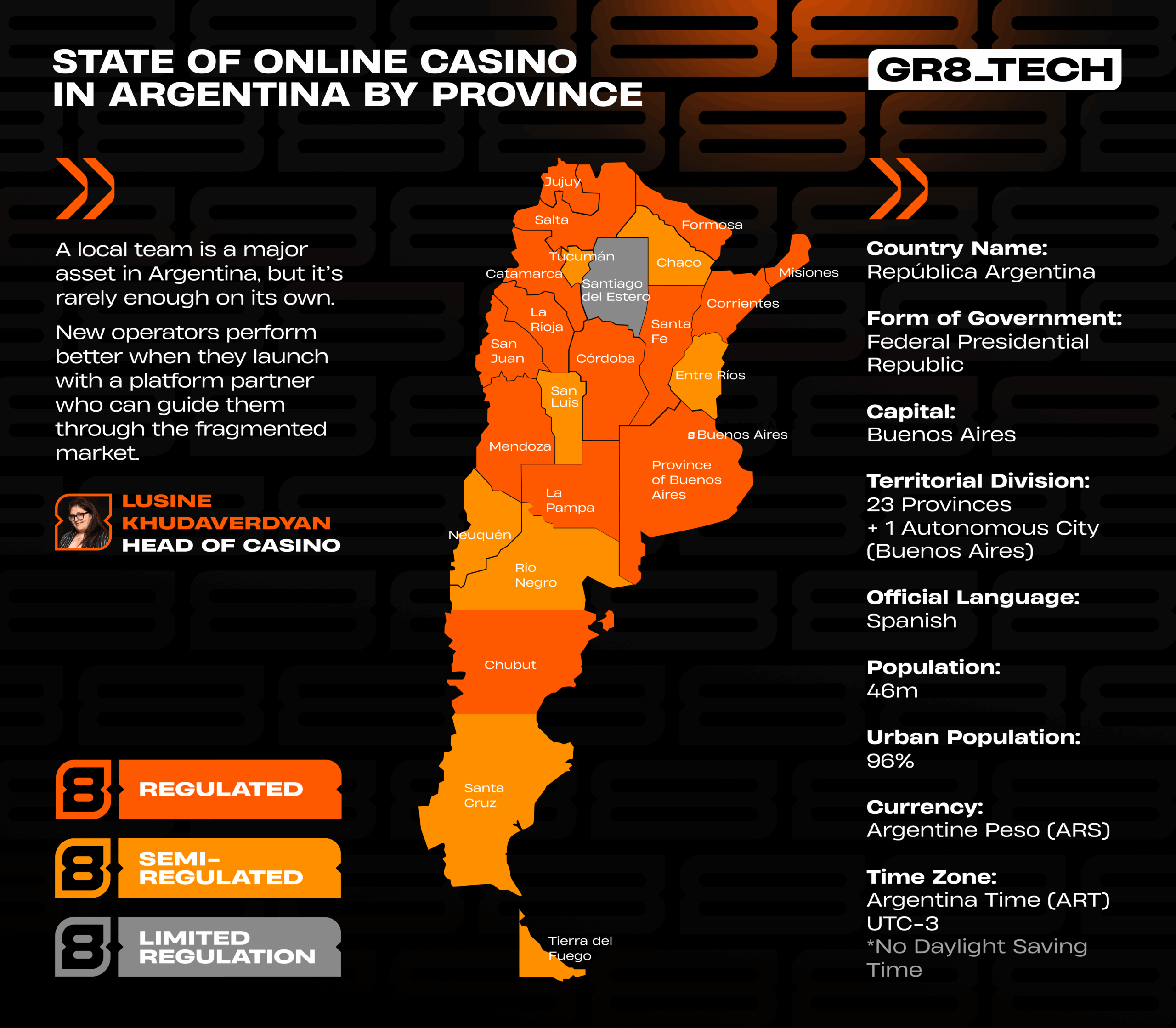
From what I see, the Province of Buenos Aires, CABA, Chubut, Córdoba, La Rioja, Mendoza, San Juan, and Santa Fe have relatively mature licensing regimes with defined taxes, technical standards, and compliance rules. Renowned brands that plan a long-term presence in the market tend to choose these provinces to obtain an online gaming license in Argentina.
Catamarca, Corrientes, Formosa, Jujuy, La Pampa, Misiones, and Salta may suit operators who want more flexibility and are ready to clarify license terms, technical obligations, and other regulatory gaps directly with local authorities.
iGaming Regulation in Argentina by Province (Sources: Provincial Laws and Regulatory Acts)
Chaco, Entre Ríos, Neuquén, Río Negro, San Luis, Santa Cruz, Tierra del Fuego, and Tucumán issue online permissions through individual negotiations rather than a single dedicated legal framework.
Santiago del Estero lacks a dedicated casino framework. It is the only province without explicit regulation for either online or land-based casinos that currently issues licenses mostly for lotteries and online bingo products.
Promising Starting Points
Based on my observations, most new operators prefer to start an online casino business in Argentina in jurisdictions that combine regulatory clarity and commercial potential.
- Buenos Aires Province offers access to more than 15 million residents under IPLyC regulation, covering online casinos and lotteries, with a minimum monthly fee of 2% of GGR.
- The Autonomous City of Buenos Aires (CABA) attracts a higher-value audience and issues renewable, regulated five-year licenses for online slots, roulette, card games, and lottery.
- Chubut fits operators who can demonstrate financial stability, establish a local presence, and obtain provincial tax registration. This makes the market less accessible for new entrants but reduces competition.
💡 Not sure which province better suits your gambling business model and market goals? Compare regulatory conditions across all Argentine jurisdictions.
Affiliate Strategy for Stronger Search Visibility
Without reliable traffic, operators rarely convert acquisition spend into frequent deposits, repeat sessions, and sustainable growth in the gambling market in Argentina. That's why, before starting an online casino, it's worth analyzing the local affiliate market and finding several partners to test traffic later.
From what I see, beginning operators rarely try to outspend the biggest brands on the largest affiliate websites. That channel is already crowded. Betsson, Bplay, Betano, and other licensed operators dominate the top search results, while many high-ranking affiliates still promote unlicensed offshore casinos.
Popular Casino Brands in Argentina (Sources: Online Gambling Quarterly, Google)
In my opinion, it's much safer to follow this approach:
- Research the affiliates that promote licensed .bet.ar operators, the ones that support offshore brands, and the pages that rank for casino, bonus, and payment-related keywords. This may help identify acquisition partners and uncover less competitive traffic opportunities;
- Focus on mid-tier partners. The best-known comparison sites often prioritize the same large operators because they convert well or pay higher commissions. Smaller and content-focused affiliates can offer more cost-effective services;
- Minimize competition for generic terms like “casino online Argentina” or “casino bonus”, as it usually means competing against established brands with larger budgets and stronger SEO. Instead, start with niche clusters: specific games, payment methods, promotions with the local context, mobile casino searches, and province-related queries;
- Measure user quality before scaling spend by testing the first 100–200 players and tracking FTDs/STDs, repeat deposits, bonus cost, GGR, and churn. If the traffic converts into low-value users or bonus hunters, it is a signal to avoid long-term deals;
- Treat affiliates as part of an acquisition strategy. Instagram, TikTok, YouTube, Facebook, WhatsApp, niche SEO, and CRM journey activities can support affiliate campaigns and reduce reliance on a single expensive channel.
More PSPs, Less Deposit Friction
Argentine players expect familiar payment methods, intuitive deposits, and fast withdrawals. That makes payment infrastructure one of the first areas to plan before the casino launch.
Instead of relying on just two or three providers, experienced operators negotiate with as many local PSPs as possible to secure backup options and reduce the risk of failed deposits when some payment channels become unavailable.
However, this strategy works only for turnkey and custom platform setups. In the white-label model, payment options are usually limited to those offered by a provider (more on that in the next section).
iGaming Payment Methods in Argentina
Popular payment methods in Argentinian casinos include digital wallets such as Mercado Pago, Cuenta DNI, MODO, Khipu, Ualá, and Naranja X. Debit cards (Visa, MasterCard) are also widely accepted, while Rapipago and Pago Fácil continue to serve players who prefer cash-based payments, especially outside major cities. QR payments and instant bank transfers are also common.
Payments in Argentina, 2026 (Source: WorldPay)
Crypto adoption is also high, with Statista data showing that over 30% of Argentines own cryptocurrency. Having Bitcoin, Ethereum, USDT, and other crypto options allows operators to attract players seeking privacy and inflation hedging.
Crypto broadens player acquisition in Argentina, but wallet deposits give fewer KYC signals for segmentation and fraud prevention. Tools like Crypto Balance Scanner can reveal a wallet’s balance and the source of funds, helping operators build clearer player profiles and run more relevant campaigns.
Mykhailo Petriaiev, Payments Product Team Lead
To connect dozens of local payment methods in a single layer and streamline financial transactions, some operators use a payment orchestration platform. The solution is not yet common in Argentina, and those who use it can gain a clear advantage. Its routing and cascading mechanisms automatically send transactions to the PSP with the best approval rate, availability, speed, or cost. This increases the number of successful deposits, supports player retention, and makes payment operations more resilient.
Building a Mobile-First Casino
Argentina bets on mobile. The easier it is for players to access your casino, regardless of device or internet speed, the greater your chances of converting traffic into first deposits.
The quality of the mobile UX depends on your platform provider. When selecting a platform for opening a casino, it is worth paying attention to how it supports mobile web and native apps, and how quickly its frontend loads.
Casino brands entering Argentina for the first time typically select white-label or turnkey setups. These models require less upfront investment than developing a platform from scratch and allow operators to validate the market more quickly.
| White-Label Casino | Turnkey Casino |
| Best Fit For | Operators, testing one province in Argentina, with limited local expertise | Operators with a clearer Argentina growth strategy, planning multi-province scaling |
| Ideal Stage of Market Entry | Initial market validation | Active growth and optimization |
| Speed to Market | Fastest | Medium |
| Licensing | Often handled by the platform provider | Usually handled by the operator |
| Operator Responsibilities | Marketing strategy, player acquisition, CRM, brand positioning, and basic local market testing | Licensing, PSP negotiations, operations, CRM, marketing, compliance coordination, and growth management |
| Provider Responsibilities | Platform, license support, core compliance setup, content, payment integration, technical operations, and support framework | Platform, PAM, CMS, casino aggregation, integrations, technical and payment support, reporting tools, and operational modules |
| Required Technical Expertise | Minimal | Moderate |
| Payments Localization | Restricted to available PSPs and payment methods | Ability to configure local payment stacks and add orchestration solutions |
| Ability to Test Local Preferences | Limited to tools, content, and integrations supported by the provider | High flexibility within the provider's infrastructure |
| Platform Setup Cost | USD 10–20k + revenue share
(+ possible monthly fees) | USD 10–20k + revenue share
(+ possible monthly fees) |
| Revenue Share | Highest | Lower than white-label |
| Required Team | - Payment, CRM, and a Marketing Lead
- 1–2 marketing specialists
| - Payment, Operations, CRM, and a Marketing Lead
- 1–2 marketing specialists
- Customer Support team
|
| Main Challenges | Dependence on the platform provider, limited customization, restricted payment, and content options | Limits for deep technical customization |
| Main Advantages | Fast launch, lower operational burden, provider support with compliance, content, and payments | Strong balance between autonomy, speed, and investment |
As the online gaming business grows, some operators invest in self-built solutions. This strategy brings more flexibility in integrations and customization, but also requires a full in-house team, increases project timeframes and costs, and places greater responsibility for platform development, maintenance, security, performance, and regulatory compliance on the operator.
Practical Tips for an Argentina-Ready Game Portfolio
After selecting the platform model, operators usually define a portfolio strategy and consider how to choose online casino game providers for the Argentine market.
Our internal analytics data shows that slots account for roughly 85% of casino demand in Argentina, followed by live, crash, and instant games.
Most local portfolios revolve around recognizable slot themes: candy, sweets, gold, mythology, classic fruit, adventure, animals, fishing, princess, and anime. Many Argentines prefer games with Megaways, multipliers, free spins, bonus buy, and high volatility mechanics, with Pragmatic Play, Spribe, and RubyPlay topping the list of popular game providers.
Localized lobbies strengthen player trust, so leading operators use Argentine Spanish and organize games in categories such as “En tendencia,” “Favoritos del día,” “Premios instantáneos,” “Casino en vivo,” “Oro y suerte,” “Manía Megaways,” and “Premios máximos.”
💡 This shortlist of online casino game providers for Argentina can help you build a casino lobby that drives local player acquisition, monetization, and engagement.
Adding Games to the Platform
The platform model you choose defines both how you add games and how much control you have over your casino portfolio:
- White-label lets operators select from game providers already available on the platform. If you want to add a game outside the list, you can ask the provider. The final decision depends on the provider’s commercial priorities, technical capabilities, and readiness to negotiate, integrate, certify, and deploy the games.
- Turnkey, ready-made gambling software and custom-built platforms offer much more flexibility, enabling operators to integrate specific titles.
To expand their portfolios, operators usually approach game providers directly, rely on casino aggregation platforms, or combine both approaches.
Casino game aggregators connect to the existing platform through a single API, providing access to thousands of titles. This simplifies compliance, reduces technical maintenance, and removes the need to negotiate separate contracts with every studio. In Argentina, aggregators typically require a setup of USD 5–10k and a monthly fee of up to USD 5k.
Direct integrations make more sense when operators want exclusive content or custom commercial terms. From what I see, many brands launch in Argentina with an aggregator, analyze game performance, and later sign direct agreements with the high-performing titles.
ADD GAMES THAT TURN ARGENTINE TRAFFIC INTO REVENUE
THROUGH JUST ONE INTEGRATION
The Real Power of Local Teams
From what I've seen, even the best casino platform doesn't win the market on its own. Yes, relevant games and payments differentiate the product and simplify competition, but without a CRM team that speaks Argentine Spanish, player acquisition and retention will remain limited. Local specialists talk more naturally and understand the context behind players’ requests, which is why Argentine players tend to choose brands with local support over foreign casinos.
The CRM team size depends on the platform model. White-label operators typically start with a CRM lead, a marketing lead, and one or two marketing specialists. Turnkey setups also require a support team.
Estimating the Project Budget
In my experience, the initial operational costs for online casinos rarely stop at platform fees. Traffic tests fail, not all bonuses convert into deposits, PSPs raise fees, fraud happens, and compliance requirements change. That’s why it makes sense to include these expenses in the budget from the beginning.
For Argentina, I recommend planning a full first-year budget of at least USD 500,000 for a white-label or turnkey market entry, and twice as much for from-scratch online casino development. This should help you cover licensing and legal support, platform setup, games, payment integrations, acquisition testing, and other unforeseen expenses.
Launch, Monitor, Scale
Launch success depends on how thoroughly you (or your casino software provider) can test payments, KYC, mobile UX, game performance, bonuses, reporting, and responsible gambling tools.
After starting an online gambling business in Argentina, operators typically track FTD/STD conversions, deposit approval rates, GGR per player and game, retention, bonus costs, churn, and other metrics.
Scaling comes in stages: first, operators expand the portfolio with new providers and localized titles. Once the casino revenue stabilizes, many consider adding a sportsbook in Argentina to boost player acquisition and engagement.
Checklist for Starting an Online Gambling Business in Argentina
- Step #1. Validate Market Demand: Analyze BetWarrior, Betsson, Bplay, Betano, and other gambling brands already active in Argentina, their game mix, payment options, bonuses, and acquisition channels. Create a business plan around mobile, Argentine-Spanish, local payment service providers, and players’ cautious spending;
- Step #2. Choose the Province: Compare license availability, permitted products, tax and fee obligations, technical standards, advertising restrictions, and other requirements across the 23 provinces and the City of Buenos Aires. Multi-province operation requires a gambling license in each jurisdiction;
- Step #3. Meet Local Entry Requirements: Check whether your target market demands an Argentine legal entity, a local address, a representative, tax registration, a financial guarantee, or a local partner. Prepare corporate records, beneficial-ownership details, financial statements, and evidence of technical and operational capacity;
- Step #4. Choose a Platform Model and Budget: Define how much control you need over the casino, payments, content, and integrations. White-label provides a ready-made platform ecosystem, while turnkey and self-built models offer greater control but require more involvement in licensing, PSPs, compliance, and operations;
- Step #5. Apply for the Provincial Authorization: Submit the license application and the AML, responsible gambling, technical, security, marketing, and operational documentation. Depending on the jurisdiction, this may also include platform certification, game and RNG approval, geolocation controls, or regulator access to operational data;
- Step #6. Build a Localized Casino Product: Create a fast mobile web experience in Argentine Spanish and organize the lobby into familiar categories such as En Tendencia or Premios Instantáneos. Make slots the core product, especially candy, gold, mythology, classic, animal, and adventure themes, then add live and instant games;
- Step #7. Connect Payment Systems & Prepare Operations: Prioritize peso deposits via Mercado Pago, Cuenta DNI, MODO, Ualá, and other digital wallets that support QR and instant payments. Keep credit and debit cards and bank transfers available, add Rapipago and Pago Fácil to serve cash-based users, and consider crypto options;
- Step #8. Complete National Tax Setup and Secure the Domain: Register with RCOSA and prepare for ARCA review, tax reporting, and the 2.5%–15% indirect online gambling tax, depending on RCOSA registration and local investment. Once you hold an Argentine CUIT/Clave Fiscal and appear in the competent regulator’s approved register, obtain a .bet.ar domain.;
- Step #9. Build a Local CRM and Support Team: Hire CRM and customer-support specialists who speak Argentine Spanish and understand local player expectations. Set up localized onboarding, bonus, payment, and retention communications, as well as clear support flows;
- Step #10. Launch and Expand: Before go-live, test KYC, supported payment methods, mobile UX, game performance, bonuses, reporting, and RG tools. After launch, track FTDs, repeat deposits, payment processing speed, GGR, retention, churn rate, bonus cost, and compliance performance before expanding into another jurisdiction or adding a sportsbook.
Final Thoughts
Just like any online casino market, Argentina rewards operators who are open to risk and fresh ideas.
It makes sense to follow proven market practices and copy leading brands at the start. But once you strike a chord with local players and build stable revenue, don't be afraid to test new campaigns, bonus mechanics, payment methods, game providers, and product features. Then track the metrics for each experiment to understand which ones deserve scaling.
This will help you keep up with the market changes, build a memorable casino brand in Argentina, and turn it into a sustainable, profitable business.