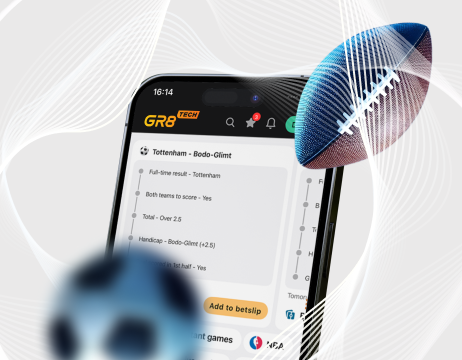
Good odds are no longer enough to stand out among dozens of sportsbook platforms. Players expect more. They seek features that keep the betting exciting and less risky. But fewer risks for players means less profit for operators, doesn’t it? Well, with the right tool, operators can give bettors more control while actually increasing margins.
Yes, I’m talking about sportsbook cash out. Check how it supports engagement and what cashout models bring the most revenue.
Real Cash-Out Value for Betting Products
📌 From the players' perspective, online betting cash-out serves as a risk-management mechanism. It lets users adjust their initial bet before the end of a sports event and lock in potential winnings or limit potential losses. The bet cash out feature may not yet be available for all markets at all bookmakers, but it's gaining traction.
Here’s how it works. Let’s say a player places a $10 bet on Real Madrid to win at odds of 2.00. After an early goal, Real Madrid's chances improve, and the player receives a cash-out offer worth $15. Now, they can either accept the guaranteed $15 immediately or keep the original stake running for a potential $20 payout if Real Madrid wins or a zero return if Real Madrid loses.
Players typically expect three types of cashouts:
- Full Cash-out: Full Cashout allows bettors to withdraw their entire bet early, before the final result or during pre-match. Players can secure profits if their bet wins or recover part of their stake if they believe the bet is likely to lose. The offered cash-out amount depends on the likelihood of the bet winning;
- Partial Cash-out: Partial Cashout lets users cash out a portion of their bet while leaving part of the stake in play. This can be particularly useful if a bettor wants to make a profit while minimizing potential losses, yet still believes there is a chance to win more;
- Auto Cash-out: With Auto-Cashout, bettors set a target cash-out value in advance. When the cash-out offer reaches that amount during the event, the platform automatically closes the bet. This allows players to lock in returns without having to monitor the live odds.
📌 For operators, sports betting cash out is a clear advantage, as the feature boosts player LTV and revenue across sports-related and non-sports bets. It helps operational teams diversify engagement strategies and usually comes with risk support. Besides, operators can promote cashouts in acquisition campaigns, positioning their brands as more bettor-friendly and differentiating their sportsbooks from competitors.
As a rule, sportsbook operators add cashout to their platforms following one of these scenarios:
- Purchase a sportsbook with already integrated cashout, along with all math models and analytical tools;
- Buy cashout as a separate module from third-party solution providers and connect it to the sportsbook;
- Develop and integrate cashout in-house and from scratch.
The second and third options are usually available for operators who run their own self-built sportsbook platforms.
How Exactly Operators Benefit from Cashout
When operators aim to increase player lifetime value (LTV), the conversation often starts with engagement. Cashout complements traditional sportsbook engagement features by giving bettors more control over their wagers.
In its turn, that sense of control builds confidence and encourages repeat deposits. Players are more eager to experiment with different cash-out betting strategies and explore additional sports and markets.
Besides, cashout releases funds during the match, allowing bettors to reinvest their money immediately rather than waiting for settlement. This frequent rotation of funds sparks betting activity across the platform, supporting healthy liquidity.
The feature also contributes to long-term retention. Since recovering part of a stake often feels better than losing everything, players retain betting motivation and stay on the platform longer.
When cash-out is part of sportsbook components, it stabilizes GGR and allows operators to build more predictable business strategies.
Why Smart Operators Switch to Dynamic Cashout
Cashout is already a good margin driver, but it becomes truly great when operators can influence its behavior. Here's what I mean.
In a standard setup, the sportsbook calculates a cashout offer using current odds, remaining event time, bet type, and a fixed margin. The feature gives players flexibility, but limits operators' impact on profits. The same margin often applies across sports, market prices, brands, and player groups, even though each carries a different level of risk.
📌 Dynamic cashout extends opportunities for operators. Instead of using one margin for every bet, they can set different margin ranges for different odds across single and parlay bets. As odds change during an event, the cashout margin changes too, based on rules the operator has already defined.
| Odds Range | Margin |
| 1.01 – 1.08 | 5% |
| 1.09 – 1.15 | 6% |
| 1.16 – 1.25 | 7% |
| 1.26 – 1.35 | 8% |
| 1.36 – 1.45 | 10% |
| etc. | etc. |
Here's how it improves day-to-day operations. For example, an operator may choose lower margins for football, where competitive pricing matters most. At the same time, they can set higher margins for niche sports or long-odds parlays, where outcomes are less predictable. Players still receive a relevant cashout offer, while operators retain control over margins.
Dynamic cashout also supports smarter risk management. When exposure grows on a specific sport, market, brand, channel, or player group, trading teams can reduce it by managing cash-out parameters.
This flexibility works especially well for multi-brand operators. A “recreational” sportsbook can offer more attractive cashouts to encourage engagement. For a sharper betting brand, the values can prioritize margin protection. Operators can even tailor cash-out conditions to different player groups. For example, VIP-mode bettors may receive more luring offers than casual players.
Parlay bets add another opportunity. They often generate higher revenue but also bring stronger volatility. With dynamic cashout, operators can configure separate margins for winning parlay selections and for specific odds ranges.
Measuring the Impact
"Does cash-out increase sportsbook revenue, or would operators earn more if players never used it?" is the key question behind every cash-out strategy.
To find the answer, operators can compare actual cash-out results with a "what-if" scenario that shows how the same bets would have settled without cash-out. This approach helps quantify the real feature value.
The analysis usually focuses on three scenarios.
Scenario #1: Player avoids a loss.
Example: A bettor places a $10 wager that starts going badly and accepts a $3 cashout offer. Without a cash-out request, the bet may have been lost in full, and the sportsbook would have retained the full $10.
Takeaway: Cashout reduces the sportsbook's profit on that individual bet, but it may still support overall profitability if it encourages players to remain active and place additional wagers.
Scenario #2: Player gives up part of a win.
Example: A player places a $10 bet with a potential return of $20. As the game unfolds, the sportsbook offers a $15 cashout. The player accepts. If they had waited until settlement and the bet won, the operator would have paid the full $20.
Takeaway: Cashout improves profitability because the sportsbook settles the wager at a price below the final payout.
Scenario #3: Player uses cashout like a cancel button.
Example: A bettor places a $10 wager, changes their mind a few moments later, and cashes out for $9.80 before the odds move.
Takeaway: This isn't typical cashout behavior, but rather a bet-cancellation mechanism. It is worth analyzing it separately from standard cash-out activity to measure the feature performance without distortion.
After comparing thousands of eligible cashout bets with the "what if there had been no cashout" version, operators can answer questions like:
- Which player segments make cashout profitable, and which reduce margins?
- Does cash-out increase overall betting activity?
- What's happening after cashing out? Do players place more bets?
- What cash-out margins generate the best results?
TL;DR: Sportsbook Cash-Out
- Cashout Balances Player Control and Operator Revenue: Bettors use it to manage risk and secure returns, while operators benefit from higher engagement, retention, and extra acquisition opportunities;
- Cashout Supports Different Betting Strategies: Full Cashout closes the entire wager, Partial Cashout settles only part of it, and Auto Cashout is settled immediately at a predefined value;
- Operators Can Add Cashout in Three Ways: Through a sportsbook with built-in cashout, integrate a third-party cashout module, or create a fully in-house solution;
- Cashout Encourages Betting Activity: Faster returns keep players active and confident, support repeat wagering, and diversify journeys;
- Dynamic Cash-out Ensures Granular Margin Management: Operators can configure different margins for singles and parlays by odds range, sport, brand, player segment, channel, and bet type;
- "What-If" Analysis Reveals Cashout's Business Value: Comparing actual cashout outcomes with hypothetical non-cashout scenarios helps operators identify profitable player segments, optimize margins, and measure the feature's impact on sportsbook performance.