












Articles

Why Betting Companies Need a UX Research Repository

5
28.04.23
Author: Valeriia Abdualimova
Read time: 6 min
Published: 28.04.2023
Last Update: 08.12.2025

Author

Valeriia Abdualimova
UX Researcher and Data Keeper
Valeriia Abdualimova

👋 Hello there! I'm Valeria, a UX researcher at GR8 Tech. In the early stages of establishing the UX Research team, we encountered challenges in effectively organizing and managing the collected data. It only worsened over time: sharing insights with colleagues was inconvenient, and research results were frequently misplaced in personal Google Drives.

However, we've since discovered a remedy—the UX Research Repository. This article delves into the significance of implementing a User Research Repository within a product-oriented company, explains the problems it addresses, and provides a list of tools for creating your own.

No Storage—No Impact

Let's take our experience as an illustrative case. Our user researchers interviewed players of various segments, focusing on their challenges and difficulties when engaging with our platform. Additionally, in our UX research methods, we gather feedback on our latest innovations, test new features and services, and engage in similar research activities.

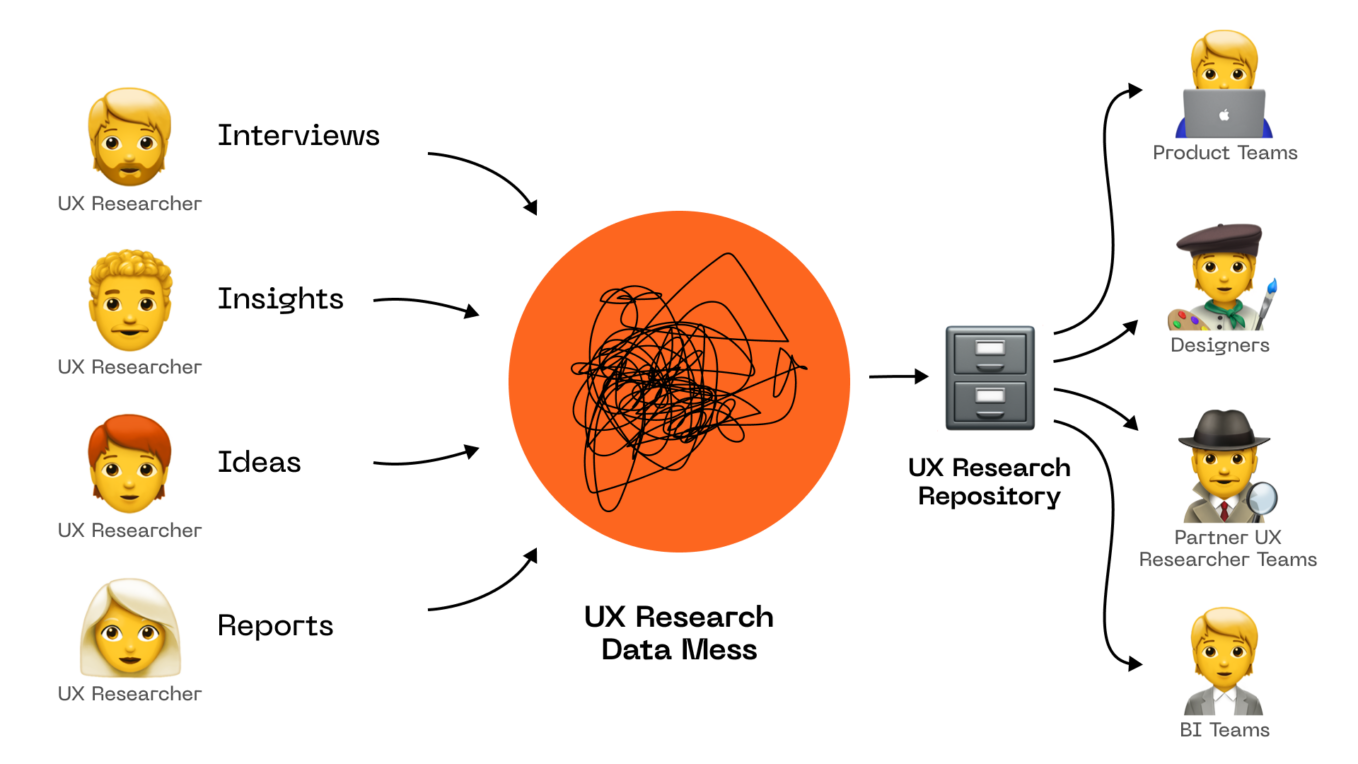
Initially, our approach involved storing files and tables on Google Drive. Conducting UX research became sheer chaos:

  • Some data got lost.
  • We ended up generating an excessive number of files and folders.
  • In some instances, researchers were the sole repository for innovative ideas.
  • Sharing insights resembled sharing spammy links in a chat.
  • Researchers frequently resorted to printing interviews to identify intersections of user concerns. This physical approach allowed them to visually analyze, highlight, and capture crucial points.

The real-time input from these interviews is crucial in enabling us to draw conclusions, formulate hypotheses, conduct A/B testing, and roll out features into production.

A structured storage system is essential for gaining in-depth insights from user experience research. Furthermore, data needs to be continually developed. Equally important is the seamless accessibility of these insights, not only for researchers but also for our colleagues in different departments.

Effective dissemination of insights is of paramount importance. After all, valuable information is only helpful if it can be efficiently shared.

Why Your Brand Needs a User Research Repository

✅ You always retain valuable ideas, and colleagues also have easy access. All videos, interviews, and images are consolidated in one centralized location, streamlining the process of locating vital data.

✅ The repository allows tracking the research evolution of specific topics. Business priorities, ideas, and challenges may change, but having access to historical data ensures you can continuously monitor the progression or regression of critical research.

✅ The repository minimizes redundant research efforts. It helps identify gaps in previous research, facilitating more informed decision-making for future projects.

✅ You gain constant visibility into the ongoing research. Researchers in larger organizations often expend resources investigating the same issues their counterparts are exploring in different departments. The UX repository ensures that everyone is well-informed about the research initiatives of other teams, fostering collaboration and efficiency.

Choosing a Tool to Create a UX Research Repository

We gain insights from our interview transcripts, analyze them, validate the findings with user quotes, and present them on our main page. Consequently, the primary purpose of the repository is to systematically store information in a centralized location that offers convenient accessibility for all team members.

We evaluated over ten UX research repository examples in selecting a suitable tool. The following is a compilation of our observations based on the experiences of the GR8 Tech team.

  1. Dovetail – As you might guess, we will elaborate on this later.
  2. Notion – A good tool, but less ideal for effectively tagging interviews.
  3. Condes.io – Similar to Dovetail but comes at a higher cost.
  4. Confluence – no way.
  5. Knowsi – Deemed complex and less intuitive.
  6. Airtable – Essentially an advanced version of Excel.
  7. Excel – Proved problematic for managing various types of data.
  8. Aureliuslab – Lacked a convenient insight display.
  9. Productboard – Tailored more towards product-focused themes.
  10. EnjoyHQ – Offers ample integrations with apps like Slack, but it is not particularly user-friendly.
  11. Optimal Workshop – Deemed too expensive.
  12. Reveall – Encountered issues with numerous bugs and delays in resolving them.
  13. UserBit – Potentially suitable for smaller projects, but Dovetail's tagging capabilities were preferred.

Allow me to explain why we settled on Dovetail.

Pros and Cons of Dovetail Research Repository

Pros:

  • Efficient Interview Tagging: Dovetail offers a convenient interview tagging feature for conducting UX research. You can enable transcription by uploading interview transcripts and video files, transforming interviews into text. You can then apply unlimited tags, differentiating between internal tags for a specific study and external tags applicable to all studies in the repository.
  • Robust Search Functionality: Dovetail offers a powerful search bar to locate content related to any research topic or type. The main page, which categorizes insights into various sections, simplifies and structures the search process. You can customize each branch for researching insights and other materials, making it easy to highlight insights for sharing.
  • Tag Charts: Following the application of tags, Dovetail can generate tag charts that can be downloaded and shared in image format.
  • People Tab: You can save contact information for respondents with whom you intend to collaborate repeatedly. Furthermore, you can organize these contacts into different audience segments and perform other structuring tasks.
  • Stories Feature: Researchers can combine multiple findings into a comprehensive article. This feature enables the addition of tags, support for graphics and images, and enhances the distribution of insights.
  • Dovetail UX: Dovetail boasts a straightforward interface that ensures even beginners can use it within minutes. 

And cons:

  • Transcription Accuracy for Non-English Interviews: Dovetail's transcription feature may encounter challenges with interviews conducted in languages such as Russian. While it can recognize and transform speech into text, it tends to produce errors when dealing with variations in tone or multiple simultaneous speakers.
  • Simplicity of Project Structure: Dovetail's project structure is relatively basic, featuring only two levels: a folder containing projects and a list of projects within it. Sometimes, project connections can be more intricate than this simple hierarchy allows. It would be valuable if Dovetail added expanded project sorting capabilities, including more categories and the ability to create subcategories.

How We Use the UX Research Repository for Business Development

Considering our global operations, we've expanded our partner storage capabilities to accommodate colleagues from various regions. This global collaboration enables us to gather data from various countries, allowing us to investigate user experiences and identify common product issues and areas of intersection. Additionally, teams can save valuable resources by referring to previously researched topics when projects are duplicated.

Our development of features for ULTIM8 Sportsbook relies on the insights we've gleaned from our extensive experience as an operator, with a deep dive into the user experience of bettors. Currently, product managers, product designers, and UX designers are the primary users of the UX research repository. We also gather presentations and insights from the Business Intelligence department, which we conveniently organize, store, and share for product-related tasks. 

The UX repository streamlines the utilization of research outcomes for product enhancements, encompassing insights, feedback, hypotheses, and ideas—all centralized and accessible to every company member. 


Do not repeat our mistakes. Creating a repository will likely become necessary if you plan to establish a performing UX research department. Delaying this process can lead to significant challenges in efficiently structuring your accumulated data, so you do not benefit from your efforts at all. 

Please rate the post
1 2 3 4 5
Thanks for your rating!
Ask us anything
By submitting this form, you confirm that you have read and understood our Privacy Notice.

Use data

to stand out

Behind each button of our products are hours of work by user researchers, designers, and product managers. Decades of operational background ensure your brand will be appealing to players.

Talk details

GR8 iGaming insights to your mail