In betting, as in any tech business, you adapt or get left behind. If your product still focuses on pre-match bets, doesn’t appeal to players, is hard to get for newcomers, or ignores AI, you are already lagging.
Our marketing team asked me about what is happening in betting from the product perspective, and here is what my team and I have found out.
#1. Less Pre-Match, More Live
Today’s bettors want to be entertained constantly with a wide range of sports content. That’s why you already see them switching from pre-match to real-time wagering. The latest research by Optimove also proves this, indicating that over 54% of players from the US, the UK, and Europe resort to live betting.
We expect to see further growth in this trend in 2026. At this point, 24/7 live content coverage will not just be a nice-to-have opportunity but a must for every sportsbook operator.
In terms of figures, it means the ability to deliver up to 30–50 live events at any moment to stay afloat and retain players.
With the Region Specifics in Mind
Operators showcasing live events to different regions simultaneously will have the edge. Want to follow their lead and expand your geographic reach? Focus on local demand.
Here’s how you may achieve it within a sportsbook platform:
- Saturating the feed with a wide scope of live events (world championships, online game tournaments, niche sports events — the more, the better) and eliminating content gaps caused by the time difference;
- Adjusting the event list to the preferences of the target region. For example, by adding local competitions and niche sports. The platform should suggest baseball games to Dominican fans, cricket matches to the Indian audience, or horse races to the US devotees;
- Displaying local content providers to each particular region. It matters because many bettors expect to see familiar interfaces when rooting for favorite events. By delivering exactly what players are looking for, you may increase retention and betting activity.
#2. New Generation, New Preferences
Sports betting used to be a waiting game: place your wager, sit back, and hope for the best. Not anymore. Today, Millennials and Gen Z fans are not ready to waste time. They want to bet on the next pitch, the next play, the next blink.
Geographically extended live content coverage doesn’t address these generation-specific demands. Action-driven live betting models do.
| Live Betting Models | In-Play Betting | Microbetting |
| Description | Betting unfolds during a live event, odds update in real time | Wagering on tiny outcomes, often resolved in minutes or seconds, throughout a live game |
| Betting Scope | Broader (totals, game outcomes, spreads, next team to score, etc.) | Ultra-specific (next corner, point, shot, yellow card, etc.) |
| UX | Dynamic and strategic, aimed at the entire game flow following | Adrenaline-packed and spontaneous, it causes quicker excitement and thrill |
| Risk Level | Moderate/High, with odds shifting throughout the game | Higher due to frequent and volatile outcomes |
| Popular Sports | Football/Soccer, basketball, tennis, American football, e-sports | Baseball, basketball, tennis, e-sports (e.g., first-person shooters) |
| EV | Keeps fans engaged throughout the game | Every moment is a mini-event, the model animates even dull games |
Microbetting is gaining traction due to technological upgrades in the AI field. Companies like nVenue are at the forefront, offering platforms that support thousands of micro-markets per game.
Both microbetting and in-play betting modify the established wagering patterns and turn any sports event into nonstop action. That said, they are not equally popular everywhere.
Despite the geographical variations, one thing is clear: as technology gets sharper and odds get faster, microbetting will grow. And it’s not just that the model will take over (it surely will) but that it will push the operators to develop offbeat live betting mechanics.
Player Props, Fantasy Leagues, and Other Updates
Microbetting has undeniable appeal. Yet, it is not the only trend younger generations fall for.
- “Why do I have to root for the entire Real Madrid Club if my favorite is just Kylian Mbappé?”. Such thoughts frequently cross the minds of sports fans. They decide long before the game, don't focus on the team or event scale, and want to bet on a particular player in real time. This forces operators to add both team and player proposition live betting options within their platforms;
- Daily Fantasy Sports (DFS) are extremely popular with Gen Z, as they combine sports fandom, strategy, stats knowledge, and friendly competition. Allowing next-gen bettors to create virtual sports characters before the event and ascribe real-life achievements to them during the game, fantasy leagues make live betting a thrill;
- Young people still don’t mind wagering on e-sports, especially while watching live streams. “League of Legends”, “CS:GO”, “Dota 2”, and other live tournaments of their choice will keep driving engagement across the platform;
- Since bettors actively follow social media influencers for entertainment and tips, we are likely to spot even more diverse UGC-based betting mechanics this year.
#3. Social Media Betting
Statistics by Datareportal reveal that over 62% of the world's population spends at least 2.5 hours per day on social media. People turn to their go-to platforms for communication, inspiration, and… entertainment. You do not compete with other betting platforms only. You also compete with TikTok, Instagram, Twitch, and Netflix.
The integration of streaming and social media engagement mechanics into a sportsbook solution can draw players away from feed scrolling to betting. Here's how these mechanics may look within the platform:
- Live chats with enhanced moderation for better control over the user flow and a greater networking effect;
- Sports event promotions not just on banners but also in direct messages for visibility increase.
- More UGC content, trash-talk overviews, and meme and pop culture elements in the communication space for session time extension and a stronger attachment;
- P2P betting possibilities that let players directly interact with each other, gather teams, and have even more fun.
Operators are discussing a potential social-driven change in sports betting, but only a few are ready to implement it. However, a wisely selected and integrated combination of practices can give a new lease of life to the sportsbook product and bring a GGR boost. Considering this, we may expect the first signs of this shift in the not-too-distant future.
#4. Helping Players to Become Betting Pros
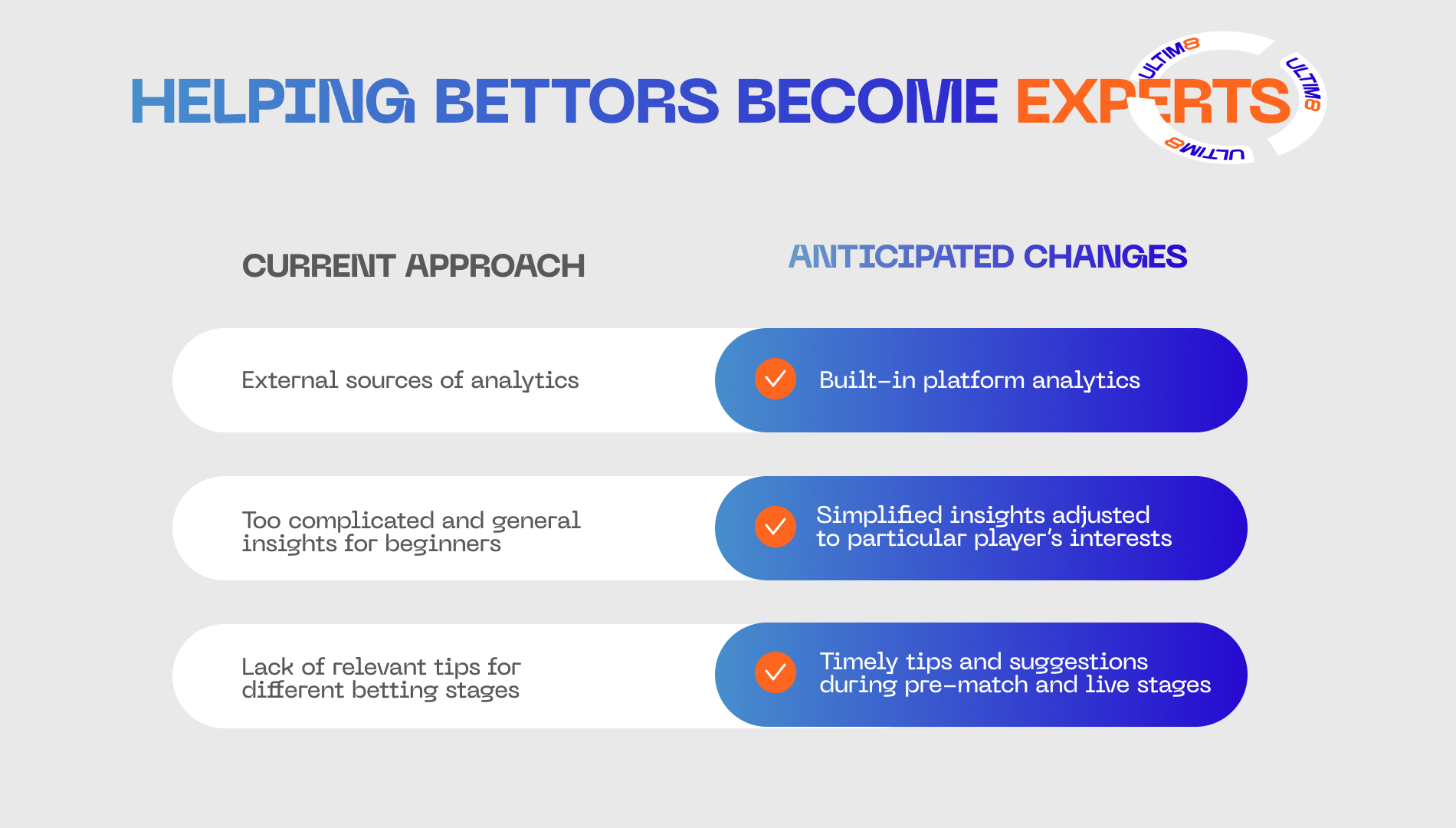
Have you heard that 82% of players occasionally look for extra insights before they bet? Our internal research also says that 44% of bettors check analytics before every event, and 42% do it outside the platform.
While some players seek tips to fill in the gaps in the gambling basics, others search for statistics to boost their expertise.
The operator's role here is to educate bettors and make the user experience as simple as possible. This means thinking through logic that smoothly guides each player (regardless of their background) from a platform visit to bet slip creation.
Similar mechanics are already widely adopted; yet in 2026, we are likely to see their more upgraded, sophisticated versions. Relevant betting suggestions during both pre-match and live stages, user-friendly platform navigation guides, AI-personalized tips, provocative “most players bet on this…” banners, digestible analytics and statistics, and other funnel-accelerating gimmicks.
The key idea behind the strategy is pretty simple: the more information the players have, the more confidently and frequently they bet. Therefore, segment your audience, turn the bettors into analytics-powered decision-makers, show them all the functionality of your platform, and make them feel like betting experts with minimal effort on their side. The bet frequency growth will follow shortly.
#5. Next Wave of AI Adoption
Sportsbooks are among the most complex iGaming environments we can model in real time. Data overruns us: odds shift mid-match, player intent evolves from one screen to the next, and engagement patterns vary by sport, region, and even hour. That’s where AI steps in, not just to process but to optimize the entire user flow.
The technology can already analyze player history (if it is available) and detect the platform-level trends with the highest engagement potential.
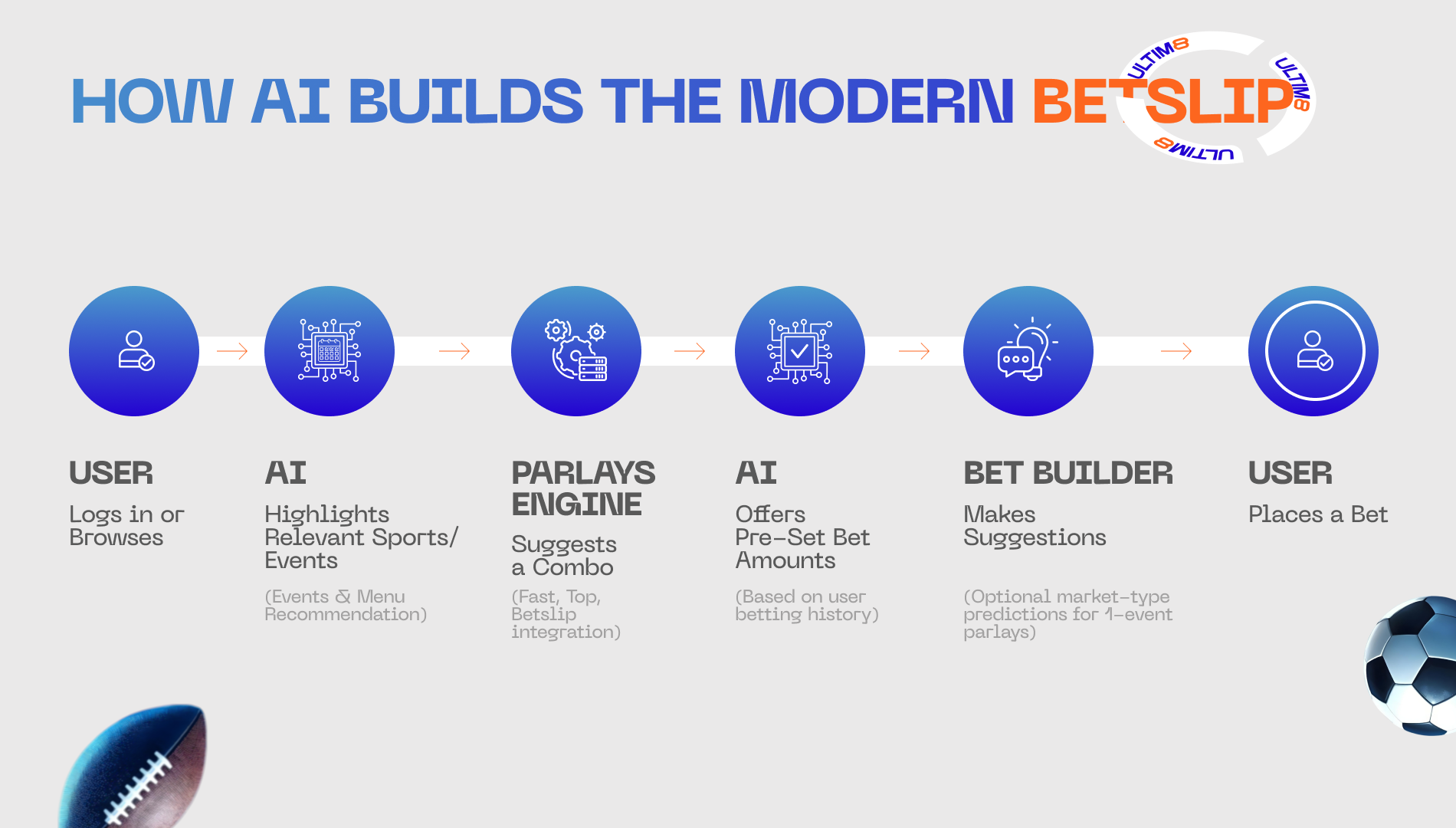
In 2026, we anticipate its impact on event recommendations. Thanks to AI, the operators are able to reconstruct the event feed on the fly with every player’s log-in. Even the sports menu is dynamically reshaped. As a result, a bettor who regularly favors MMA won’t see the same hierarchy as someone focused on European football.
AI will also keep reshaping sportsbook CRM through more precise bettor segmentation. Using RFM(D) metrics (Recency, Frequency, Monetary, and Duration), AI can break players into up to 10 micro-clusters that reflect real engagement patterns, from zero-bet users to high-value bettors. This granular approach already allows operators to personalize communication, anticipate churn, and trigger the right message or bonus at the right moment. This year, we expect the technology to develop further, helping operators to strengthen user retention and reactivation.
Smart Bet Suggestions
With ML models, guiding the player from the entry point to the bet slip is becoming a task of sheer simplicity. Where it gets more intricate is in the bet construction.
Today, AI can generate parlay suggestions that reflect both individual interests and operator-defined constraints, such as the number of legs, odds range, and preferred sports. This year, we expect AI to further impact the bet slip creation process.
Stake suggestions are likely to work the same way. Instead of offering static presets, the models will recommend amounts tailored to historical bet behavior, win/loss variance, and product interaction. These recommendations are expected to be context-specific and action-ready.
Within the platform, it may work like this: trained on similar sessions, the models analyze the behavior of a particular user and suggest a combo of first scorer, total goals, and card market to this user during a Premier League match. In this way, the chances of placing a bet go up.
Risk Management That Is Embedded, Not Separate
User journey personalization and risk management require the same behavioral data. Modern AI systems leverage it to identify abnormal patterns (e.g., abuse cycles, arbitrage strategies, after-goal betting, and potential chargeback scenarios) across different gameplay stages in real time.
Advancements in AI-based segmentation can raise the accuracy of risk prediction. Rather than relying on rules, the algorithms will detect threats through user pattern recognition.
It will help us identify players with unusual session pacing, inconsistent payment methods, or erratic product switching much earlier and exclude them from bonus campaigns because of the high likelihood of fraud (not because of the committed fraud).
This technological breakthrough will also change player penalization. Instead of expelling bettors for anomalies in isolation, the algorithms will profile them across time in compliance with overall confidence levels and risk scoring.
Thoughts to Go
Some updates are more evident and easy to catch up with, while others require vast technical capabilities and resources.
The competition is also getting fierce, with countless entertainment apps stealing people's attention. Every time you leave bettors without live content of their choice or fail to deliver intuitive experiences, you inevitably lose them to Instagram, YouTube, or the Block Blast game.
Keep this in mind when adjusting your sportsbook to the upcoming changes or entering a new market. Build a product that supports micro betting and player props, geo/age-targeted live content, relevant AI functionality, social media mechanics, and other bettor-focused features.