In this article, we provide a structured understanding of what an online casino turnkey solution is and its function as a strategic shortcut for entering competitive markets with speed, control, and compliance. You’ll discover what’s included in a standard turnkey casino setup, which parts can be customized, how these platforms compare to white-label solutions, and why more operators are choosing turnkey as their foundation for scale.
What Is A Turnkey Online Casino Solution?
A turnkey online casino business is essentially a fully operational setup ready for immediate use by a new owner, with only minimal configuration needed—you “turn the key” and start operating. In simple terms, a turnkey casino solution is a pre-built online casino platform (including the software and services) delivered by a provider so that an operator can launch rapidly without building everything from scratch.
Who is it for? Typically, entrepreneurs and casino operators want a fast, scalable market entry, as the core casino systems are already developed and integrated.
Why is it relevant now? Speed-to-market and regulatory complexity are huge factors. The demand for ready-made casino platforms has reached an all-time high because the ability to launch faster and more cost-effectively can mean the difference between capturing market share or missing the moment. In an industry projected to grow to well over $100 billion in the next few years, many operators are choosing turnkey casino software to seize new opportunities quickly.
Key Components of a Turnkey Casino Solution
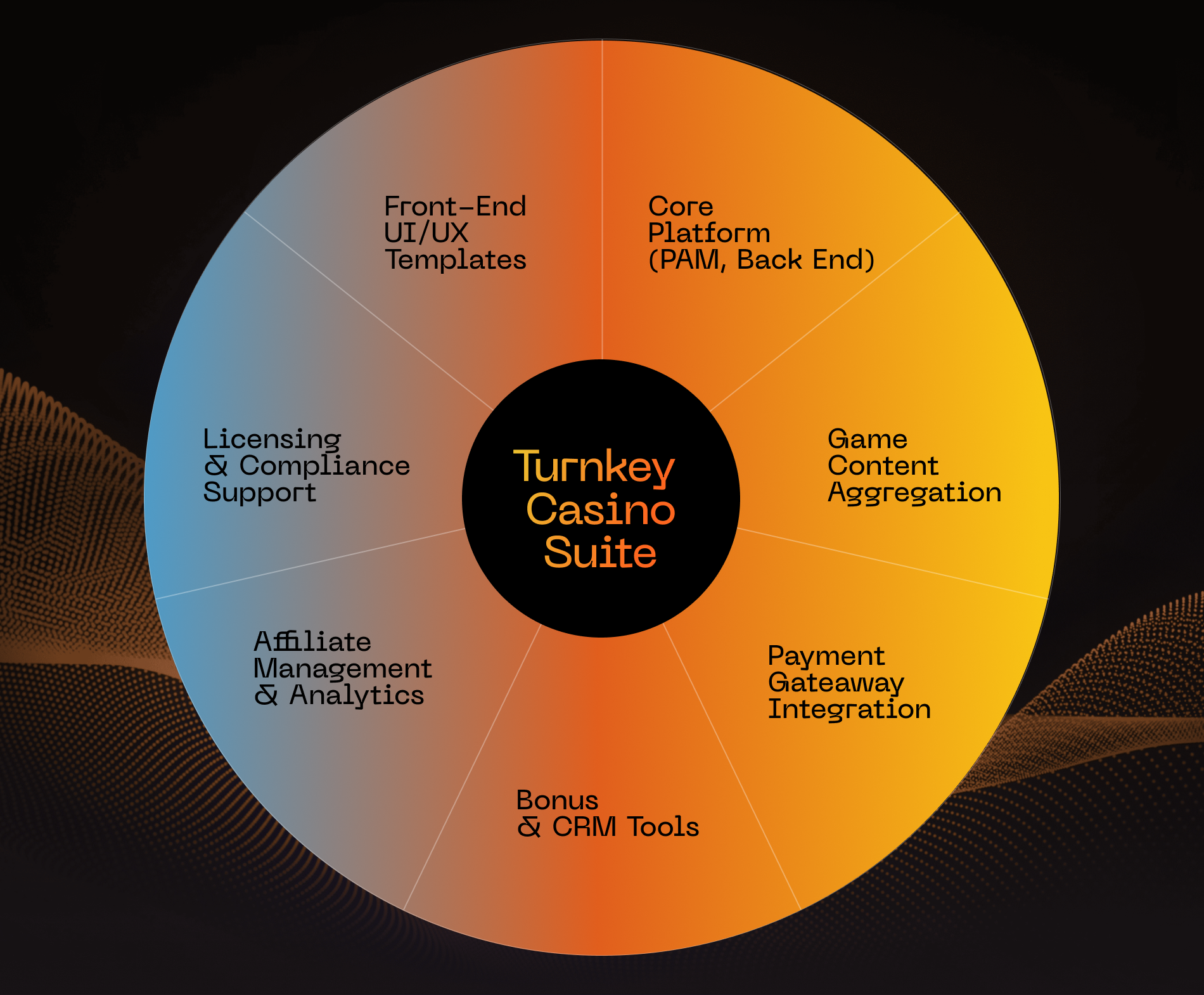
What’s included in a standard turnkey setup? This is one of the first questions operators ask. A turnkey casino solution is delivered as an all-in-one package—essentially, everything you need to run an online casino is provided out-of-the-box. Key components typically include:
- Core Platform (PAM and Backend): At the heart is a Player Account Management system (backend platform) handling user accounts, wallets, transactions, and security. This core includes site content management, a customer database, and often a back-office dashboard for monitoring operations. It’s the brain of the casino, managing gameplay data, player balances, and risk controls in one place.
- Game Content Aggregation: Turnkey online casino software usually comes pre-integrated with hundreds or even thousands of casino games from top providers—slots, table games, live dealer casino streams, even new genres like crash games. Instead of negotiating individual deals with dozens of game studios, the platform’s content aggregator offers a one-stop integration to popular game catalogs. This means on day one, your casino can offer big-name slot titles and live games that players expect.
- Payment Gateway Integration: Handling deposits and withdrawals globally is daunting, so a turnkey casino solution includes built-in payment processing. Expect a gateway with support for credit cards, e-wallets, bank transfers, and often local payment methods in target markets. Many solutions have multiple Payment Service Providers (PSPs) pre-integrated, along with fraud detection and KYC tools for verifying players. Multi-currency support is standard so that players can transact in EUR, USD, crypto, or any currency needed.
- Bonus & CRM Modules: Player retention and marketing tools come bundled in a quality turnkey package. This typically includes a bonus engine for configuring promotions (welcome bonuses, free spins, cashback, tournaments) and a CRM system to segment players, run campaigns, and track customer life cycles. These tools let you deploy loyalty programs or VIP rewards out-of-the-box, crucial for engaging players beyond their first deposit.
- Affiliate System & Analytics: Since many online casinos grow through affiliate marketing, most turnkey iGaming solutions either include an affiliate management module or easily integrate with third-party affiliate software. This allows you to track referrals, manage affiliate partners, and monitor marketing performance. Additionally, robust reporting and analytics dashboards are provided so C-level managers can see real-time KPIs, player behavior data, and financial reports in one place.
- Licensing & Compliance Support: Navigating gambling licenses and regulations is a major hurdle for new operators. Turnkey online casino providers often assist with licensing and compliance, either by guiding you through obtaining your own license (e.g., MGA, Curaçao, UKGC) or by ensuring the platform meets technical compliance standards for various jurisdictions. Crucially, regulatory features like responsible gaming tools, anti-money-laundering (AML) checks, data protection, and age verification are built into the system. This support enables operators to launch in a compliant manner from day one, rather than retrofitting these essentials later.
- Front-End UI/UX and Website: To tie it all together, a turnkey gambling solution provides a front-end website or at least ready-made UX templates that you can skin with your own brand. The website is typically mobile-responsive and optimized for fast loading. You get a functioning casino site where you mainly need to apply your logo, visuals, and preferred style. Some solutions even offer multiple themes or the ability to easily customize the layout and features via a content management system. The goal is that your players see a unique, branded casino site, even though the under-the-hood components are standard.
Turnkey casino platform overview
In short, a modern turnkey internet casino software delivers virtually all essential modules “out of the box,” from games and payments to player management and marketing tools. Think of it as a casino-in-a-box: the heavy lifting of software development and integration is already done. Your job as the operator is to configure it to your liking, focus on branding, and prepare for launch, which can happen in a matter of weeks rather than the many months it would take to build these systems independently.
Customization & Flexibility—What Can Be Tailored?
A common concern is: if the platform is pre-built, how much can we customize it? Modern turnkey solutions are far from rigid; in fact, flexibility is a selling point. Operators can typically tailor a wide range of features to fit their strategy:
- User Interface and Branding: The look and feel of the casino front-end is usually fully customizable. You can implement your own design, menus, and user experience flows. Instead of using a generic template, colors, layouts, and graphics are adjusted to reflect your brand identity. Many providers offer front-end customization tools or APIs, so your site can be unique in the market (and not just a clone of other turnkey sites).
- Game Content Selection: While hundreds of games are available, you decide which ones to offer. If you want to emphasize, say, live dealer games or add a niche game provider, you can. Best turnkey gambling solutions allow enabling or disabling specific game suppliers and often support adding new providers via standard APIs. This means you’re not locked into a fixed library—you control your game portfolio mix.
- Payment Methods and Services: Similarly, operators choose which payment options to activate for their audience. If a particular local e-wallet is popular in your target country, a good turnkey solution lets you integrate it (if it’s not already supported). You can also configure risk settings, transaction limits, and automate certain payment workflows as needed.
A ready-made platform doesn’t mean a cookie-cutter experience. You can—and should—tailor the games, interface, and promotions to fit your brand. The best turnkey solutions give you a head start on development but still let you innovate on top.
- Modules and Features: Turnkey gambling software is increasingly modular. This means if there’s a feature you don’t need initially (for example, a sportsbook or bingo module), you can usually disable it. Conversely, you can add modules—many providers allow integrating third-party services or custom features through APIs. For instance, you might plug in a specific fraud detection service or a bespoke analytics tool on top of the provided ones. The best platforms act as an open ecosystem, not a closed box.
- Bonus and CRM Configuration: The promotional tools are highly configurable. Operators set their own bonus rules, loyalty point formulas, segmentation criteria for player marketing, and so on. You aren’t forced to run one-size-fits-all promotions; you have the freedom to design campaigns that suit your customer base. Some turnkey casino business providers even let you script custom bonus mechanics or offer an API to build unique gamified promotions.
- “Full Turnkey” vs “Customizable Turnkey”: These terms often reflect the level of tailoring. Creating a turnkey online casino typically involves using the entire package as provided, allowing for maximum speed and essentially a plug-and-play setup with minimal changes beyond branding. A customizable turnkey approach means the provider will allow deeper changes to the software or swap in different components. In practice, most turnkey solutions today are customizable to a large extent.
You might start with the base system and, over time, replace the default front end with a fully custom one or add bespoke applications alongside it. The key is that a reputable provider will support your growth and technical tweaks rather than locking you into a rigid setup.
Advantages of Turnkey Casino Solutions for Operators
Why do operators choose turnkey? Simply put, it addresses many pain points that principals face when launching or scaling an online casino.
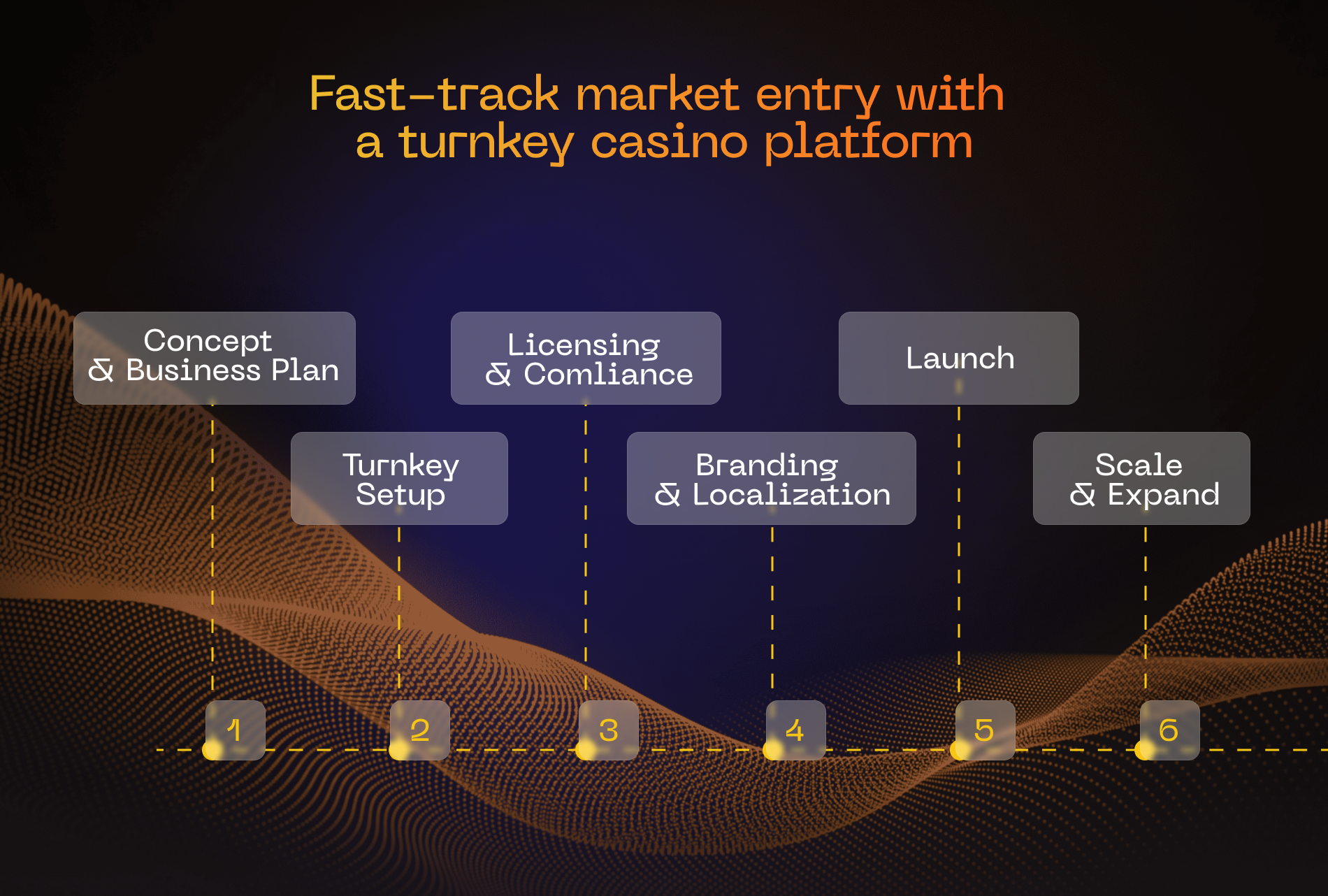
Speed To Market
Problem: Time is money in the fast-moving iGaming industry. With markets opening rapidly (from new U.S. states to emerging regions in LatAm, Africa, and beyond), being able to launch in weeks rather than years is a huge competitive edge. Building a full tech platform from scratch might take 9–12 months of development at a minimum.
Solution: In contrast, a well-optimized turnkey casino solution can have you live in a matter of a few weeks to a couple of months. For example, one industry provider noted that a custom-built casino often requires a team of developers 9–14 months to go live, whereas a turnkey platform can be operational much faster and with far less risk. This speed means you can capitalize on market opportunities or seasonal upticks right away. It also means earlier revenue—instead of burning cash on a long development cycle, you start earning from players sooner.
Cost Efficiency
Problem: Developing an online gambling platform in-house is not only slow but also extremely expensive. Estimates vary, but creating a custom iGaming platform can cost hundreds of thousands of dollars in development and infrastructure before launch. Then add the ongoing costs of a tech team, servers, game licensing fees, etc.
Solution: Turnkey gambling solutions dramatically lower the barrier to entry: the technology is developed once and amortized across many clients, so operators pay a fraction of what it would cost to build. Typically, you might pay an integration/setup fee and then either a flat monthly fee or a revenue share to the provider. In either case, your upfront investment is far lower than building from scratch.
You also save on hiring since you don’t need a full software engineering department to run a turnkey casino, as the provider maintains the platform. This makes the business model viable for mid-sized operators who couldn’t otherwise afford the tech build. Even larger operators see cost benefits in not reinventing common systems. In summary, turnkey casino solutions let you start an online casino without the CAPEX of development. You can allocate budget to marketing, licensing, and content instead.
| Feature / Aspect | Building an Online Casino from Scratch | Using a Turnkey Casino Solution |
| Initial Setup Cost | €500,000–€2,000,000+ - Custom platform development - UI/UX design from the ground up - Server architecture & setup - Legal and corporate structuring | €25,000–€100,000 (Setup Fee) - Platform configuration & branding - License application support - Pre-configured server environment |
| Time to Market | 12 – 24+ Months - 6-12 months for platform development & QA - 6-12 months for licensing (e.g., MGA) - 3-6 months for third-party integrations | 1 – 3 Months - 2-4 weeks for branding & configuration - 4-8 weeks for licensing (e.g., Curacao) - Go-live is rapid as integrations are pre-built |
| Development & Tech Team | In-house team or agency required (high cost) - CTO, Project Manager - 5-10+ Software Developers (Backend, Frontend) - 2-3 QA Engineers - DevOps & System Administrators Annual Salary Cost: €400,000 - €800,000+ | Provided by the solution partner - No in-house development team needed for the platform - You might hire 1-2 technical managers for oversight. Annual Salary Cost: €0 (for platform dev) |
| Licensing & Legal | Complex, lengthy, and expensive - You manage the entire application process directly - Requires dedicated legal counsel and compliance officers Cost: €25,000– €50,000+ in legal & application fees (for MGA/UKGC) | Streamlined and supported - Provider guides you through the process, often with a sublicense model (e.g., Curacao) or full license support (e.g., MGA). Cost: Often included in the setup package or as a lower-cost add-on. |
| Game & Payment Integrations | Time-consuming and costly - Each game provider requires individual commercial negotiation and technical integration. (Est. €5,000–€15,000 per provider). - Each Payment Service Provider (PSP) requires a separate integration project. | Pre-integrated & ready to go - Access to a portfolio of 50-100+ game providers and multiple PSPs from day one. - Activating a new provider is a simple configuration, not a development project. |
| Ongoing Costs | High & Variable - Team salaries (€400k+ annually) - Server hosting & CDN (€5,000 - €20,000+/month) - Software updates, bug fixes, security patches - Game provider minimum fees | Predictable (Revenue Share Model) - Platform Fee: Monthly minimum fee or a 10% - 40% GGR share - Provider handles all server costs, maintenance, and platform updates. Your costs scale with your revenue. |
| Risk & Complexity | Very High - Risk of development delays and budget overruns - Responsibility for all technical maintenance, security, and compliance updates - Huge capital investment before generating any revenue | Low - Fixed launch cost and predictable ongoing fees - Technical and regulatory burden is outsourced - Allows you to test the market with minimal upfront financial exposure |
Regulatory Readiness
Problem: One of the biggest headaches for any gambling operator is compliance with laws and regulations because they change and evolve constantly. Keeping up with the legal side of an iGaming operation on one’s own is a challenging and dangerous endeavor.
Solution: Luckily, a good casino turnkey solution comes with regulatory know-how built in. The platform will support multiple major gambling jurisdictions (Malta, Curaçao, Isle of Man, etc.), and it’s continuously updated to meet requirements (think: GDPR data protection, anti-fraud and KYC rules, anti-money-laundering monitoring, and certified RNGs for fair play).
GR8 Tech even offers license acquisition support with our geo-ready solutions, advising on which license fits your needs and helping prepare documents. If you go with a white label (under the provider’s license), compliance is largely handled for you—we'll discuss that later. With turnkey (your own license), you still must obtain a license, but the software won’t be an obstacle in certification. This “pre-compliance” saves time and legal costs, and it reduces the risk of costly regulatory missteps. Essentially, the platform is built for regulated markets from the ground up, so you can focus on the business, knowing the technical side meets industry standards and security protocols.
175+ providers, 15,000+ games, and only one API integration. No more headaches from communication—we handle it for you.
Infinite Casino Aggregation
Scalability & Support
Problem: As player traffic surges during peak hours or major promotions, many operators face platform slowdowns, crashes, and frustrated users. Without robust scaling infrastructure, every spike risks losing revenue, negative reviews, and damage to brand credibility in competitive markets.
Also, expanding into new markets or adding products like a sportsbook often means months of redevelopment, new integrations, and regulatory rework. For operators without modular, scalable systems, each growth step becomes a costly, high-risk IT project that stalls momentum and drains resources.
Solution: Online casino turnkey solutions are engineered to scale as your user base grows. Instead of worrying if your servers or database can handle a spike in players, you rely on the provider’s cloud-based infrastructure. Modern turnkey platforms boast 99.9%+ uptime and cloud scalability to handle thousands of concurrent players seamlessly.
When you need to enter a new geography or add a new vertical (say, adding a sportsbook or bingo to your casino), you can often do it by enabling modules rather than rebuilding your platform. Moreover, you get technical support and maintenance as part of the package—dedicated support teams keep the software updated, secure, and running smoothly.
This means no 3 a.m. calls to your CTO about a server outage; the provider has monitoring and ops teams on it. For a C-level executive, this support is priceless. It frees your in-house team from low-level platform maintenance so they can focus on strategic growth.
Scalability isn’t only about technology, though. GR8 Tech, for example, also offers operational support like 24/7 customer service solutions, fraud management services, and consulting on best practices. In short, we become an extension of your team, helping ensure your casino can grow without hitting technical roadblocks.
Market entry with turnkey casino
Focus on Core Business
Problem: Casino operators often get bogged down in technical firefighting, like debugging payment issues, fixing site glitches, or rebuilding promo tools. This drains resources from growth-driving activities, leaving marketing, brand development, and player engagement underfunded and underprioritized.
Solution: Perhaps the most underrated advantage is that the best turnkey online casino solution provider allows the operator to focus on player acquisition, marketing, and product strategy, not on reinventing tech infrastructure.
As a casino operator, your core business is providing entertainment and attracting players. Every hour spent troubleshooting payment integrations or building a bonus system from scratch is an hour not spent on growth strategy. By outsourcing the heavy lifting of technology to a specialist, you can invest your time and resources where they matter most: crafting a unique brand, forming partnerships, optimizing your marketing channels, and analyzing player data to inform business decisions.
Our clients often come to us because they want to focus on acquiring players, not building technology. A turnkey platform lets operators concentrate on growth and customer experience while we handle the backend complexities. Ultimately, this alignment means you operate more like a modern digital business—agile, customer-focused, and data-driven—rather than sinking effort into software development and IT maintenance.
Limitations & Misconceptions About Turnkey Solutions
No solution is perfect for everyone, and some limitations and myths around turnkey casinos deserve clarification.
Myth: “Turnkey means no flexibility”
Critics sometimes assume a turnkey casino software solution is a cookie-cutter product where every casino looks and works the same. While that might have been true a decade ago with basic white-label sites, it’s no longer the case.
As discussed, the best turnkey solutions today are highly modular and customizable. You control your branding, choose your game mix, and configure your promotions—your casino can be as unique as you make it.
Myth: “It’s only for small operators or new startups”
Turnkey solutions enable new entrants to launch on a shoestring, but that doesn’t mean larger companies don’t use them. In fact, many midsize and even some tier-one operators use turnkey or Platform-as-a-Service offerings to power their brands precisely because they’re efficient.
Modern turnkey platforms are built to scale – they can handle growth from a few hundred players to hundreds of thousands. For example, GR8 Tech’s Hyper Turnkey online casino software solution is explicitly targeted at established operators who need an enterprise-grade solution that can “deliver an easy-to-operate, scalable solution” as they expand to new markets.
The notion that you’ll outgrow a turnkey solution is often more about choosing the right provider. A top-tier platform will be scalable and extensible; if you want to bring certain development in-house down the line, a good partner will facilitate data migration or custom integration.
Dependency on Provider
One legitimate consideration is that when you adopt a turnkey platform, you inherently rely on the provider’s technology and support. If the provider has outages or delays in updating features, your business could be impacted.
You also need to ensure the provider’s roadmap aligns with yours—e.g., do they support the new market you want to enter, the new payment method your customers demand, etc.? This is why due diligence is key: operators should choose a reputable, proven provider with a strong track record. Contractually, clarify what happens if you need to pivot or eventually leave the platform.
The best providers mitigate this risk by using modern, open tech standards and offering full data ownership to the operator. That way, you won’t be handcuffed if you ever decide to transition off the platform (though many stay long-term because it continues to meet their needs).
Cost and Revenue Share
While turnkey saves huge development costs, it’s not free. Typically, there are setup fees and ongoing fees. Some turnkey deals, especially under white-label arrangements, involve sharing a percentage of gaming revenue with the provider. Over the long run, this can add up to a significant amount (though you’re paying for value: constant tech updates, new games, etc.). For operators with very large revenue, a rev-share model might feel limiting, which is why larger operators sometimes negotiate flat fees or even licensing the software outright.
The misconception is that turnkey is always a revenue-share “lease” of a platform. In reality, business models vary. If maintaining 100% of revenue is critical, you can often find a plan where you pay a higher fixed fee but keep all profits.
There is also the upfront cost of a gaming license for turnkey operators (since you typically obtain your own license), whereas a white-label might spare you that initially. These costs and trade-offs need to be weighed against building from scratch (where you’d be investing millions and still have tech maintenance costs).
In summary, turnkey is cost-effective, but it’s not a magic wand—you still need a solid business plan and sufficient capital to cover licensing, initial fees, and marketing to attract players once you launch.
Turnkey vs. White-Label Casino Solutions—What's the Difference?
The terms “turnkey” and “white-label” in online gambling are related and sometimes confused. Both involve a provider delivering ready-made solutions, but the scope of control and ownership differs significantly:
| Aspect | Turnkey Casino (Own Brand & License) | White-Label Casino (Under Provider’s License) |
| Branding & Control | Full control over branding, UX, and operations. It’s your platform to run. | Limited control; you skin the site with your brand, but a provider may handle core operations (support, game management). |
| Licensing | You obtain your own gambling license (e.g., Malta, Curaçao). Full autonomy in choosing jurisdiction. | Operates under the provider’s license, so compliance is pre-handled, but you must abide by the provider’s jurisdiction. |
| Technical Ownership | The platform is delivered “turnkey” but essentially independent—you manage the day-to-day and own the player data. | The provider hosts and manages the platform. You’re essentially renting space on their system; your data and tech are within their ecosystem. |
| Customization | Highly customizable—add/remove games, features, payment methods as you see fit. Often modular for expansions. | More template-based—some customization (logos, maybe layout tweaks), but core features and integrations are as the provider sets them. |
| Time to Market | Quick, but the timeline depends on obtaining your license and any custom setup (often a few weeks to a few months). | The fastest route: With licensing and the platform ready, we can launch in mere weeks or even days after applying the front-end skin. |
| Costs | Higher upfront costs (license fees, setup fees) but no revenue sharing in many cases— you keep what you earn. Ongoing fees are typically flat or per module. | Lower upfront cost (no direct license fee, lower setup), but usually revenue share with provider and/or monthly payments. It can be costlier in the long run if revenue grows. |
| Autonomy & Growth | Complete autonomy to pivot, expand to new markets (by obtaining new licenses), and scale the tech. Suited for long-term scaling and building an independent brand. | Less autonomy—expanding to markets outside the provider’s license might require migrating off the platform. Suited for testing the waters or smaller operations that prefer a hands-off approach. |
In essence, a turnkey solution is like getting the keys to your own casino platform: you drive, you take responsibility for the license and operations, but you also keep all the profits and control.
A white-label solution is more like leasing a fully serviced casino: the provider handles the heavy lifting (technical upkeep, licensing, and often customer support), and you focus mainly on marketing and brand customizations. White-label is attractive for minimal hassle, but it comes at the cost of control and a share of revenue. Turnkey requires more responsibility from the operator but offers greater freedom and potentially higher long-term returns.
💡Which is right for you? That depends on your strategy, experience, and resources. Many new entrants start with a white label to get to market super-fast and test their brand. As they grow, they may graduate to a turnkey solution to gain independence and avoid revenue share.
Established operators almost always prefer turnkey or custom solutions because they want complete control over their platform and data.
TL;DR: Turnkey Solutions in a Nutshell—10 Key Takeaways
- Launch an online casino in weeks, not months, with a fully pre-built, integrated platform.
- Access thousands of ready-to-go games and multiple payment methods from day one.
- Benefit from built-in compliance tools and licensing support for major jurisdictions.
- Customize branding, UX, game selection, bonuses, and payment options to fit your strategy.
- Add or remove modules like sportsbook or bingo without rebuilding your platform.
- Save significant CAPEX by avoiding in-house platform development and large tech teams.
- Scale seamlessly with cloud infrastructure built for high player volumes and 99.9%+ uptime.
- Receive ongoing technical maintenance, updates, and operational support from the provider.
- Focus internal resources on marketing, partnerships, and player acquisition—not tech firefighting.
- Retain long-term control and growth potential compared to more restrictive white-label models.
Conclusion
Turnkey casino solutions in 2025 and beyond are not one-size-fits-all boxes; they are flexible, powerful toolkits for building an online gaming business. As the industry continues to expand, with technology like AI personalization, crypto payments, and new game formats on the rise, having a robust, upgradable platform is crucial. Turnkey providers are continually evolving their offerings to incorporate these innovations (from AI-driven bonus engines to modular crypto wallets), ensuring their clients stay competitive.
Consider the opportunity cost for any executive pondering the build vs. buy question. Every month spent building technology is a month without players and revenue. Turnkey solutions offer a way to accelerate time-to-market while still allowing you to differentiate your brand and maintain control where it counts. In an environment where regulatory landscapes shift and player expectations climb, this approach can provide both a safety net and a launchpad. The key is to treat it not as a shortcut for its own sake, but as a strategic move—one that lets you focus on what truly makes your casino stand out, while a trusted partner takes care of the tech and compliance. That combination of speed and foresight is increasingly what defines the winners in iGaming.