Most iGaming operators already offer a wide range of payment methods: cards, wallets, local options, and crypto. Yet payment friction remains one of the most common reasons players abandon deposits. That’s because conversion issues often stem from how multi-currency payment flows are structured and presented to players, especially when fiat and crypto options coexist.
Crypto’s shift from a niche experiment into a mature financial infrastructure has raised player expectations. Stablecoins, instant settlement, and 24/7 liquidity have made fast, transparent deposits the baseline. Players now notice even small UX missteps.
As crypto-first and hybrid operators scale, issues like currency resets or unclear flow separation create hesitation and drop-off. To understand what actually drives smooth deposits, we analyzed payment widgets of top-performing iGaming platforms and crypto casinos and identified the patterns players now expect by default.
Let’s break down what this research revealed about player payment behavior and how you can translate those insights into higher conversion rates.
Research Scope: What We Looked At and Why It Matters for Conversion
Decisions such as which currency a payment widget opens in, how crypto and fiat options are presented, or where players can switch currencies directly affect how smoothly deposits are completed. When these decisions don’t match player expectations, the result is rarely a visible error—it’s players pausing, reopening the widget, switching back and forth between options, or abandoning the deposit altogether.
For operators, this friction shows up in familiar ways: lower deposit completion rates despite stable traffic, increased support tickets around “how to deposit” or “which option to choose,” and inconsistent behavior across markets where players rely on different currencies or crypto networks. These issues become more pronounced in crypto-native experiences within a multi-currency payment processing framework, where players expect clarity and speed, and payment flows need to scale without being reworked for each region.
From our experience working with operators, we know how valuable multi-currency and crypto-native setups are for scaling globally, accommodating higher deposit volumes for VIP players, and ensuring operational flexibility. That is exactly why our research focused on this type of payment environment. The goal was to understand how players already move through multi-currency payment flows on platforms where deposits perform reliably, and to treat those observed behaviors as constraints when designing the payment experience for our clients.
For this, we analyzed what happens when a player clicks the Deposit button on top-performing crypto iGaming platforms: how the payment widget opens, how currencies and crypto networks are presented, which defaults are applied, and what control players have once they’re inside the payment flow. As a result, we identified repeatable patterns that can be applied across brands, markets, and currencies.
6 Common Payment Flow Patterns in Multi-Wallet iGaming Platforms
When players open a payment widget, they rarely explore it. Most already know what they want to do and expect the flow to work in a familiar way. Our research confirmed a set of payment behavior patterns that high-performing platforms consistently follow and players now expect by default.
6 Payment Flow Patterns Players Expect by Default
1. Players Expect Their Currency Context to Be Preserved
Players assume that the payment widget opens in the currency they are already using, whether that’s the currency selected in their wallet or the one they registered with. Being asked to reselect the same currency again feels unnecessary and often triggers a moment of doubt: “Am I in the right place? Did something reset?”
On platforms where the payment widget consistently preserves this context, players move into the deposit step immediately, without having to reselect their currency. Where it doesn’t, players are more likely to reopen the widget, switch currencies back and forth, or exit the flow altogether.
Conversion impact: By preserving currency context, platforms reduce friction at the very first deposit step—precisely where hesitation most often turns into abandonment.
2. Mixing Crypto and Fiat Complicates Deposit Decisions
Research consistently showed that players treat crypto and fiat payments as fundamentally different experiences. Fiat payments rely on habit and familiarity: players recognize logos, payment methods, and typical steps. Crypto payments require confidence and clarity, especially around currency and network selection.
When crypto and fiat options are mixed into a single list or dropdown, players slow down. They hesitate longer, switch tabs unnecessarily, or select wrong options before correcting themselves. Platforms that clearly separate crypto and fiat flows within the payment widget UI reduce this uncertainty and make decision-making more straightforward.
Conversion impact: Separating crypto and fiat reduces cognitive load, helping players make faster, more confident deposit decisions.
3. Players Expect to Adjust Currency and Networks Without Restarting
Payment behavior often changes mid-deposit. Players may reconsider their currency choice, switch networks within the same cryptocurrency, or move between fiat and crypto after seeing available options. Research showed that players expect to make these changes inside the payment flow itself.
When players have to leave the widget or navigate elsewhere on the site to adjust their choice, drop-off rates increase. In contrast, platforms that allow currency and network switching directly within the payment flow keep players engaged and moving forward.
Conversion impact: Providing controls directly in the widget helps maintain player intent and avoid breaking the deposit flow.
4. Crypto Payment Pages Succeed When They Look Familiar
Across leading platforms, crypto payment pages follow a highly consistent structure. Players expect to see the currency and network clearly selected, with recognizable logos, a QR code, a copyable wallet address, and visible information about limits or important conditions. Even small deviations from this structure cause players to slow down, recheck details, or hesitate before proceeding.
Conversion impact: Familiar crypto payment structures increase player confidence and shorten the time between intent and transaction.
5. Currency Choice Works Best When It’s Prioritized
In practice, most players rely on a small set of familiar options: typically stablecoins and, in some regions, a single dominant fiat currency. Still, they expect to choose their deposit currency, especially on platforms that support crypto alongside fiat.
Our research shows that problems arise when currency lists are presented without hierarchy. When all currencies are shown with equal visibility, players spend more time comparing options and are more likely to hesitate. What appears first acts as guidance. When everything looks equally important, that guidance disappears.
High-performing platforms address this by ordering currencies by popularity. The most commonly used options are shown first, while less frequently used currencies remain available through secondary selection.
Conversion impact: Prioritizing currencies by popularity reduces decision time, preserves flexibility, and keeps deposit flows fast and predictable.
6. Familiar UI Patterns Speed Up Deposits
When a payment widget follows familiar and intuitive UI patterns, players spend less time figuring out what to do next. If the flow looks and behaves like payment interfaces they have already seen elsewhere, decisions happen faster and with more confidence.
Speed matters because deposits are a means to an end. Players come to place bets and start playing, not to evaluate payment options. The faster they select a method, complete a deposit, and see funds on their balance, the sooner they move into gameplay.
This matters even more in an environment where attention is scarce. iGaming platforms compete not only with other casinos but with any digital experience that offers instant engagement. Slow or unfamiliar payment flows break momentum and increase the risk of drop-off.
Conversion impact: Familiar, predictable payment UX shortens time-to-deposit and increases the likelihood that players reach gameplay without interruption.
How to Turn These Payment Behaviors into Higher Conversion
If reading through these findings feels overwhelming, I get it. Translating player behavior into a clear, high-converting payment flow is not trivial, especially when you’re dealing with multiple currencies, crypto and fiat logic, different markets, and real revenue on the line. Most operators don’t want to design payment UX from scratch, and they shouldn’t have to.
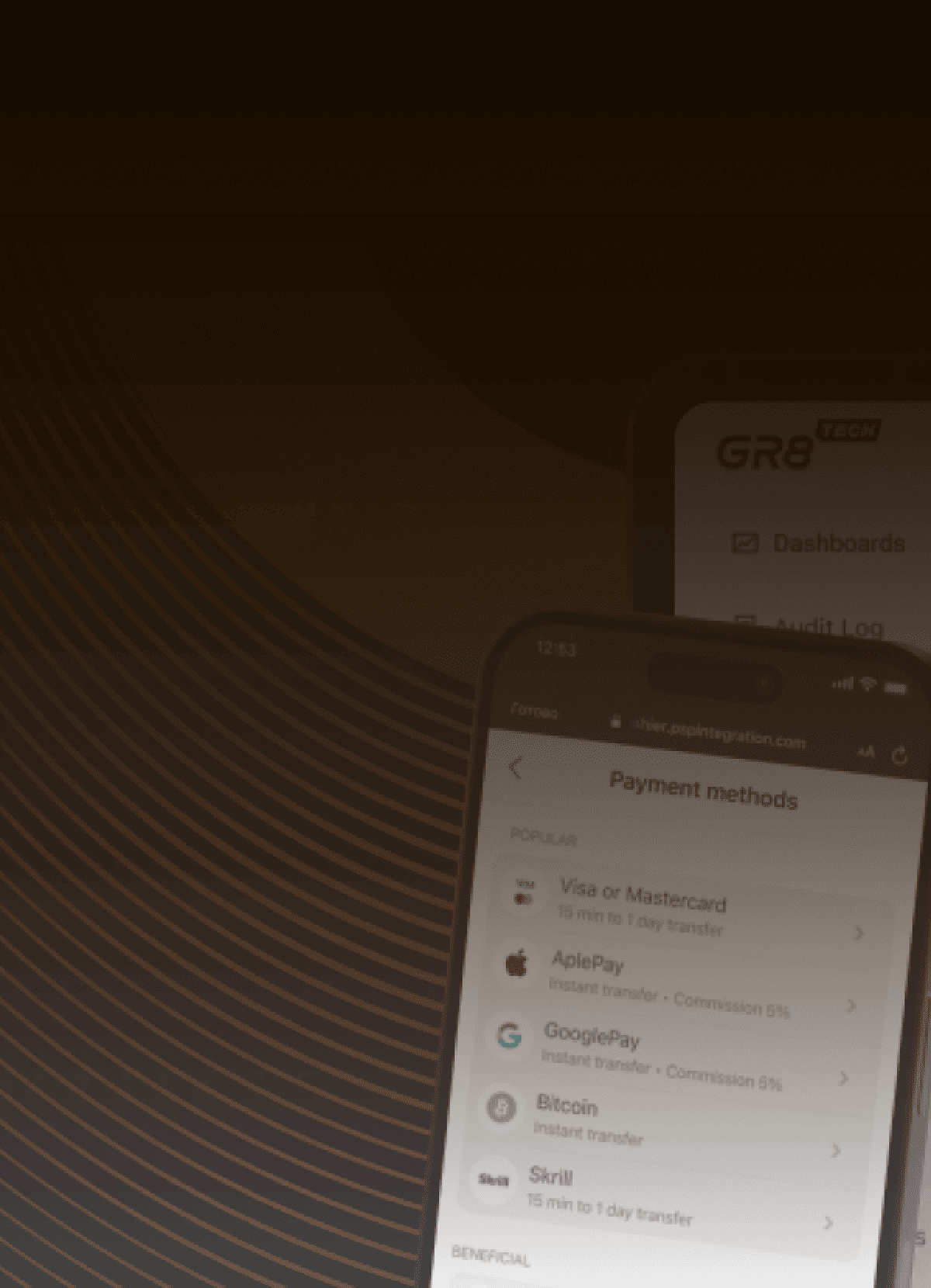
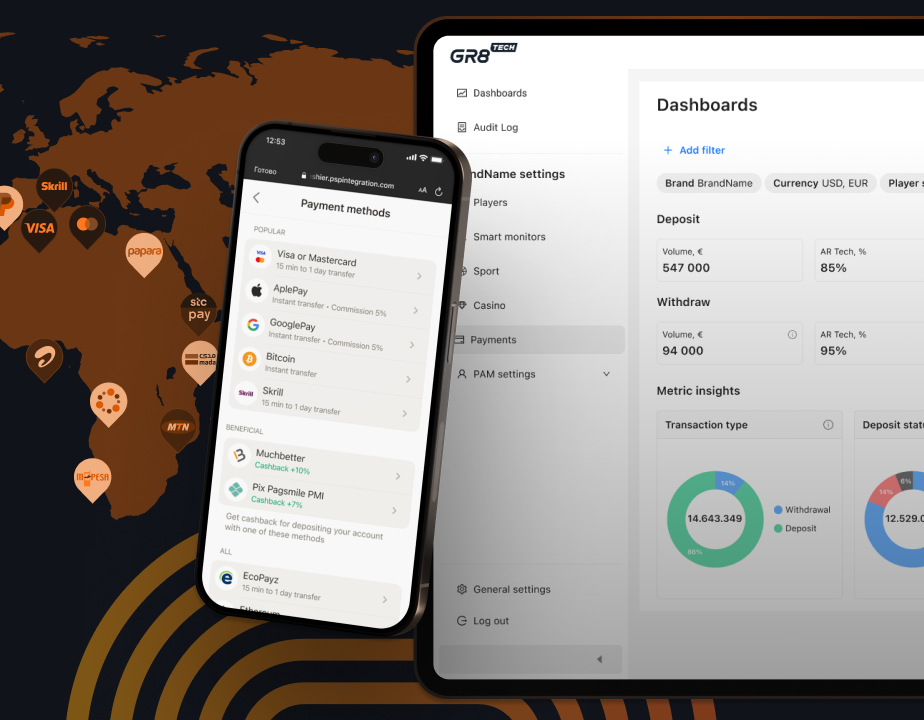
That’s exactly why this research wasn’t done as a theoretical exercise. It laid the groundwork for GR8 Tech’s new Multi-Currency Payment Widget, now supported by our Payment Gateway. The idea was to take proven player behavior patterns and build them directly into a production-ready payment widget, so operators can get it out of the box.
See how the Multi-Currency Payment Widget works
Open Widget Documentation
How These Findings Are Built into GR8 Tech’s Payment Widget
Several implementation decisions followed directly from the research.
First, the payment widget opens in the player’s existing context. When a player initiates a deposit or withdrawal, the widget defaults to the currency they are already using — either the one selected in their wallet or the one they registered with.
Fiat and crypto payments are handled as distinct payment flows. Rather than presenting all options in a single list, the widget clearly separates crypto and fiat into dedicated sections. Each section shows only the currencies and payment methods relevant to that payment type.
Currency and network switching happen inside the widget. Players can switch currencies or crypto networks directly within the payment flow, without leaving the widget. This allows players to react to availability or change preference mid-deposit without breaking intent or restarting the process.
Crypto payment pages follow a familiar, consistent structure. For crypto deposits, the widget presents the elements players expect to see: selected currency and network, QR code, copyable wallet address, and clear informational blocks for limits or important conditions.
Currency visibility reflects real usage patterns. Frequently used currencies, particularly stablecoins, are prioritized visually, while less common options remain accessible without cluttering the interface. This balances speed for the majority of players with flexibility for edge cases.
The widget is delivered as an iframe-based component, allowing operators to apply the same payment logic across mobile and desktop environments. While layouts adapt to different screen sizes, the underlying flow, defaults, and controls remain consistent.
Validating and Improving the Widget Using Real Player Behavior
Player behavior evolves, markets change, and even well-established UX patterns need validation in real conditions. That’s why we’ve set up interaction tracking to understand how players actually use the widget in production: how often they switch currencies or networks, where they pause, and how long key actions take. It allows us to identify small but meaningful friction points. For example, moments where players hesitate longer than expected or repeat the same action more than once.
At the same time, we actively collect feedback from merchants, who see the business impact of these moments directly in their deposit and revenue metrics.
Combining behavioral data with merchant input allows us to validate earlier assumptions and prioritize widget improvements that matter most commercially. Instead of large redesigns, we make targeted adjustments to specific elements of the flow. This ongoing optimization helps keep the widget aligned with real player behavior and supports higher deposit completion rates, contributing directly to stronger GGR for operators.
Takeaways for Operators
For operators, the main lesson is straightforward: payment conversion is rarely limited by the number of available methods. It’s limited by how closely payment flows align with player expectations. Here are some key takeaways:
- Players don’t want to relearn payment flows. Familiarity drives confidence and speed
- Preserving player context (currency, payment type) reduces early drop-off
- Crypto and fiat should be treated as distinct flows
- Giving players control inside the payment flow prevents unnecessary exits
- Prioritizing commonly used currencies improves decision-making without restricting choice
- Continuously analyzing player behavior and incorporating merchant feedback helps payment flows evolve and drive higher conversion and GGR
If you’re planning to expand into new markets, support multiple currencies, or increase crypto adoption, aligning payment flows with real player behavior is one of the most effective ways to improve conversion without adding operational complexity.
Our widget is built on these principles, translating proven behavioral patterns into a ready-to-use payment flow you can deploy and scale with confidence.