Bonus abuse is one of the most expensive problems in iGaming, not because it is rare, but because it affects multiple parts of the business at once: acquisition efficiency, promo ROI, risk operations, player experience, and margin control.
We tried to figure out how bonus abuse appears alongside multi-accounting, traffic fraud, payment fraud, risk-verification issues, and tech bugs—and, critically, as part of increasingly organized “engineered networks,” not just isolated bad actors.
The Scale of the Problem
Fraud and bonus abuse have plagued the gambling industry for a long time, and GR8 Tech’s head of RAF operations, Artem Kolodyazhnyy, is under no illusions about the scale of the problem.
“Today, fraud is not about isolated tricks, it is about engineered networks. Of course, we can detect a lot of separate players, we can detect all of them. But the most important issue we have right now is about engineered networks. The main categories in anti-fraud right now are multi-account, traffic fraud, bonus abusers, payment fraud, risk-verification processes, and tech bugs.”
Kolodyazhnyy believes these networks of fraudsters are responsible for the worst fraud in the industry right now. “You think you're in a fight with one suspicious account, but in fact, you are fighting this network of hundreds working together. This is the most important point in the industry right now. We cannot be sure at any moment that this issue relates only to one or even 10 accounts. This issue can destroy all your work right now for all your players, and that's why you must have a really strong anti-fraud system in place.”
Vlad Andrusenko, GR8 Tech’s head of sportsbook product, highlights how combating payment fraud is a pivotal issue for new operators. He says: “It’s a common issue for any area where you can deposit and withdraw funds, and one of the fraud areas which is really critical for operators to make or break. If you don't nail it down with your platform product operation risk management system, it could be very costly and could easily take an operator out of the market.”
So, how much money are operators actually losing to fraud? Kolodyazhnyy says for new operators it can be as high as 20% of monthly GGR (gross gaming revenue), depending on the region in which they are launching. A key factor here is how the operator approaches their welcome bonus promo offer. But once an operator is established, it is usually around 3-5% of GGR that continues to be lost to bonus abuse, with an estimated 10% saved by GR8 Tech’s anti-fraud measures.
The market is flooded with bad actors who see the iGaming industry as fertile ground for exploitation, be that in terms of bonus abuse or other forms of extortion such as interruption of service or attempted penetration of protected systems. There's money generated in this industry and there's money at play in the industry and that's going to attract all sorts of nefarious actors, either coming in the front door as customers that are seeking to abuse a bonus that is susceptible to abuse. Or coming in the back door and trying to penetrate the systems.
Ashley Lang, the CEO of Pragmatic Solutions
The Most Vulnerable Markets
One of the leading voices on bonus abuse and co-founder of Greco Ozric Vondervelden says that the market that is suffering the most from bonus abuse isn’t geo-specific—it’s the crypto market.
He explains: “It's not the case for all operators, but many of them have more relaxed application processes. The nature of crypto is harder to track than bank cards. Two of the natural defences that operators usually have aren't there, so they're much more highly targeted.
“Another area is fiat (non-crypto) operators in the grey market. A big part of the abuse there is the lack of expertise among many of these operators. Many of them don't come from a gaming background. There's a lot—it's a very saturated space right now. It's very competitive, and a lot of operators are going in with big offers without a real understanding of the risks they're exposed to.”
When honing in on specific countries, Brazil and the USA are highlighted for having significant bonus abuse issues. Vondervelden says: “Brazil, I believe, had the largest amount of bonus abuse that we've ever seen pre-regulation, and during regulation, there was a period of time where operators were trying to interpret the guidelines.
“It's only now becoming widely understood in Brazil that bonuses aren't banned. There are certain ways they can offer bonuses, so bonuses have started returning to that market. There are hundreds of thousands of very skilled bonus abusers in that market waiting, sort of in hibernation.
“I just did an analysis on the US to identify the level of value on offer there, and it's pretty significant. Individual operators are offering things like 100% up to $1000. In certain markets and states, the value of all those offers to a single player is in the region of $22,000, which for some people is a salary. So there's a huge incentive for players to find ways to scale this, since you can make $22,000 with one identity in a couple of weeks’ work.
“It's very instinctual to then go and use your family members’ identities and then expand from there and pay people for identities. Next thing, they could be outside recruitment centres or hiring IDs from behind the bar. And this is what we're seeing in the US. There's a lot of abuse there, mainly due to the massive value the casinos have been offering in this race for market share since the regulation.
“Then you've got Europe, which is pretty steady. For most European countries, there's a longer history of regulation and a longer history of abuse. It's a constant pain that most operators have somewhat adjusted to.”
While online casinos in Europe do have a long history of bonus abuse, Vondervelden admits that there are always plenty of new methods and techniques being discovered and utilised by fraudsters to take advantage of casinos.
New Ways to Take Advantage
“New exploits emerge with new technologies in the space. There's a category of content where multiple players can play on a single slot game, which you can watch behind a streamer. We've seen there are some games that have progressive features within the game, so you can predictably tell when a winning spin is going to come in. Given the nature of this content, players can enter and leave the game at any point, so they were entering for the winning spins and then exiting after them. So they were able to make huge profits from this.
“I'll share one more. There's an aggregator, where for specific studios through that aggregator, players are able to change the game name in the domain URL. As a result, what the operators were seeing on the back end was this changed game name essentially. So players were able to play one game, but on the back end, it seemed they were playing another. As a result, they're able to use games where you can exploit bonus wagering requirements, but completely invisible to the operator. And so the operator wasn't able to even identify that there was a problem, as it was an issue with the aggregator.”
Another form of bonus abuse that operators are now having to deal with is matched betting firms. Entain has recently taken legal action against OddsMonkey, a service that uses software and guides users on how to take advantage of welcome bonuses offered by different casinos and sportsbooks to make a profit. Jeffrey Haas, MD of ID8 Global Gaming Business Accelerator, who previously held key roles at PokerStars and DraftKings, among others, believes regulators and the industry need to accept this kind of opportunity; after all, it is technically legal. Haas says: “In respect to smart bonus abuse with matched betting tools like OddsMonkey, we've all been reading about Entain suing their owner for IP property infringement. But the fact is, consumers want to have an edge at any game they're playing, and OddsMonkey gives them that opportunity.
“They can turn free bets and promotions into withdrawable profit by betting both for and against. It is a smart approach. So, if I'm the regulator, I'm saying ‘OK, this is what consumers like to do.’ How do we find a better way of facilitating this form of entertainment?”
A crucial period for all new operators when it comes to defending against fraud and bonus abuse is their opening weeks. As Kolodyazhnyy puts it: “The start period is absolutely crazy for all sides—platforms and operators—because immediately all kinds of scammers’ activities come to you and try to do something with your product and try to understand what kind of risk management you have right now. They can destroy all your potential, or you could have an absolutely terrible situation.”
How can you protect against this? He emphasizes the importance of both the technology and the personnel used:
Operators must have both a brilliant risk management system and a brilliant risk management team. If you have only a risk management system—it can be a really good system—but you don't have a really good operational team too, it doesn't work—and vice versa. It’s something which either makes or breaks an operator.
Artem Kolodyazhnyy, GR8 Tech’s head of RAF operations
Lessons From PayPal
In fact, Kolodyazhnyy points out, this isn’t a unique issue for the iGaming industry. He elaborates: “With online payments, before PayPal, there was no payment provider who had more than 1% of the market, but PayPal was really successful, specifically in anti-fraud and risk management, and due to their being able to really excel in managing different kinds of frauds, including chargebacks, they were able to offer some guarantees to the audience. That's how they conquered the market.
“So it's similar in iGaming. The better you are at risk management, the less you need to budget for losses from fraudulent players, which means you can give more to casual players and restrict them less. You can make their play much easier and seamless. So it's both the biggest challenge and the biggest opportunity for operators.”
Kolodyazhnyy points to a lack of experience among staff as another issue that can leave operators vulnerable to fraud. He says: “Experienced talent is sparse on the market, and that's why the market is not really structured compared to other areas such as IT software development. If we take a look at iGaming operational roles, they're not yet structured from the perspective of what kind of skills you need to have, what the standard processes are. Even if you take a look at platforms, the same kind of tools have different structures because that's a rapidly evolving thing. Everyone comes up with their own solutions. I'd say this area is something which is tricky, but if you nail it down and you have a smart team which can navigate obstacles and challenges, then that's something which could be your competitive advantage both as a provider and an operator.”
Bringing in defensive measures to prevent abusers from taking advantage is crucial, but according to Vondervelden, a mistake he has seen many times is that operators negatively impact the experience of genuine players because of the actions of abusers. He explains: “Operators penalise all of their players for the actions of a few bonus abusers—it’s pretty destructive. They implement things like slow withdrawals because they're having to review every player. Because of the anxiety of abuse and [the thought of] letting that slip through as a withdrawal. They will block a ton of content during bonus play because of a few players who use it as part of their bonus abuse. Or they will really tighten the terms and conditions of their promotions—putting win caps in place which can create a really poor user experience for all of their players.”
What is arbitrage?
Arbitrage is the practice of betting on every outcome of a sports match by taking advantage of bookmakers' offering different odds. By comparing the odds of all bookmakers, it is possible, on some events, to guarantee a small profit by covering each outcome at different odds with different operators. When capitalising on bonus offers and scaling with multiple accounts, it is possible to make significant amounts of money. In some markets, services such as OddsMonkey help users to find and place bets for arbitrage. While the practice is legal, it violates the terms and conditions of most sportsbooks, so users who are caught partaking in arbitrage will see their accounts restricted.
Arbitrage Fraud Trend in Sports Betting
Where to Draw the Line?
The reason that operators do this, though, is that it can be extremely difficult to tell if someone is a bonus abuser or not, even for an expert like Vondervelden. It comes down to where operators decide to draw the line. The Greco co-founder explains: “It depends on how you define bonus abuse. I consider it as encapsulating everybody who is optimising value by breaking the rules. But when it comes to advantage play, which isn't technically breaking the rules, the lines are a little bit blurred because it's a scale. On one end, you've got your VIPs, on the other end, you've got your bonus abusers, and you have to draw a line in the sand somewhere. I consider it bonus abuse when it’s somebody who is consistently taking value and optimising that value. If you could plot a player's value on a line, we're looking at, firstly, is that player is in the negative in terms of their value? And at what rate of decline? And you know, every operator has a different tolerance towards bonus abuse. We (Greco) advise on where we would draw that line, but it is ultimately up to them.”
So what can the industry do to fight back against the fraudsters and bonus abusers? Kolodyazhnyy believes it’s moving in the right direction. He says: “The industry is finally moving to react to fraud, proactively managing risk as part of growth. I believe that most providers now try to do risk management in real time and proactively manage these risks. It looks like in the next two to three years, everyone, every kind of platform will have a lot of AI solutions, a risk management ecosystem. After all, it is really important - it is about 10 to 15% of your GGR at risk, so it is absolutely crazy.”
Pragmatic Solutions CEO Lang emphasises the importance of getting the tech right. He explains: “From a technology perspective, it requires governance and system integrity to be prioritised at the software design level. As a business, we need to think about prevention of fraud and system penetration at the design level, not as an afterthought, not as a bolt-on. From an operator's point of view, it comes down to the availability of real-time data and the tools to derive insights from transactional data as it happens. It's too late if you're figuring out you've been taken advantage of in your month-end reports, right?
“You need to be doing that in real time, and you need systems that first publish real-time data and then analysis tools to inspect and interrogate real-time data to derive an insight or identify a pattern of behaviour that you know will lead you to believe there might be something going on in terms of an abuse of a bonus.
Fortunately, there are many tools available to operators and new companies emerging regularly now to support bonus abuse defence. What operators require is a PAM platform that publishes detailed transactional data in real time and that has the capability to respond to insights from connected data processing platforms and to act immediately by automated modification of the player account. But the scale and extent of these types of abuses or manipulations of the operating system are going to vary by market and vary by operator. Whether you're high profile or not, whether you have a mature system or not. But regardless, those are the opportunities available to operators to mitigate and prevent themselves from being the ones who are taken advantage of.
Ashley Lang, the CEO of Pragmatic Solutions
Ozric Vondervelden’s Guide to Types of Bonus Abuse
Few in the industry understand bonus abuse as well as Greco co-founder Ozric Vondervelden. He explains some of the most common types of abuse.
Advantage Play
This is the main behavior of bonus abusers and the hardest one to spot. It’s when a player is playing the offer as intended—so they're not breaking any of the terms of the bonus—BUT they're optimizing their play to get maximum value out of the bonus.
Something that needs to be understood is that almost all promotions have a positive value to the player. It's kind of counterintuitive, as if a player could attempt the same offer repeatedly, they might lose 80% of the time. But it's still profitable because that 20% of the time they win, they win disproportionately large, covering their losses and making a profit.
This is the case for most promotions that exist, so players can make a profit simply by playing a promotion in a way that's optimized. And there are several things that a player can control to affect value. There's the RTP of the game that they choose, there's the volatility of the game, and there's the stake sizes. All of these things impact value, and they're essentially optimizing these things. This is not generally considered illegal, but it becomes a problem when players scale. So if a player can scale accounts, they can essentially print money. It's an infinite money glitch.
Breach of terms: Use of persistent slots
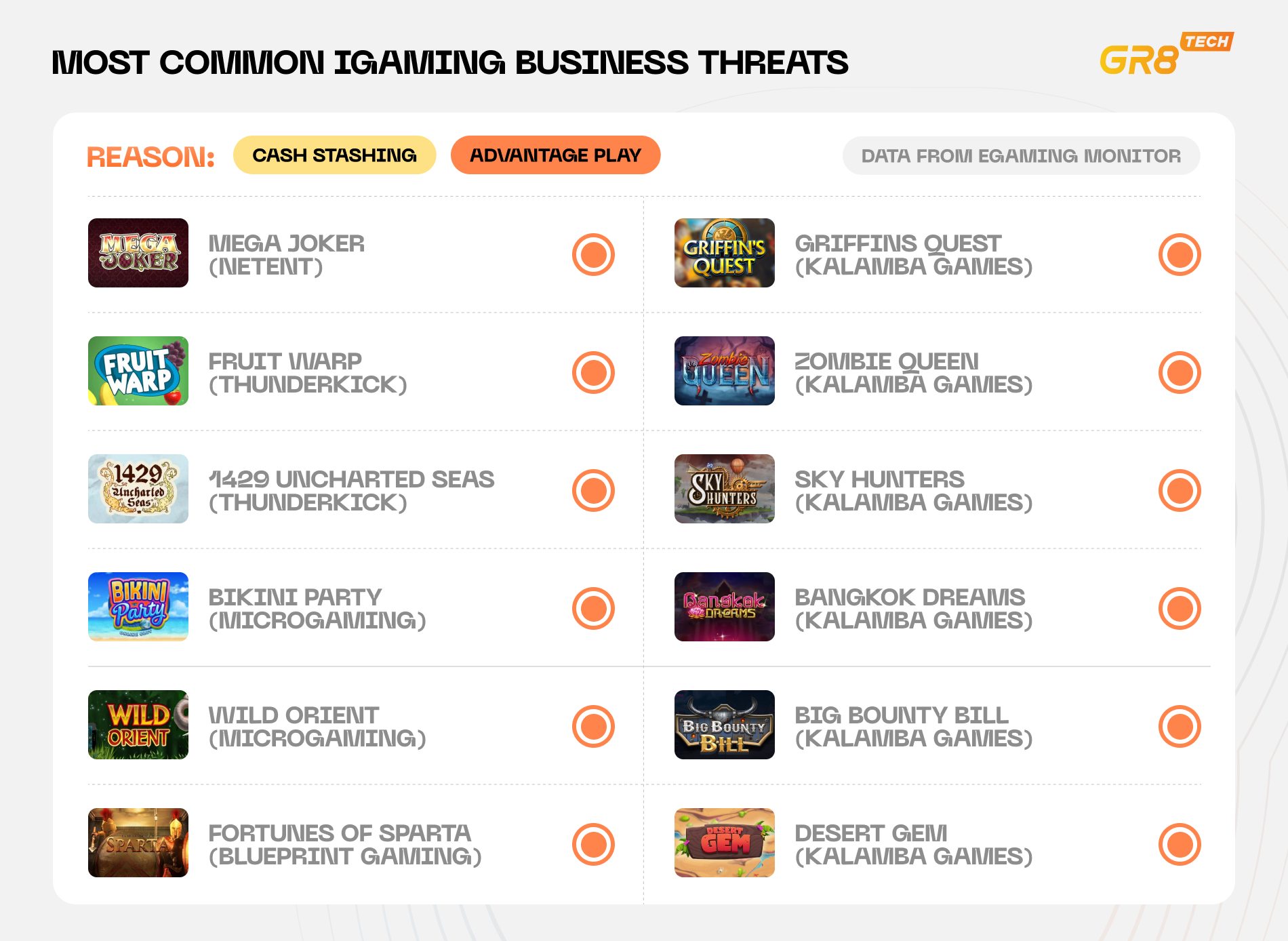
This is very common at the moment. These are games that can store value. So during bonus play, the player will store value in the game but zero the balance on their account. They'll come back with cash, and then they will finish the in-game progression and release all that value as cash, cheating the wagering requirements in the process.
Typically, when an operator gives a £100 bonus, you expect about 15% conversion to cash across all players. The impact of this is that it increases to around 80% conversion from bonus to cash.
Breach of terms: Cash stashing
This is another big issue. Almost all operators, when they give a player a bonus, require the player to lose the cash they have on the account before they start consuming the bonus funds. What players can do is, rather than losing the cash, they hide the cash in unsettled bets and then access the bonus funds without risking their cash. And they'll either win or lose with a bonus, but ultimately, they haven't risked anything. They go back to their unsettled cash bets, release them from the game, and withdraw them.
Bonus engine logic abuse
Players are essentially finding bugs in how the bonus engine works or incompatibility issues between content, bonuses, and the bonus engine. One example is if a casino is running a promotion like a tournament on the site, and the player who had the biggest win multiplier wins the tournament. There are certain games where a player can build up progression in the game and change stake sizes. So they built loads of progression in this game on €100 stakes. Then, during this tournament, they switched to 10-cent stakes, finished the progression, and this big win came in. But the win was based on the gameplay with €100 stakes, so the multiplier was huge compared to the stake size. Imagine the kind of win you'd get on a bonus round of a game when you're playing €100 stakes—but triggered on a 10-cent stake.
Increasingly Sophisticated Tools
One solution for combating fraud could actually be the use of cryptocurrencies—at least that’s the belief of Haas, who is also a venture partner for Dreamcast Ventures, who invest in tech-driven companies. As Haas puts it, “Crypto helps with this in such a significant manner. The benefits are low processing costs, low processing time, and no chargebacks. So if an operator has to deal with the margin implications of having chargebacks on credit cards or other forms of payment, that [sort of fraud] just doesn't exist on crypto. It is also the perfect transparency on financial flows using tools like Chainalysis. That's one of the great ways to fight it, because it's huge.”
But while the tech behind cryptocurrencies could be used to help fight fraud, Haas points out that another new technology is presenting a whole different issue—fake documents produced by AI to get around KYC (know your customer) checks. He explains: “You're starting to see people use artificial intelligence to produce false KYC documents in order to pass ID verification testing. If they do that in conjunction with stolen credit cards, it allows them to deposit and run full chargebacks because it's effectively identity fraud. The tools of the fraudsters are becoming increasingly sophisticated, and you must empower operators to fight back with more powerful tools.”
Vondervelden agrees that technology, and AI in particular, will be at the centre of bonus abuse going forward, although he posits that the basic principle of abuse doesn’t evolve much. He elaborates: “We see new behaviours when it comes to new content or even a new type of bonus engine promo category. But the fundamentals don't really change, and every time a new category emerges, we explore it to understand what risks are associated with it.
“The thing that I expect to change is the scale and the ease of access. Something I can do right now is go on to ChatGPT. I can ask it to analyse the terms and conditions of a casino promotion and find the optimal game to use. And I can get it to run a Monte Carlo simulation to calculate the value of the promotion.
“With AI agents, I can get it to go and perform the whole process. So this makes it far more accessible. When you add in syndicates, multi-accounting groups, people using scrapes and stolen IDs, you can essentially put the whole thing on autopilot. This is going to be a big challenge for operators.”
For Kolodyazhnyy, there is a dream solution for the industry that would make life easier for many operators. That of a shared list of known fraudsters for the whole industry to be aware of. He explains: “It is my really old dream, but seven years ago I thought about shared standards. A shared general setup of information [across the iGaming industry].
We don't have one general blacklist of scammers. We don't have one big setup of multi-accounting protections. We don't share all this important data. I don't mean the data of players, no. But I would like us to pay attention, for example, if a grArtem Kolodyazhnyyoup of players tried to destroy five platforms in the last year, all these platforms separately have this information. But another five platforms don't know that they have this risk because these scammers will come to them next.
Artem Kolodyazhnyy, GR8 Tech’s head of RAF operations