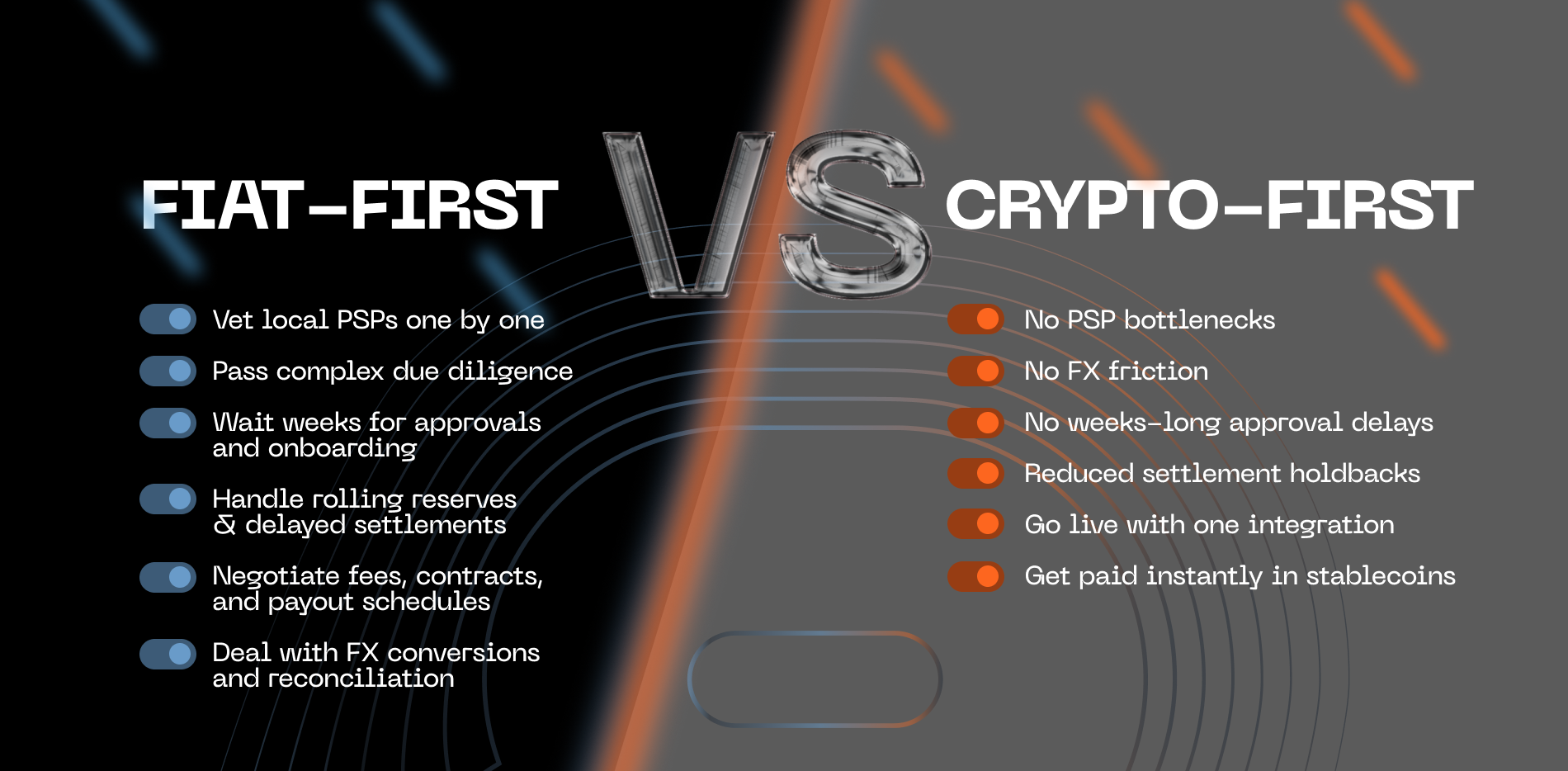
Launching iGaming brands in new geographies can take months, especially with traditional payment setups. You’re chasing local PSPs, waiting on approvals, negotiating terms, testing flows, and hoping settlement cycles won’t kill your margins.
At GR8 Tech, we practice a faster way. Crypto-first market entry, particularly stablecoins, has become our proven shortcut to quicker launches, lower costs, and minimizing reliance on third parties like PSPs. It’s how we help operators go live across various regions, including Asia and LATAM, often in less than two weeks.
It’s not a theory. It’s a playbook, and I’ll walk you through it.
How Crypto Fixes Expansion Bottlenecks
For many iGaming operators, entering a new geography is a waiting game. Waiting for PSPs to respond. Waiting for compliance reviews. Waiting for contracts, KYC approval, test transactions, and maybe even a few miracles along the way.
I’ve seen this play out too many times. That’s why we started doing things differently by helping operators launch with cryptocurrency payments first.
Why crypto first?
This strategy isn’t about using trendy technology for its own sake. It’s about avoiding unnecessary friction. Instead of building your entire fiat infrastructure upfront, a crypto-first entry lets you start fast, test fast, and scale based on actual performance.
Our clients often come to us with a common challenge: they want to explore a new market but are hesitant to invest a lot of time and resources into setting up payment processing. They want to know if the market is viable before locking in PSP contracts or hiring local teams.
Crypto payment gateway solves this. With one integration and a ready-to-go stablecoin setup, I’ve seen operators go live in weeks across Southeast Asia, Latin America, and beyond.
Want to go crypto-first? We provide a simple start and scale.
Explore our crypto rails
Why does crypto-first beat fiat-first?
Launching with fiat ties you to geography from day one. You’re dependent on local PSPs, legal requirements, and whatever banking timelines happen to apply. That usually means sequential expansion—launching one market at a time, repeating the same setup steps over and over.
A crypto-first approach doesn’t care where your users are. You can launch in five regions simultaneously, with one crypto gateway integration, and start collecting real-world performance data immediately. There are no settlement delays, no tiered fee structures to negotiate, and no last-minute changes from acquirers or banks.
The difference isn’t just operational; it’s strategic. With crypto payment solutions, you get a clearer picture of which markets deserve further investment, and which ones don’t.
How does crypto-first market entry work in practice?
Here’s what a typical rollout looks like at GR8 Tech:
- Prioritize markets. We help the operator shortlist regions where crypto usage is strong: places with active wallets, stablecoin familiarity, and fewer regulatory bottlenecks.
- Plug in a verified crypto PSP. Once you've chosen your markets, we can quickly activate a pre-integrated crypto payment processor from our reliable partners. There’s no need for any new integration or configuration processes.
- Go live. After conducting a few test transactions, the brand is launched. Players pay with crypto or stablecoins like USDT in various networks. Funds appear instantly and are ready for play.
- Let our payment gateway handle the rest. Behind the scenes, we take care of balance updates, exchange rates, fees, and reconciliations.
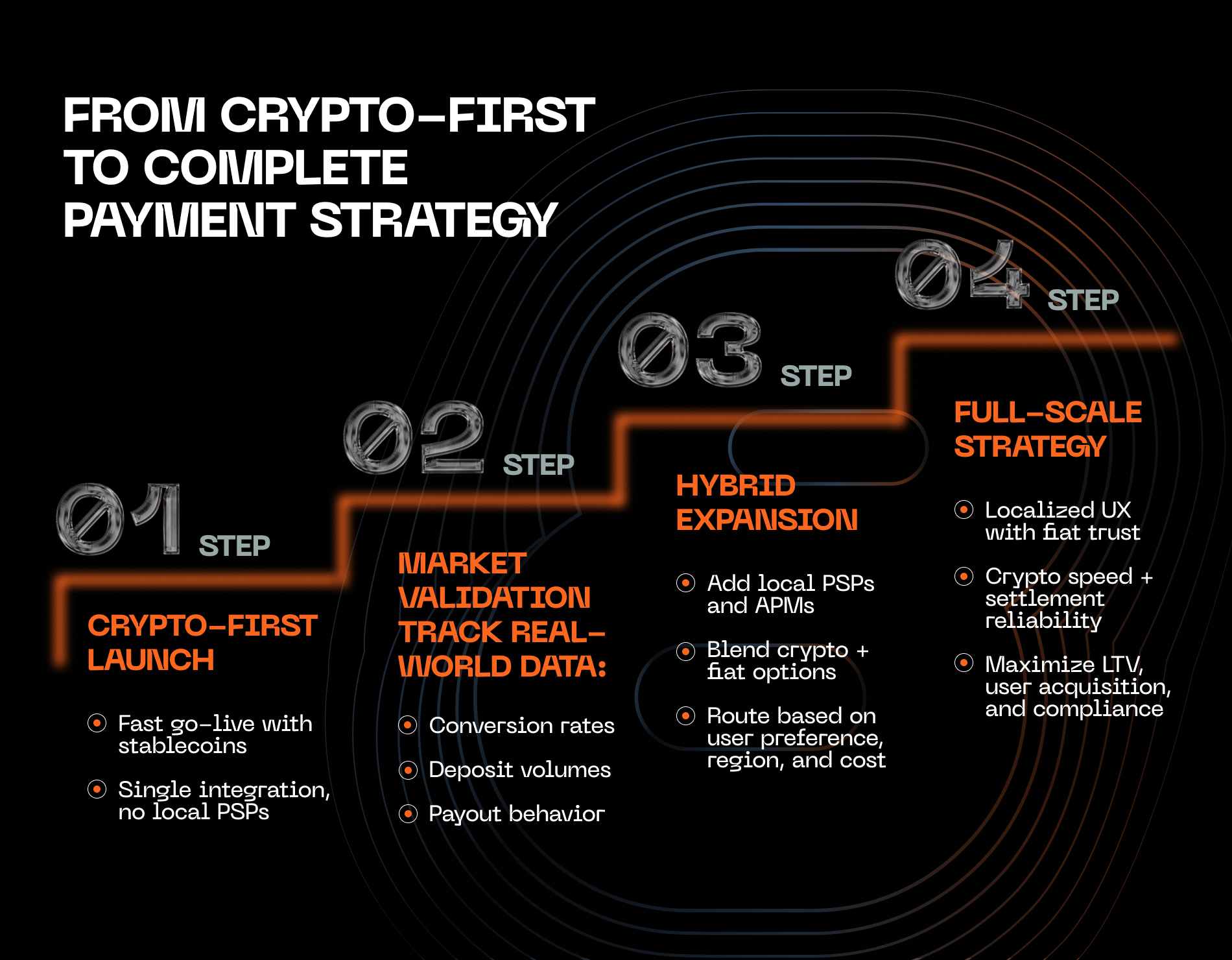
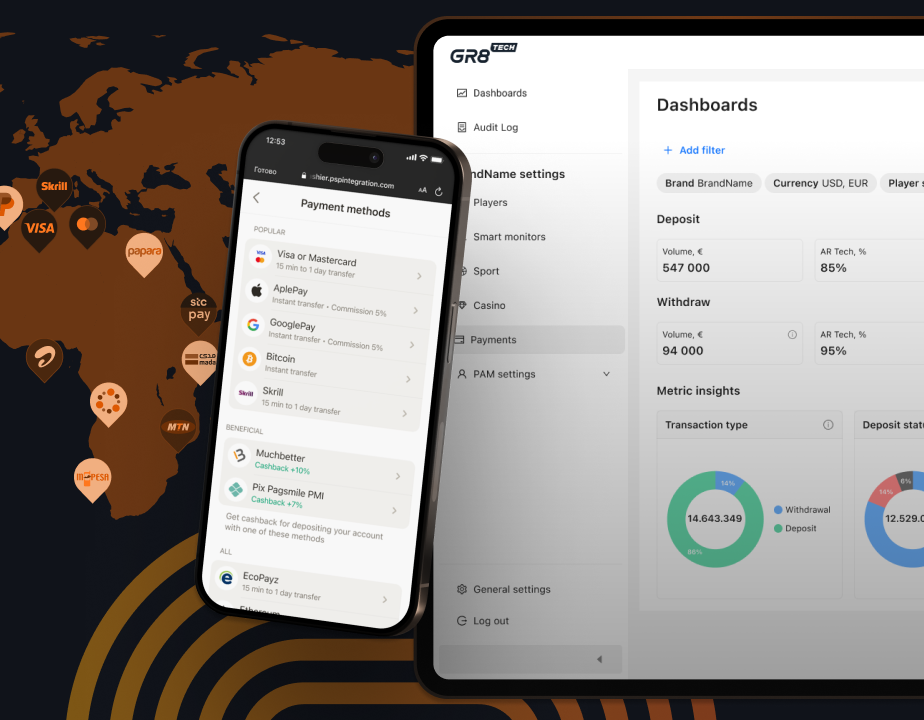
- Track and iterate. We monitor deposit volumes, conversion and acceptance rates, and payout behavior. If the market performs well, we layer in local PSPs to bring e-wallets, bank transfers, or local payment methods. If it underperforms, the operator can pull back with no long-term lock-in.
What comes after crypto?
If the test proves successful, we treat crypto as the foundation, not the finish line. Most operators evolve into a hybrid setup, keeping crypto and stablecoins for speed and coverage while adding local fiat options like card payments, bank transfers, or regional APMs to boost user acquisition, LTV, and regulatory trust.
GR8 Tech supports this evolution end-to-end. We handle new PSP integrations, configure routing logic, and ensure your users receive a seamless experience regardless of their payment choice. So when you’re ready to add complexity, it doesn’t feel like starting over—it feels like leveling up.
Common Concerns About Crypto
Crypto still raises eyebrows in some boardrooms, and that skepticism is fair. But let’s separate myth from reality.
“It’s just a trend.”
One concern I often hear is that crypto is a passing phase that could fizzle out like other tech fads. That would be easier to believe if the world's biggest companies weren’t already treating it as infrastructure. Stripe, Worldpay, PayPal, Mastercard, Visa, Shopify, and even JPMorgan Chase are actively integrating stablecoins into their operations. At the same time, central banks are piloting their own digital currencies. The technology isn’t going away. It’s being institutionalised.
“Adoption is still too low.”
Another common objection is that crypto adoption is too low to matter. But according to Chainalysis, crypto usage is growing fastest in parts of Central and Southeast Asia, Sub-Saharan Africa, and Latin America—the same regions where iGaming is booming. We’ve already helped operators launch in these markets using cryptocurrency payment solutions, sometimes even before local PSPs were available.
We proactively monitor crypto wallet penetration and on-chain activity in different geos to inform our clients’ expansion plans.
“What about volatility?”
This one’s valid. No iGaming operator wants to gamble with revenue, especially not in wildly fluctuating assets like Bitcoin or Ethereum. That’s why we rely on stablecoins.
Stablecoins: Crypto Without the Chaos
Stablecoins offer the best of both worlds: the speed, reach, and low costs of crypto without the volatility that makes BTC or ETH risky for operators.
The most widely used stablecoins, like USDT (Tether) and USDC (USD Coin), are pegged 1:1 to the US dollar. USDC is backed by fully reserved cash and short-term US Treasuries held in a regulated money market fund, with daily public reporting. Tether is backed by reserves that exceed its liabilities, with daily updates on tokens in circulation. This level of transparency and stability is why more fintechs are building around stablecoins than around any other digital asset class.
According to Visa, stablecoin transaction volume reached $2.2 trillion in Q1 2025, already rivaling the scale of legacy payment networks. It’s not just users who trust stablecoins. Infrastructure providers, PSPs, and platforms like ours now rely on them for real-world operations.
In practice, stablecoins make daily business tasks easier. Operators can:
- Hold player balances in a non-volatile asset
- Avoid currency conversion fees
- Settle payouts in minutes, not days
- Skip regional banking delays or freezes
Besides, stablecoins are available 24/7/365 with low transaction costs and near-instant transfers, while accessing actual USD through banks is often expensive and time-consuming, if it’s possible at all.
Based on our experience, most players prefer stablecoins for deposits and withdrawals. And when they don’t, operators can still accept crypto payments in BTC, ETH, or other tokens, converting them instantly to stablecoins behind the scenes to manage risk and simplify accounting.
This is how crypto becomes a reliable operational layer. For several of our clients, it has become their default setup, even in mature markets.
5 Cases When Starting With Crypto Makes the Most Sense
Crypto-first isn’t the answer to every market. But based on what I’ve seen, there are clear scenarios where this approach works best:
- When time is tight. You’re racing to launch before a major event or campaign, but fiat onboarding is crawling. Approvals, KYC, contracts, test flows—all of it takes too long. With a crypto payment gateway, you can skip the queue and go live in days.
- When fiat rails are missing or messy. Some regions simply lack reliable fiat rails, or the available PSPs are expensive, bureaucratic, or both. Crypto payment gateways give you access to the market without needing perfect local conditions.
- When you’re testing multiple markets. Rolling out five geos with five PSP stacks is slow and costly. A crypto-first approach lets you test them all at once through a single integration. You get data fast—and can double down on what works without overcommitting.
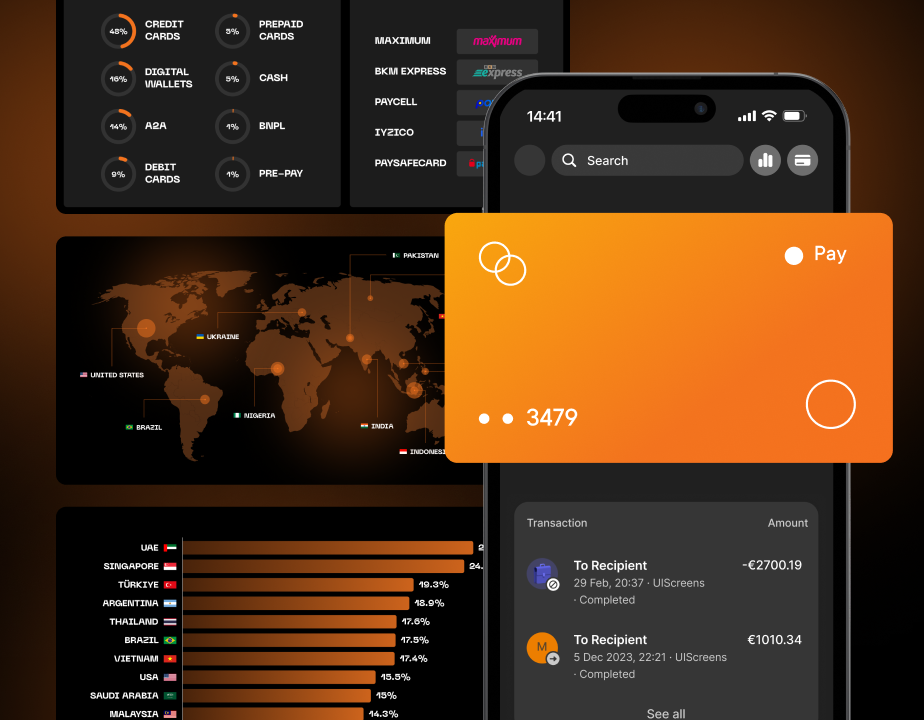
- When your audience already uses crypto. In markets such as Brazil, Indonesia, Nigeria, or the Philippines, cryptocurrency is already quite familiar. Players often prefer USDC or USDT payments because they're faster and more common than cards or bank transfers.
- When you want to stay lean. Market unproven? New brand concept? A cryptocurrency payment gateway helps you launch lean, validate quickly, and scale only if it works, with minimal cost and no sunk setup.
Crypto-first approach makes sense when speed, flexibility, and agility matter most.
The Best Time to Start Is Now
There’s never been a better moment to rethink how you enter new iGaming markets.
Crypto and stablecoins are no longer niche. They’re part of the global payments infrastructure used by players, supported by fintech giants, and adopted by a growing number of operators across emerging regions. Waiting for PSPs to catch up often means missing your window. Starting with crypto payments lets you move now and adapt as you grow.
With a crypto-first approach, you can unlock several advantages:
- Time to market shortens from months to weeks
- Lower upfront risk lets you test geographies before committing to full fiat setups
- Immediate global reach and more resilient operations are available to you through a single integration.
If you’re thinking about launching in a new region, this could be your fastest route to validation and revenue without the usual delay, overhead, or complexity. And when it comes to scaling, it can evolve into a complete, localized payment strategy.