Online casinos thrive on player engagement, but keeping that engagement alive takes more than flashy bonuses or occasional tournaments. Orchestrating a nonstop lineup of offers, campaigns, and seasonal pushes demands structure. Behind the scenes, operators have the promo calendar—a tool for planning, scheduling, and coordinating every promotional activity.
But if you want to understand what a promo calendar actually is, there might be some confusion—there are several types in iGaming. We’ll cover three of them: casino provider-driven, sportsbook event-driven, and casino CRM-driven. We also highlight the mechanics of building campaigns, the types of promotions that fill these calendars, and the metrics that show whether a campaign is working.
What Is a Promo Calendar?
A promotional calendar is a centralized schedule for all upcoming promotional campaigns. It serves as a planning hub where the marketing and CRM teams can organize promotions on a timeline, mapping out bonuses, tournaments, and special offers ahead of time.
The Three Promo Calendars
In this section, we describe three different types of promo calendars—casino provider, sportsbook, and CRM—each serving a unique purpose and focusing on a separate part of an online gambling business.
Casino Provider Promo Calendar
The provider promo calendar is anchored to external launches—new slots, jackpots, or network tournaments released by content game providers. Operators use it to align offers with these launches, turning fresh content into engagement drivers and ensuring players are aware of new titles as soon as they arrive.
What’s important is that the difference between a basic scheduling tool and a fully functional promotional platform can be substantial. It’s the provider’s responsibility to design workflows that actually support an operator’s business goals.
| Regular Promo Calendar Workflow | Advanced Promo Calendar Workflow |
| Operator decides to run a custom promo. | Operator decides to run a custom promo. |
| Operator sends request to the platform provider. | Operator contacts the content provider directly, defining terms. |
| Platform negotiates with the game/content provider. | Promo details are entered straight into the advanced calendar. |
| Platform relays provider’s confirmation back to the operator. | Calendar automatically handles financial settlement and compliance checks. |
| Operator schedules promo in calendar (often with delays). | Notifications, creative assets, and targeting are synced in real time. |
| Players eventually see the promotion go live. | Players see the promotion go live instantly, with no bottlenecks. |
| Insight: Every step passes through intermediaries, creating friction, slower turnaround, and less flexibility. | Insight: Direct operator–provider contact, with the calendar handling the heavy lifting, cuts out middlemen and makes campaigns faster, more accurate, and easier to scale. |
Some calendars introduce delays and intermediaries at every stage, while others enable direct, real-time orchestration.
Most B2B providers act as intermediaries when it comes to custom promos—operators pass their requests to the platform, the platform negotiates with the content provider, and then relays the outcome. What we do differently is allow direct contact between the operator and the provider.
Lusine Khudaverdyan, GR8 Tech’s Head of Casino BU
Well-structured calendars also help operators avoid clashes and overlaps since multiple providers may release titles in the same week. With a proper calendar, operators can prioritize which launches to feature, coordinate creative assets, and pre-schedule supporting CRM campaigns.
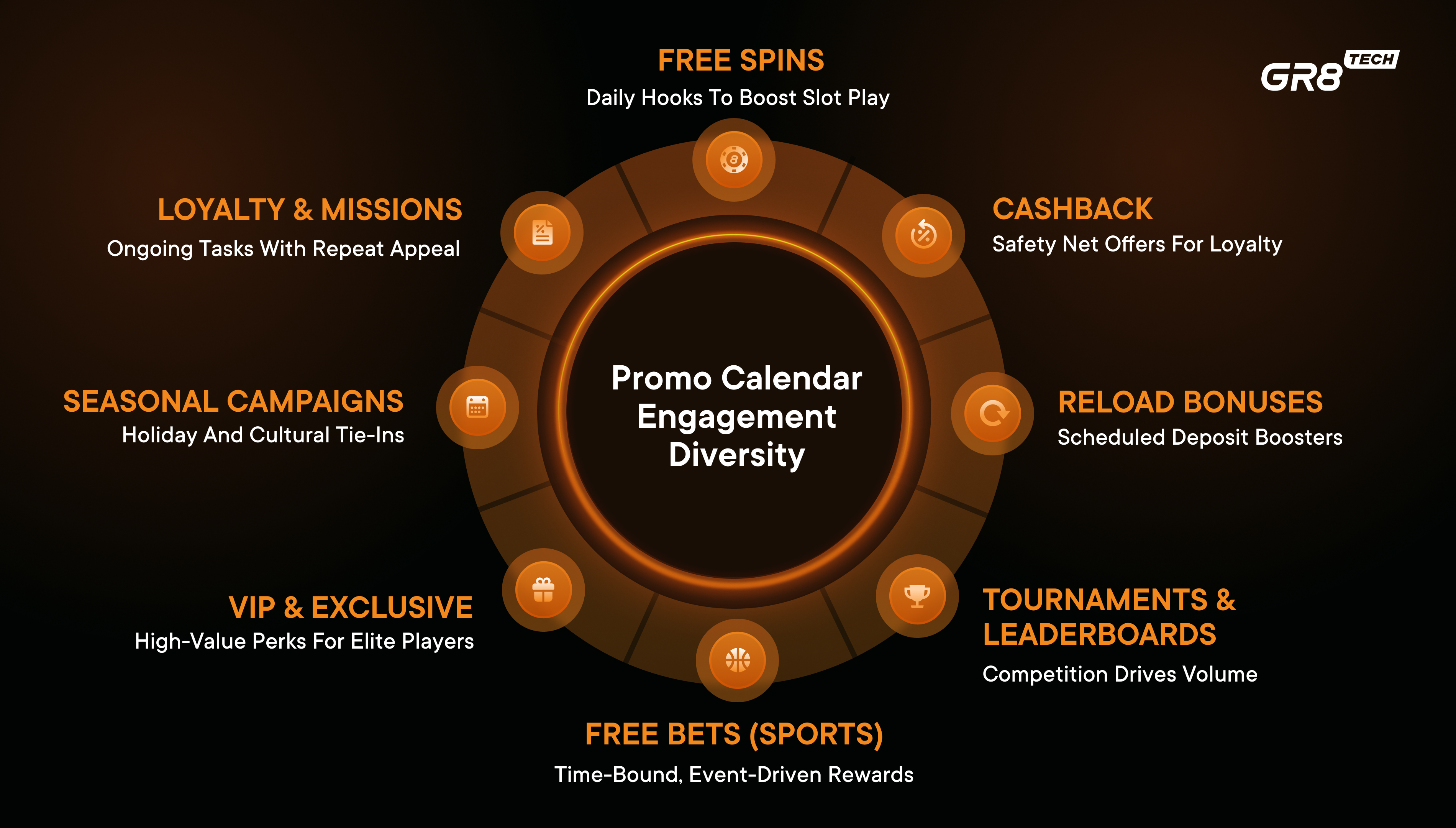
Typical promotion types linked to provider calendars include:
- Free Spins on New Releases: Bundled with game launches to drive traffic to fresh titles.
- Provider Tournaments: Network-wide competitions with pooled prize funds. The calendar ensures operators know when these are happening and can localize communication.
- Launch Bonuses: Temporary deposit matches or reloads tied specifically to new titles.
- Jackpot Highlights: Special campaigns around progressive jackpots reaching new thresholds.
Sportsbook Event Calendar
The sportsbook event calendar follows the sporting year. Major fixtures like Champions League matches, regional derbies, or international tournaments are mapped out, and bonuses or free bets are scheduled around them. These calendars give operators a way to synchronize campaigns with the moments when players are most attentive, often combining sports offers with cross-product promotions in the casino lobby.
In practice, sportsbook calendars are also regional tools: an operator in Europe may prioritize football, while another in India might focus on cricket. The calendar ensures that localized campaigns are visible to players ahead of time, with countdowns, opt-in options, and reminders built into the flow. This helps operators ride the peaks of sporting interest without creating operational chaos.
Common sportsbook promotions tied to this calendar include:
- Free Bets: Offered for placing qualifying wagers on specific matches.
- Odds Boosts: Enhanced payouts scheduled for high-profile fixtures.
- Accumulator Insurance: Refunds if one leg of a multi-bet fails, often timed for weekends or tournament rounds.
- Cross-Product Campaigns: Free bets combined with free spins or casino bonuses to link sports and casino play.
CRM Promo Calendar
The CRM promo calendar is fully operator-driven. It defines weekly bonuses, seasonal pushes, reload offers, or cashback. This calendar is less about reacting to outside events and more about creating consistency. It provides players with a predictable rhythm while giving operators a framework to test, measure, and refine their communication strategies.
The strength of a CRM calendar lies in balance: enough predictability for players to stay engaged, enough variation for operators to keep campaigns fresh and measurable.
Typical bonus types mapped into the CRM calendar include:
- Free Spins (FS): A core mechanic, often scheduled midweek to keep activity steady. They become reliable anchor points that players expect.
- Deposit Match / Reload Bonuses: Percentage-based or fixed reloads, often placed on weekends or payday cycles. In CRM calendars, they’re pre-scheduled and paired with reminders to maximize uptake.
- Cashback: Used after heavy activity periods (like Mondays following a weekend) or as small recurring “Friday cashback” touches to maintain engagement.
- Seasonal and Holiday Bonuses: Designed for events such as Christmas, New Year, or Black Friday. These often escalate in generosity over consecutive days (e.g., 90% → 200%) and temporarily increase cadence from twice a week to daily.
- Surprise Bonuses: Flexible, short-term offers (e.g., a midweek mystery card with either spins or cashback). They add unpredictability and allow operators to A/B test player preferences.
- Non-bonus Content Touchpoints: Not every entry in the calendar has to be a bonus. Operators sometimes schedule light-touch CRM activities, such as “game of the week,” “slot picks,” or even themed content like horoscopes, to keep communication diverse.
Promo Calendar Workflow
Whether it’s a provider calendar, a sportsbook event calendar, or a CRM-driven one, the workflow behind them is basically the same, but the offers themselves can look very different. For instance, a free bet tied to a Saturday derby, a slot tournament when a major provider releases a new game, or a reload bonus that’s part of a CRM journey. But underneath, the process runs through four major stages.
The first is setup. A team member in the back office or CRM creates the promotion entry, gives it a name, chooses the type, and adds a description. At the same time, the eligible audience is defined. It may be every player, only new sign-ups, or a VIP segment in a particular region.
Then comes scheduling. Start and end dates are entered so the campaign launches and closes at the right time, even across multiple time zones. In regulated markets, this stage typically involves approval from compliance before the campaign can go live.
The third stage is communication. Promotions are tied to assets and messages that reach players. An operator may schedule emails, push notifications, or in-app banners to trigger exactly when the offer begins, making the player experience feel consistent.
Finally, there is monitoring. Once the campaign is live, dashboards flare up with data, including participation, deposits, engagement, and other vital metrics (we’ll discuss these later in detail). If adjustments are needed, such as extending the campaign or increasing the prize pool, they can be made without disrupting the overall flow. The calendar view also gives operators a single overview of all campaigns, preventing overlaps and helping teams avoid cannibalizing one promotion with another.
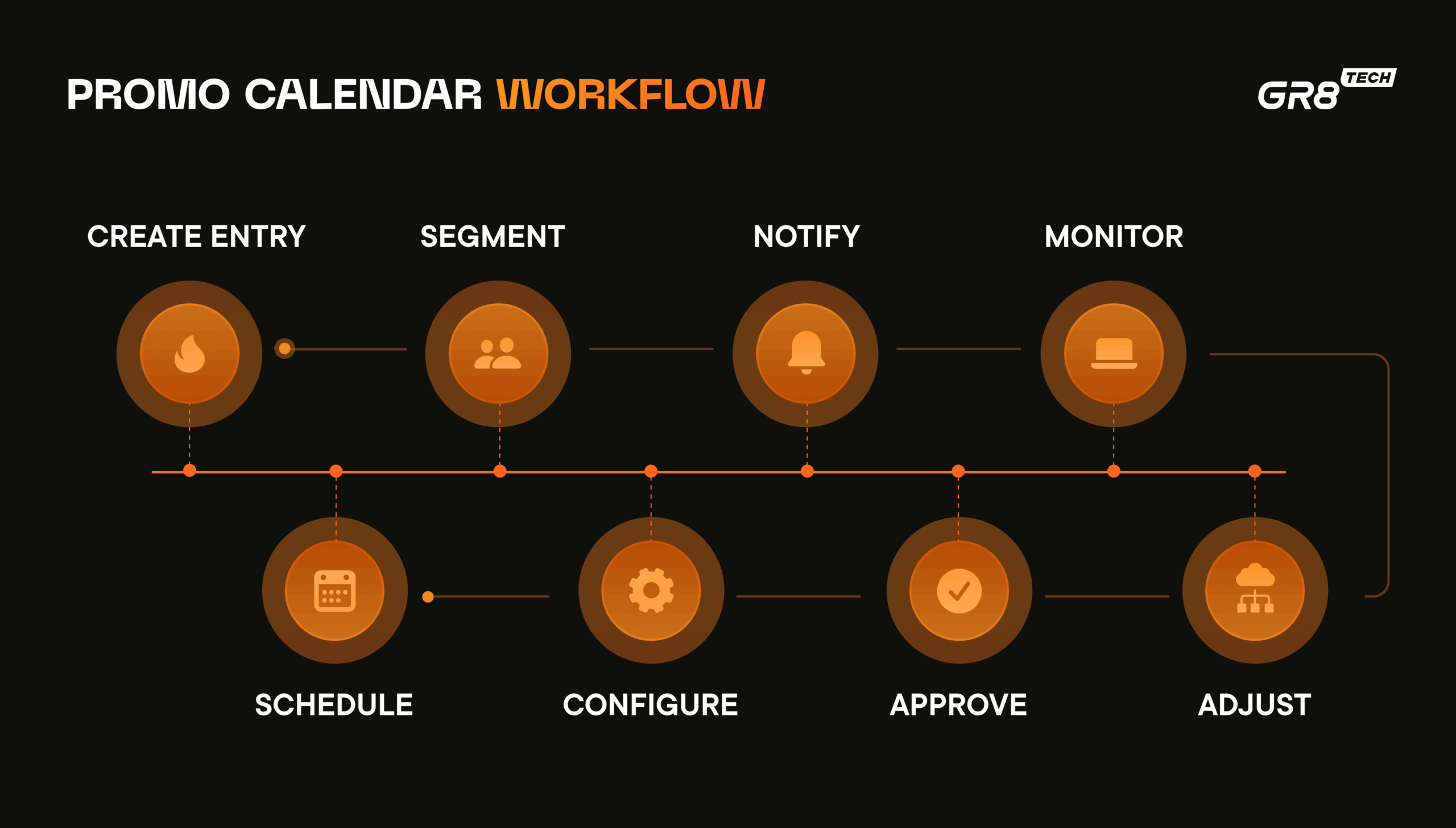
💡 Executive box: These four stages capture the core logic of any promo calendar, but the reality is that workflows differ depending on the campaign and the level of detail required. Some operators break the process down further, from creating the entry and segmenting the audience to configuring rules, securing approvals, and adjusting after launch.
Promo Calendars in Action: How It All Works
So far, we’ve looked at the structure of promo calendars and the common stages behind every campaign. To see how this works in practice, the next section walks through three scenarios — one for each type of calendar. Each example shows how the same logic is applied differently depending on whether the focus is a provider launch, a sportsbook event, or a CRM-driven engagement plan.
Scenario 1: Casino Calendar (The Slot Launch)
Launch day.
The new slot campaign begins with an announcement scheduled for the exact launch hour: “New Release! 50 Free Spins on Dragon Quest.” The calendar entry guarantees that banners, in-lobby tiles, and push notifications all appear simultaneously. For the player, it feels like the casino rolled out the red carpet the moment the game hit the lobby.
Midweek.
To sustain momentum, the calendar schedules a follow-up campaign a few days later: a reload bonus tied specifically to the new title. Players who enjoyed their first spins are nudged to return, with messaging timed to land during midweek lulls. The sequence is pre-planned, so design assets and segments are ready, and the operator can focus on tracking performance rather than scrambling to coordinate.
Weekend.
Heading into the weekend, the promotion escalates. A mini-tournament is scheduled around the same slot, with leaderboard updates and prize drops. The calendar orchestrates opt-in reminders, countdown timers, and automated prize distribution. To players, the game now feels like an event; to the operator, the campaign runs without manual intervention.
Follow-up.
After the event closes, the calendar shifts to analysis. Dashboards show how many players tried the game, how many deposited again, and whether the launch converted into ongoing play. This closes the loop and feeds back into planning for the next provider release.
💡 Executive box: A provider-driven casino calendar campaign turns a single game launch into a multi-stage event. By structuring the rollout (launch, midweek reload, weekend tournament, follow-up), operators maximize visibility and engagement while minimizing operational strain. Unlike CRM cadences, these campaigns are anchored to external content, making the promo calendar the bridge between providers and players.
Scenario 2: The Sportsbook Event Calendar
Build-up.
Sportsbook engagement rises and falls with the sporting calendar. An anchor point is a derby match or international final, and the promo calendar ensures operators are ready. Days before kickoff, players see the event listed under “Upcoming Promotions,” often paired with a countdown. Anticipation is built into the schedule.
Match day.
On the morning of the event, targeted messages go out: “Place three wagers on tonight’s match and unlock a free bet.” Because the campaign was scheduled weeks earlier, creative assets and segments are already aligned, freeing sportsbook teams to focus on odds and risk management.
In-play.
Once the match begins, the calendar triggers live promotions. For example: “Halftime boost — bet in the next 15 minutes for enhanced odds.” These promotions are prepared in advance but only fire when relevant, ensuring timing feels natural to the player.
Post-match.
After the final whistle, the calendar closes the loop. Winnings are credited automatically, and a follow-up message highlights both the event recap and upcoming fixtures. Operators immediately see engagement and turnover in their dashboards, helping shape the next week’s plan.
💡 Executive box: A sportsbook event calendar turns unpredictable match results into predictable engagement cycles. By mapping pre-match, in-play, and post-match promos in advance, operators reduce last-minute strain, localize offers to the fixtures that matter, and maximize betting activity.
Scenario 3: The CRM Promo Calendar
Planning.
Unlike provider or sportsbook calendars, the CRM promo calendar is driven entirely by the operator. At the start of each month, CRM managers map out the rhythm of engagement: midweek free spins, weekend reload bonuses, and seasonal pushes around holidays or market-specific events. This becomes the baseline schedule that players come to expect.
Execution.
Once the plan is set, content and design teams prepare assets, while CRM managers configure journeys across email, push, and SMS. The calendar provides a single source of truth, ensuring that communications don’t overlap and that each bonus has the right creative attached.
Delivery.
As the weeks unfold, the calendar ensures campaigns go out on schedule. A Wednesday free spins email is followed by a Friday evening reload notification; a seasonal event can be slotted in without disrupting the wider plan. Players don’t see the calendar itself, but they feel its rhythm through consistent and timely engagement.
Analysis.
On Monday mornings, the calendar shifts to analysis. Dashboards show how many players tried the game, how many deposited again, and whether the launch converted into ongoing play. In an advanced calendar, this report is broken down into concrete metrics, such as:
- Participation: number of unique players who engaged with the slot during the campaign.
- Offer Uptake: percentage of eligible players who claimed the free spins, reload bonus, or tournament entry.
- Deposit Conversion: how many players made a qualifying deposit tied to the campaign.
- Session Frequency: average number of plays per participant during the launch window.
- Revenue Uplift: incremental GGR compared to baseline weeks without a launch.
- Retention Curve: Day-7 and Day-30 activity among players acquired or reactivated by the campaign.
- Channel Effectiveness: open rates, click-throughs, and conversions from emails, push notifications, or in-app banners.
- Bonus Clearance: how many players completed wagering requirements and how much net revenue they generated.
The data feeds back into planning for the next provider release, allowing the operator to refine timing, offers, and communication strategy based on hard data rather than assumptions.
💡 Executive box: The CRM promo calendar is the operator’s control center for long-term engagement. It keeps promotions consistent, aligns internal teams, and links communication to measurable outcomes. Where provider and sportsbook calendars drive spikes, the CRM calendar maintains the heartbeat that sustains retention.
Metrics Across Three Types of Promo Calendars
A promo calendar not only organizes campaigns but also defines how their impact is measured. The core metrics (participation, deposits, engagement, retention, and others) are largely the same across provider, sportsbook, and CRM calendars. What changes is how those metrics apply: some matter more in the context of a game launch, others are most relevant during a sports event or within a CRM journey. The table below brings these indicators together, showing how operators track performance and compare results across different types of promotions.
| Metric | Provider Promo Calendar | Sportsbook Event Calendar | CRM Promo Calendar |
| Participation / Uptake | Number of players who try new games tied to provider launches; tournament entries. | Number of bettors wagering on promoted matches; free bet opt-ins. | Players in journey: number of users who entered the CRM campaign flow. |
| Offer Acceptance | % of players activating provider-driven offers (free spins, deposit match). | % of eligible bettors claiming free bets or boosted odds. | Offers accepted: % of players who clicked and claimed the CRM offer. |
| Deposit Conversion | Ratio of players depositing after provider campaigns. | Deposits made in connection with sporting event promos. | Deposit completed: % of recipients who deposited after claiming. |
| Activation Rate | N/A (provider offers are usually auto-credited). | N/A. | % activated: share of players who used the bonus after receiving. % dep-to: conversion from deposit to claim. |
| Bonus Clearance | N/A. | N/A. | Players with cleared bonus amount: number who completed wagering requirements. |
| Engagement Frequency | Sessions on new launches; tournament play per user. | Number of bets per promoted match; in-play bet activity. | Touchpoints per user: open rate, click rate, push/SMS engagement. |
| Delivery Metrics | Mostly on-site exposure. | Exposure via site/app plus notification sends. | Delivery stats: emails/SMS sent vs. delivered; opens, clicks, CTRs per channel. |
| Revenue / Uplift | Incremental GGR from provider-driven promos. | Incremental betting volume on event-linked campaigns. | Revenue uplift from CRM journeys vs. control groups. |
| Retention / Churn | Retention of players who engage with provider content (Day-7, Day-30). | Retention of bettors acquired during event campaigns. | Longer-term retention tied to CRM campaign cadence. |
| A/B Testing / Insights | Comparing provider offer formats (free spins vs. deposit match). | Testing promo mechanics (free bet vs. boosted odds). | Testing subject lines, bonus types, segmentation logic across campaigns. |
| Financial/ROI Linkage | Operators assess uplift against provider costs. | Event ROI measured as betting turnover vs. bonus spend. | In some cases, operators tie delivery and acceptance stats to ROI, traffic quality, and engagement profitability. |
The promo calendar provides reporting dashboards that tie these metrics to each campaign. For example, all data on issued bonuses and usage might be accessible through built-in reports, making it straightforward to compile a “promo calendar performance” report for the month. On such a dashboard, operators view a table or chart for each promotion, displaying its CTR, number of participants, gross revenue from those players, cost of bonuses, and ROI percentage.
Using these metrics, you can make informed decisions to double down on the types of promotions that show high engagement and ROI uplift or rework/drop those that underperform. The promo calendar thus becomes a data-driven cycle: plan → execute → measure → adjust. Over time, this leads to an optimized promotional strategy that aligns with player preferences and business goals, rather than relying on gut feeling or guesswork.
Closing the Loop
The three-calendar model shows why no single tool is enough. The casino calendar ensures operators capitalize on game launches and tournaments that capture immediate attention. The sportsbook calendar anchors promotions to the rhythm of sporting events, translating unpredictable match results into predictable engagement cycles. And the CRM calendar sustains the everyday cadence of offers and communication, ensuring players stay connected long after the excitement of a launch or match fades.
Together, these calendars create a complete system. They give operators foresight and flexibility, marketing teams a single source of truth, and executives the metrics needed to make data-based decisions. Promotions become less about guesswork and more about a disciplined cycle: plan, execute, measure, and refine.
The experience feels seamless for the player. It’s structured and scalable for the operator. And for the business as a whole, promo calendars become strategic levers for growth.
Online Casino Promotional Calendar: TL;DR
- Promo calendars are the backbone of iGaming promotions. They turn ad hoc offers into structured, measurable campaigns.
- There are three distinct calendars:
– Provider calendars align with game launches and tournaments.
– Sportsbook calendars sync promotions with the rhythm of sporting events.
– CRM calendars set the day-to-day cadence of player engagement.
- The workflow is consistent across all three. Every campaign moves through setup, scheduling, communication, and monitoring.
- Scenarios show the difference. A casino drip campaign builds habits, a sportsbook calendar turns match days into engagement cycles, and a CRM calendar sustains long-term retention.
- Metrics make it measurable. Participation, deposits, activation, and retention are tracked across calendars to show what works and what doesn’t.
- The payoff: calendars give operators foresight, reduce strain, and let executives make data-driven decisions. For players, it feels seamless. For businesses, it’s structured and scalable.