In Brazil, betting is evolving, and so are the regulatory standards. Since the first legalization step in 2018, rules have sharpened year after year. Today, we know the authorization path, the costs, taxes, and even how promotions must run. Yet many operators fail to catch up, lose their licenses, or choose to operate illegally.
Here, I outline the market dynamics and latest regulatory updates and explain how to gain a foothold in Brazil in 2026.
Why Brazil?
Because it’s massive! Brazil's population exceeds 212 million, making it the 7th most populous country globally and the largest country in Latin America, both by territory and population. Around 90% of Brazilians reside in urban areas. The IMF anticipates that Brazil's GDP will rank 10th worldwide by 2027. Notably, the middle class in Brazil is expanding. Now, it comprises 50.1% of the population, according to a study by Tendências.
Following an economic downturn in 2015 and 2016, Brazil was on a slow path to recovery, which was further hindered by the pandemic and a skyrocketing inflation rate of up to 12%. The post-pandemic rebound has put Brazil back on a growth track. Unemployment now stands at 5.2% (5.64 million people), while the government works to stabilize annual inflation at around 5% and hold interest rates at 15%.
Despite the increasing number of elderly in Brazil, a significant portion of this demographic group remains economically active. 25% of those over 50 participate in economic activities, generating more than BRL 3 trillion.
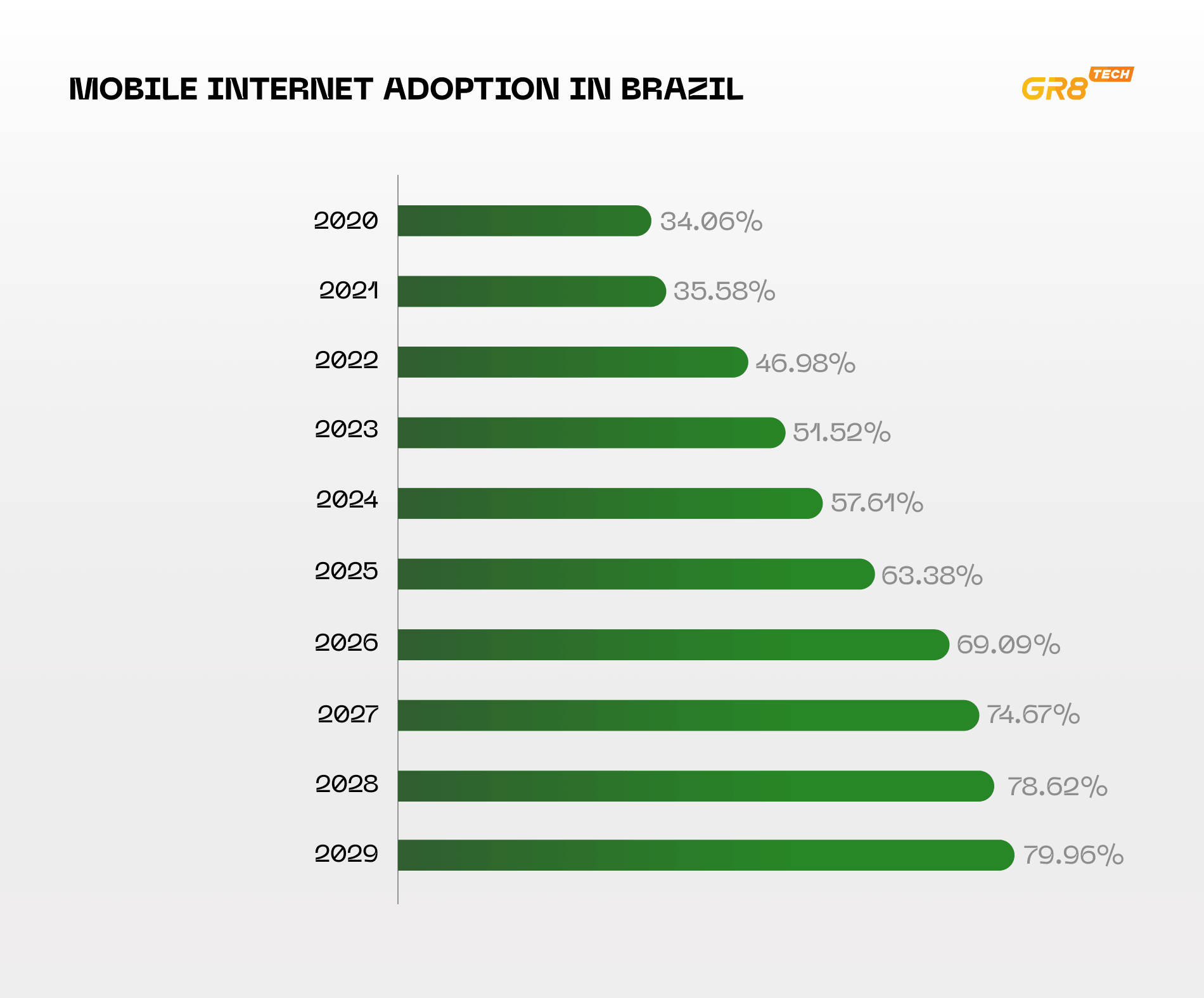
Moreover, Brazil boasts a high level of mobile internet penetration, reaching 86.2% in 2026 and encompassing over 161 million active online users.
Gambling Culture in Brazil
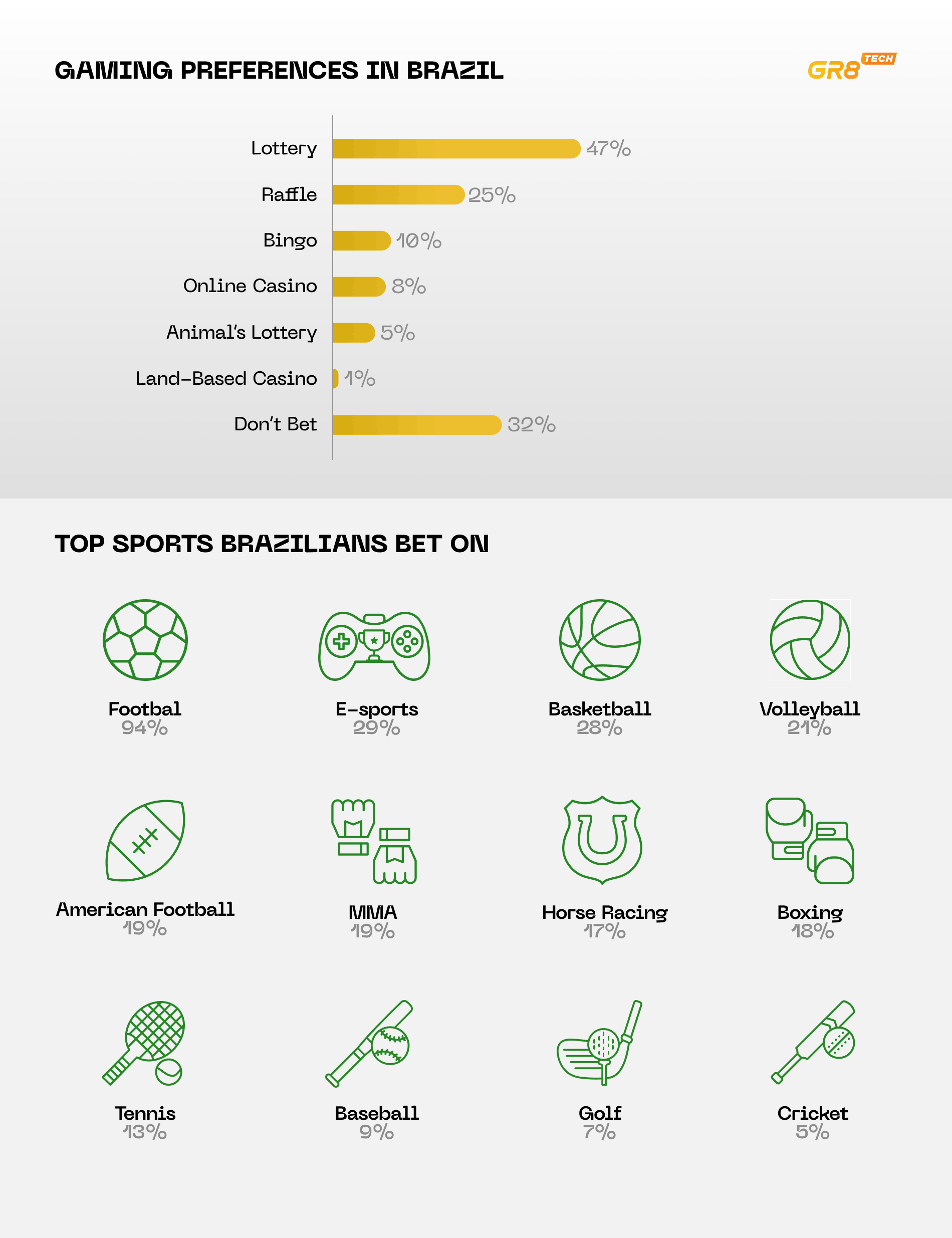
Brazil lives and breathes sports, with football, volleyball, and basketball topping the list. This passion doesn’t stop at the sidelines. It sparks curiosity around sports betting. With millions of fans hungry for action, every match, tournament, or championship becomes an engagement driver in the operator’s hands.
An interesting non-tech trend is happening right now. Together with classic sports, the NFL is catching on. As Brazilians get more into the NFL, betting operators can use it to retain profits during a seasonal drop in December.
Brazilians are interested in local sports leagues and major international events like the FIFA World Cup, Olympic Games, and UEFA Champions League. Their enthusiasm creates year-round opportunities for betting brands.
But what also matters, along with the high population, growing economy, regulatory shifts (more on that later), and love for sports, is the cultural acceptance of gambling and betting.
Lotteries, roulette, poker, and sports betting—Brazil treats these gambling activities as part of its culture. This creates favorable market conditions for new iGaming platforms.
Source: Hibou and ENV.MEDIA
iGaming Market Overview
According to Statista, the Brazilian gambling market grows 6.54% annually and is projected to surpass USD 9.04 billion by 2029. The M&A firm attributes this to the market’s increasing popularity, technological advancements, and the entry of big international companies.
Experts think Brazil will become one of the biggest global online sports betting markets due to the increasing number of betting platforms. In 2022 alone, Brazil had 3.2 billion accesses to iGaming sites, even though the market didn’t have solid regulations yet.
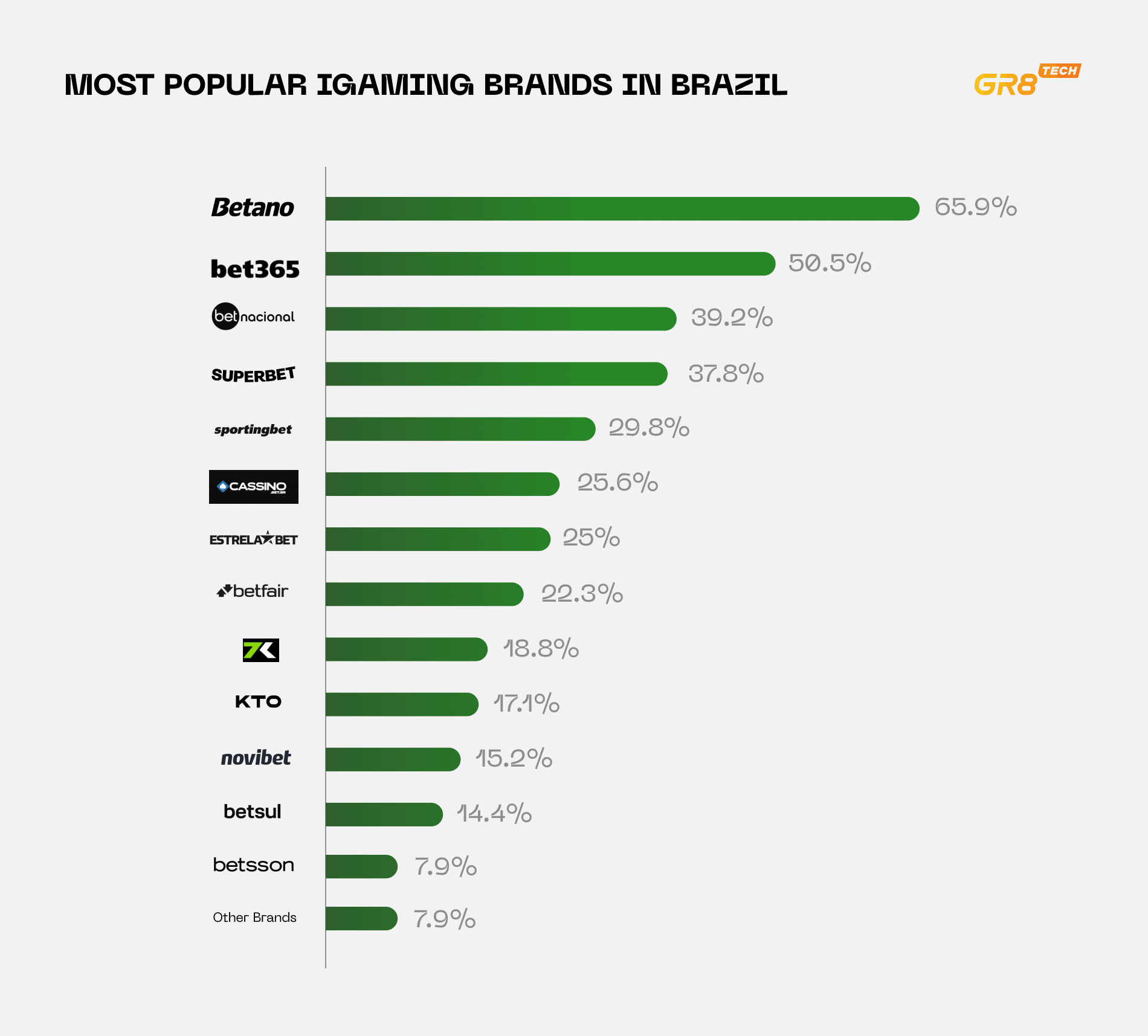
As of 2026, Brazil counts 78 licensed operators running 138 brands. Among them, 13 stand out as the most recognized and trusted by Brazilian bettors.
Brazilian Bettors Demographics
The typical gambler profile in Brazil consists of adult men from the upper-middle class with foundational education levels. About 60% of these guys are single and primarily reside in the Southeast and Northeast regions, making up 68% of the market.
Of these individuals, 84% are male, 39% are heads of household, 57% are single, 21% are married, and 11% have an academic degree.
While there are frequent users, many place wagers 1–2 times per week or about 2 times per month. Besides, they are not comfortable placing large bets at once.
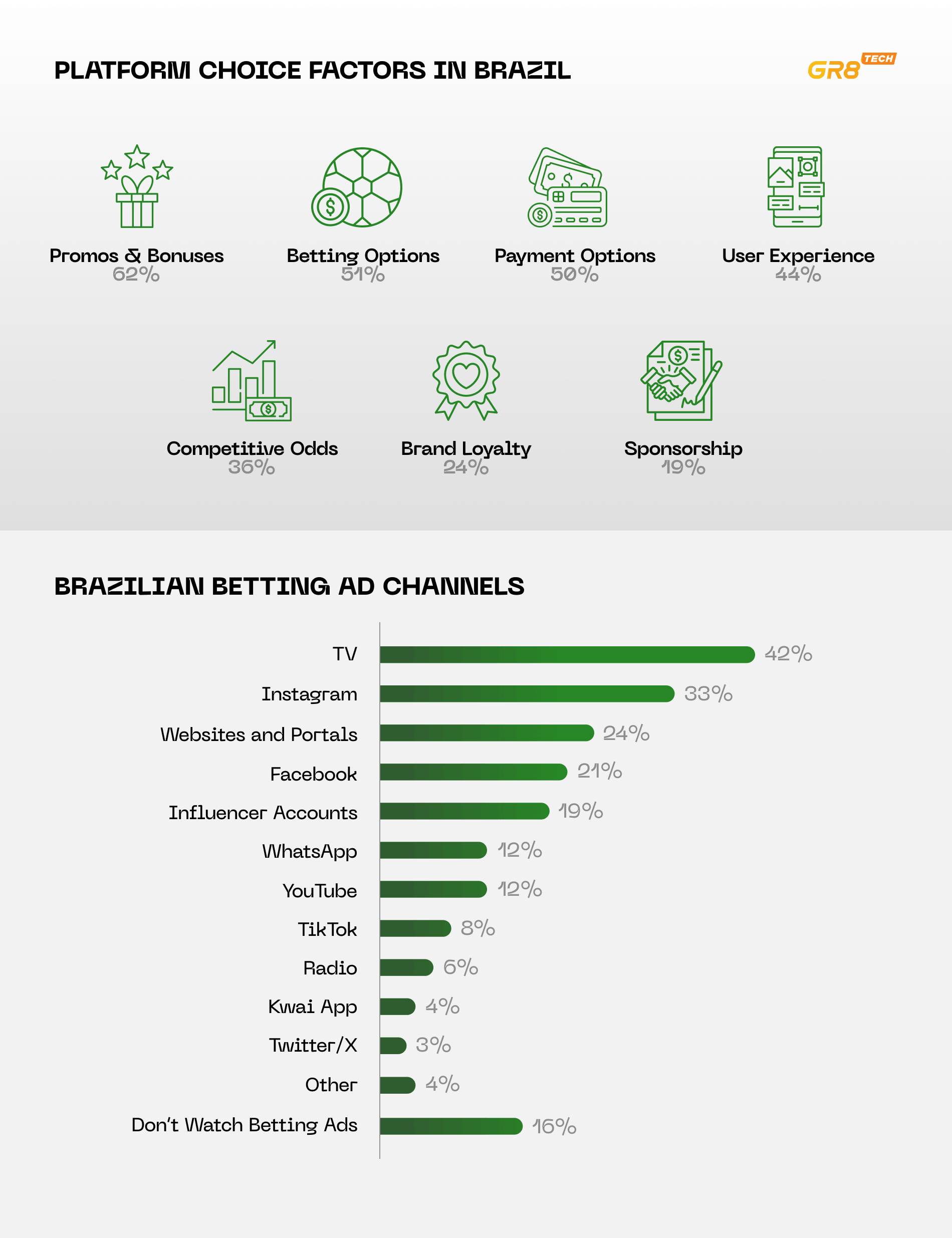
This target group relies on recommendations from their friends, social media, and TV when choosing an iGaming platform or a betting analytics source. They also compare bonuses, payment options, and user experience.
Latin America is second after Africa in terms of motivations for betting. Within Latin America, Brazil is among the countries where the primary reason for placing bets is the desire to win money. However, it is worth noting that a significant percentage of Brazilian bettors seek fun, the competition spirit, and extra excitement.
While casino games deliver instant fun and engagement, sports betting is treated as a skill-based entertainment that demands research, analysis, and strategy. Surveys show nearly half of Brazilian bettors call themselves intermediate, while 23% consider themselves advanced or professional. That confidence impacts behavior: 44% spend 30–60 minutes researching before placing a bet. For operators, the signal is clear: Brazilians crave expertise. It means platforms that deliver insights and tips won’t just attract players. They will fuel retention and engagement.
SOLUTION TO MEET BRAZILIANS' SPORTS BETTING APPETITE
TEST ULTIM8
Thorny Path to Brazilian Betting Regulation
Brazil’s gambling story abounds in twists. In 1934, President Getúlio Vargas legalized casinos, sparking the Golden Age of Brazilian gaming. Venues like Copacabana Palace Casino and Cassino da Urca didn’t just offer roulette and blackjack. They became cultural hubs where Frank Sinatra, Carmen Miranda, and even Albert Einstein mingled. But the celebration ended in 1946, when President Dutra signed Decree-Law No. 9,215, banning casinos nationwide.
The debate never stopped. For decades, regulation attempts failed until momentum returned in the 21st century. In 2018, Law No. 13,756 issued by the Bolsonaro government opened the door for fixed-odds betting. It also appointed the Secretariat for Prizes and Betting, within the Ministry of Finance (SPA/MF), as the official regulator.
Then, in 2023, President Luiz Inácio Lula da Silva ratified Law No. 14,790, establishing a fully-fledged framework for casino, sports betting, and lottery, as well as taxation, compliance, and operational rules.
Today, Brazil’s market is not just back. It’s modernized, way more structured, and ready for ambitious operators who want to play by the rules. According to the international consultancy Regulus Partners, the region has a high chance of becoming the fifth-largest market in the world for the iGaming sector. Yes, some aspects, like crypto transactions or more stringent control measures, still need adoption, but it seems it’s only a matter of time.
| Legislative Act | What It Covers | Key Regulatory Updates |
| Provisional Measure No. 168/2004 | Prohibition of bingo halls and electronic gaming machines | - Suspends all bingo authorizations in Brazil (Art. 1)
- Prohibits bingo, video-bingo, and slot machine operation (Art. 2)
|
| Law No. 13,756/2018 | Introduction of fixed-odds sports betting as a lottery modality | - Legalizes fixed-odds betting (“apostas de quota fixa”)
- Appoints the Secretariat for Prizes and Betting (SPA/MF) as a regulator
- Empowers each state and a federal district to operate and regulate its own lottery (Art. 35-A)
|
| Law No. 14,790/2023 | Comprehensive framework for sports betting, online casino, and fantasy sports | - Defines fixed-odds betting (Art. 2)
- Specifies licensing requirements (Art. 7)
- Obliges operators to allocate 12% GGR tax to public institutions (Art. 29)
- Introduces compliance, AML, and responsible gaming rules
- Provides fines and sanctions for failing to comply with fiscal/legal obligations (Art. 41)
- Defines fantasy sports games and exempts them from licensing (Art. 49)
- Sets monthly supervision fee amounts for operators (Annex)
|
| Ordinance SPA/MF No. 615/2024 | Prize payment regulations for operators and bettors | - Obliges operators to use financial institutions authorized by the Central Bank of Brazil
- Permits payment by PIX and TED (but no foreign wallets), as well as debit cards and book transfers
- Prohibits payments by cash, payment slips, checks, crypto assets, and credit cards (Art. 3)
- Sets strict KYC/AML in payments
|
| Ordinance SPA/MF No. 722/2024 | Technical and security requirements for betting systems | - Obliges operators to comply with LGPD (data protection law) and keep logs for at least 5 years
- Specifies that transaction logs, bettor data, GGR, tax details, and legal funds through must be provided through the SIGAP system
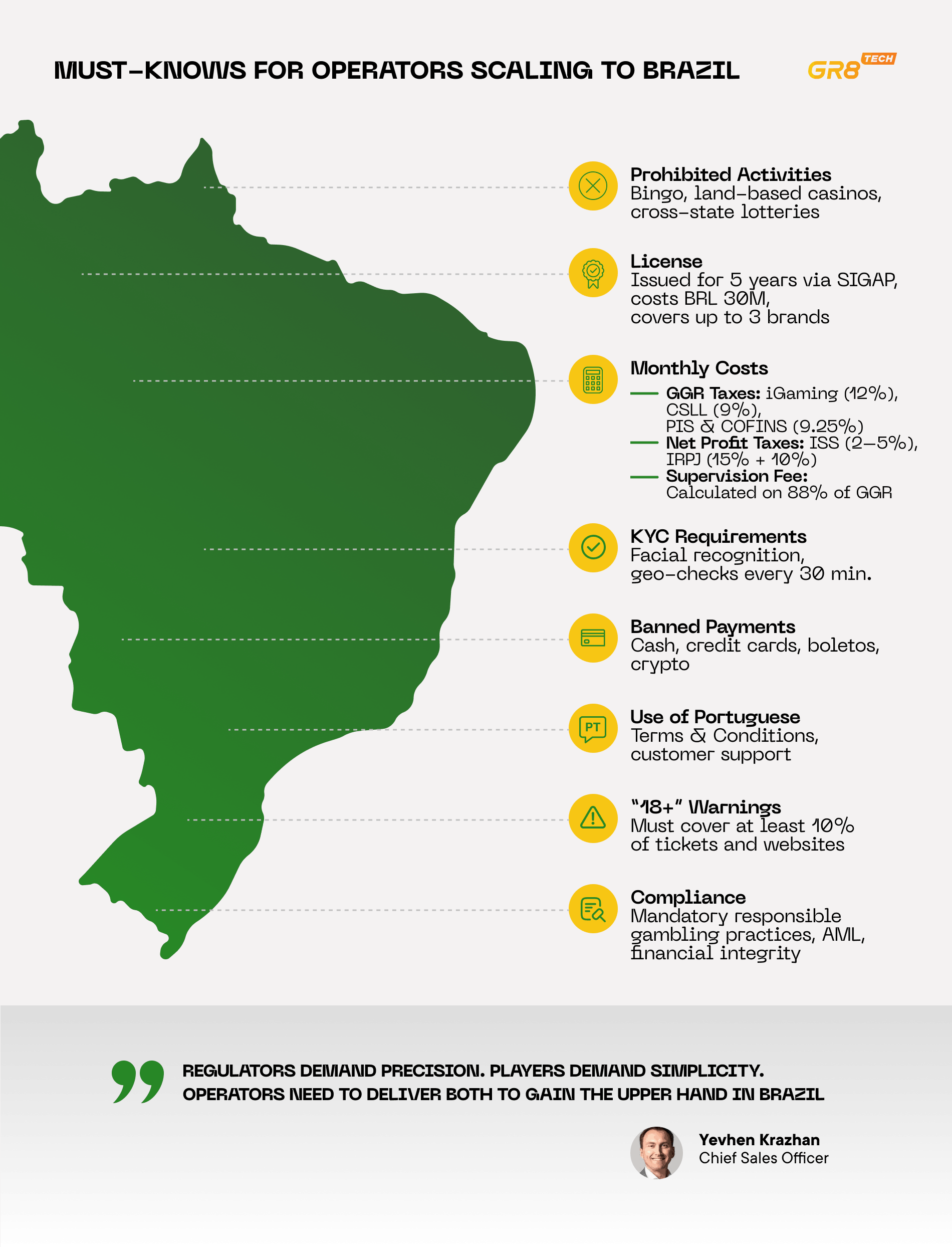
- Introduces mandatory facial recognition for identity verification, “one account per bettor” rule, and geolocation checks every 30 minutes
|
| Ordinance SPA/MF No. 827/2024 | Licensing procedure for betting operators | - Defines application requirements and procedures for authorization via the SIGAP system
- Specifies the requirements for capitalization, local presence, and tech/security standards
- Sets documentation, review process, and terms
|
| Ordinance SPA/MF No. 1,207/2024 | Technical requirements for online casino games and live game studios | - Defines requirements for testing labs and certification
- Introduces mandatory system audit for RNGs, payment gateways, and betting markets
- Excludes skill-based games, fantasy sports, multiplayer games, and peer-to-peer (P2P) betting games from the category “fixed-odds betting” (Art. 3)
|
| Ordinance SPA/MF No. 1,231/2024 | Responsible gaming, advertising, and bettors’ rights | - Sets advertising rules and mandatory warning signs (“18+”, “gambling risk”)
- Defines bettors’ rights and duties
- Introduces a betting exchange (“bolsa de apostas”) and specifies its rules (Art. 49)
- Makes betting operators jointly liable for communication, advertising, publicity, and marketing actions carried out by their affiliates (Art. 21)
|
| Ordinance SPA/MF No. 1,902/2024 | Market monitoring and integrity | - Obliges operators to report suspicious betting to SPA/MF via the SIGAP system
- Introduces thresholds for reporting anomalies in secondary markets
- Expands data-sharing with sports bodies
|
| Ordinance SPA/MF No. 817/2025 | Operational compliance, reporting standards, and strategic initiatives | - Requires operators to maintain data accessibility for SPA/MF in real time
- Expands obligations on fraud prevention
|
| Provisional Measure No. 1,303/2025 | Emergency update to strengthen enforcement and penalties | - Expands sanctioning powers against illegal operators
- Criminalizes the advertising of unauthorized betting
- Obliges operators to pay prizes within 120 minutes after event closure
- Requires mandatory tools for deposit limits, self-exclusion, pauses, and alerts
|
Operational Hurdles in Today’s Market
Brazil’s gambling laws are becoming sharper but remain complicated. From my experience, eight major pitfalls keep operators from staying compliant. I call them the “8 Brazilian Traps,” or, let’s better say, “8 Ciladas Brasileiras.”
#1. Not Every iGaming Activity is Legal
In Brazil, sports betting, both online and offline, requires licensing, and so do betting exchanges (P2P betting), online casinos, and lotteries. Fantasy sports are not prohibited and don’t need SPA/MF approval. But bingo, land-based casinos, and cross-border lotteries remain banned.
#2. Licensing: SIGAP and Obligatory Tech Reports
In Brazil, operators must obtain a license to offer the permitted iGaming products. Until January 2025, gaps in the authorization framework left room for interpretation. However, that changed with Ordinance No. 827, which closed those loopholes but brought new compliance challenges for operators.
Here’s how the licensing path looks today:
- Choose the type of betting activity and make sure it falls under the permitted categories;
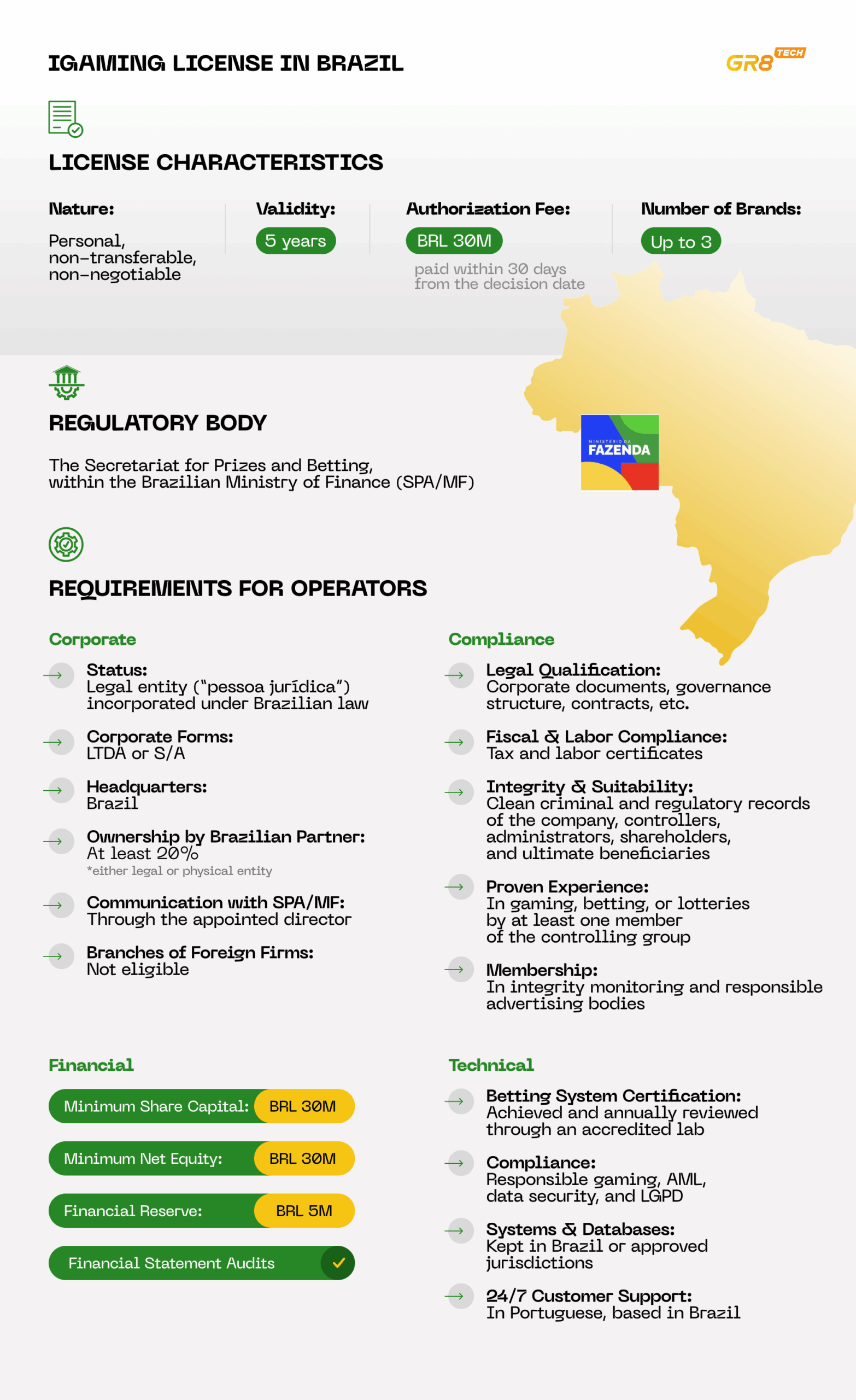
- Confirm corporate eligibility by establishing a Brazilian legal entity (LTDA/S.A.) with headquarters in Brazil and at least 20% Brazilian ownership;
- Prepare documentation aligned with the latest SPA/MF requirements (corporate, technical, compliance, and financial);
- Obtain an e-CNPJ (i.e., an e-signature/company’s digital certificate for filings);
- Submit the license application to SPA/MF through the SIGAP system, following the guide;
- Monitor the evaluation process (it takes up to 150 days) and respond to SPA/MF requests promptly;
- Pay the license fee of BRL 30 million after approval within 30 days;
- Wait for official publication in the Diário Oficial da União;
- Go live on “bet.br” (i.e., it’s allowed to operate exclusively under a “bet.br” domain);
- Submit technical certification reports within 90 days of authorization.
Legal Basis: Ordinance No. 827
Fraudulent or insufficient documentation, licensing breaches, bankruptcy, and annulment in the public interest trigger harsh consequences: warnings, heavy fines (0.1–20% of GGR), or even license revocation.
#3. Taxes Don’t Stop at 12%
By Law No. 13,756, operators must allocate 12% of GGR to public purposes every month. The remaining 88% becomes the base for the monthly supervision fee that must be paid by the 10th of the following month.
| Value Range | Monthly Supervision Fee |
| Up to BRL 30.837.749,76 | BRL 54.419,56 |
| From BRL 30.837.749,77 to BRL 51.396.249,60 | BRL 90.699,26 |
| From BRL 51.396.249,61 to BRL 85.660.416,00 | BRL 151.165,44 |
| From BRL 85.660.416,01 to BRL 142.767.360,00 | BRL 251.942,40 |
| From BRL 142.767.360,01 to BRL 237.945.600,00 | BRL 419.904,00 |
| From BRL 237.945.600,01 to BRL 396.576.000,00 | BRL 699.840,00 |
| From BRL 396.576.000,01 to BRL 660.960.000,00 | BRL 1.166.400,00 |
Legal Basis: Law No. 14,790
Besides, there is an income tax on players’ winnings. It does not directly reduce operator revenue but adds compliance responsibility. The rule is as follows: net prizes (“prêmios líquidos”) obtained from fixed-odds betting and fantasy sports are subject to a 15% annual income tax (IRPF).
On top of that, operators face corporate taxes. These include CSLL at 9% and COFINS & PIS at 9.25%, which are calculated on GGR.
Municipal ISS tax ranges from 2% to 5%, depending on the state the company is registered in, while IRPJ reaches 15% (with a 10% extra charge on profits above BRL 20,000). Both taxes are applied to net profit.
#4. KYC, Encryption, and Other Tech Intricacies
In my opinion, success in Brazil requires a balance between tech compliance and intuitive user experience.
Ordinance No. 722 stipulates that betting systems must be time-synchronized, maintain five-year data storage, and undergo geolocation checks every 30 minutes. Account statements must remain accessible for 36 months, and all financial flows must move through registered bank accounts. On the operational side, redundancy, firewalls, penetration testing, encryption, and detailed logs are non-negotiable.
But regulation only sets the baseline. Operators must deliver mobile-first experiences and anticipate tech-level user demands to stay competitive in Brazil.
Sportsbooks, for instance, need diverse betting options, as Brazilians already know single bets, parlays, and live betting, actively track odds, and use money lines and handicaps. They also expect early cash-out functionality, relevant stats widgets, tutorials, and clear user journeys.
Casinos face their own specifics. Brazilian bettors want fairness and transparency, so every slot, live dealer, or virtual sports game must run on a certified RNG that passes statistical randomness tests.
Cross-product functionality embraces simple KYC with mandatory facial recognition, smooth onboarding, legal payment gateways (PIX, TED, debit cards, or book transfers), a bonus-driven CRM system, and robust risk tools. Today, no iGaming solution can scale in Brazil without AI, which strengthens bet creation, content personalization, churn prediction, and risk management.
#5. Crypto Payments: To Add or Not to Add?
Research by Instituto Locomotiva shows that 28% of Brazilian bettors have used crypto assets at least once to deposit on platforms. Crypto transactions are hugely popular in Brazil due to national currency fluctuations, and many operators are tempted to enable them. But that’s a severe mistake. Crypto payments in betting are strictly prohibited by law.
Art. 3 of Ordinance No. 615 makes it crystal clear: all bets must go through PIX, TED, debit cards, or book transfers. Cash, credit cards, boletos, crypto assets, and intermediaries unapproved by the Central Bank of Brazil are banned. Deposits and withdrawals must only pass through bank accounts registered in the bettor’s name, and no transfers between players are allowed.
Consider this when choosing a payment service provider for your platform, and partner with trusted Brazilian services and banks (e.g., Nubank, Itaú, Bradesco, Santander, Caixa, Mercado Pago, PagSeguro, Inter, or PicPay).
#6. Spanish Portuguese Localization
I see too many operators entering Brazil who underestimate localization. Some still rely on “Google Translate Portuguese” or, worse, confuse Portuguese with Spanish. That’s a quick way to lose trust. With over 205 million Portuguese speakers, localization isn’t optional. It’s vital.
The law backs this up. Art. 28 of Ordinance No. 1,231 requires all terms and conditions to be presented in Brazilian Portuguese, while Art. 22 makes the same rule for affiliate contracts. In addition, Art. 12 of Ordinance No. 827 mandates 24/7 customer support in Portuguese, run locally.
Once, a European operator put a sombrero on Ronaldinho as part of their marketing campaign. Such an approach doesn’t compare to the real impact brands achieve when they invest in proper localization and connect with Brazilian players on their own terms.
#7. Labeling and Marketing
In Brazil, communication noncompliance can cost operators more than missed conversions. It can cost the license itself.
By law, every communication or ad must include clear warnings: “18+” and a reminder of gambling risks, spoken or written. These disclaimers must appear everywhere, from printed tickets to website homepages, and cover at least 10% of the space.
But compliance doesn’t stop there. Ordinance No. 1,231 bans campaigns that glamorize betting, promise quick wealth, or use celebrities to link gambling with success or financial state improvement.
Affiliates and partners are no exception. Operators remain liable for their mistakes. Sponsorships also face tight limits: only licensed operators may advertise through a national sports team or events with national visibility. Besides, no promotions can take place at the events targeting the young audience and in places that provide medical care or education.
#8. Responsible Gambling Updates
Yes, fixed-odds betting is taking off in Brazil, but it’s also fueling heated debates about consumer protection.
A report by the National Consumer Secretariat of Brazil states that even families receiving the “Bolsa Família” allowance transferred billions to betting platforms. No wonder this pushed regulatory bodies to tighten controls.
Responsible gambling rules, AML compliance, and financial integrity are non-negotiable today. Operators must provide deposit limits, self-exclusion, pauses, and alerts, and suspend high-risk accounts if needed. RTP transparency is mandatory for every online game, while ads must display clear “18+” warnings. Affiliates and sponsorships also face strict oversight, as SPA/MF has gotten the power to block illegal ads.
Besides, 8 out of 10 Brazilian bettors still struggle to tell whether a betting platform is legal. Authorities have already shut down over 11,000 illegal sites, but new platforms continue to mislead users. To fight back, the Institute for Responsible Gaming launched BetAlert, a website where players can check if a bookmaker holds a federal license.
This is just the beginning, and we are about to spot many more such updates in the not-too-distant future.
Closing Thoughts
We see how Brazil is opening its doors wider to iGaming, but the road ahead is still full of obstacles. In April, regulators outlined their 2026 strategy update: a National Betting System, stronger control, better support, and a sharper licensing process.
For operators, this pairs opportunities with challenges. To stay afloat in such conditions, I recommend partnering with platform providers who track every market shift and constantly update their products. That’s a surefire way to minimize risks and turn Brazil’s growing market into a stable profit source.





































Have you researched any of the operators serving the Brazil market? If so what are your thought on Meridian bet and golden matrix group? they release a new AI enable platform in October 2024 that I believe all built in house and is driven by keeping up with the growing regulations around the world Brazil included. They are one of the legal operators holding a license currently.
As of October 2025, around 80 licensed operators are active in Brazil. You can find the full list here. Golden Matrix is indeed one of them, registered locally as MERIDIAN GAMING BRASIL SPE LTDA, operating the Meridian and Pin brands under a license valid through December 2029. The company reported strong results in Q2 2025, with $29.2 million in revenue and a growing player base in Brazil. Since October 2024, they have had AI Bet Recommender as a good example of how to implement new tech in operations.