Non-sports betting is becoming a strategic engagement lever for operators looking beyond traditional live sports calendars. In LATAM and Asia, demand is rising not just for political or award show bets but also for football specials, sack races, and individual achievements, and other markets fueled by media hype rather than match results.
Here, I share my opinion on whether non-sport bets are a one-off trend or a sustainable, high-margin category and explain how casino and sportsbook operators can use them to drive engagement and revenue.
What Is Non-Sports Betting?
Non-sports betting covers wagers on outcomes that have nothing to do with athletic competition. Under regulatory frameworks like the UK’s Gambling Act 2005, it falls under bets on “the likelihood of anything occurring or not occurring” outside organized sports.
Operators structure these bets through fixed odds, parimutuel pools, or prop bets – side wagers on hyper-specific outcomes, such as the color of Gatorade dumped on a Super Bowl-winning coach. Markets are available on both online and physical betting platforms, subject to local regulations. Unlike traditional sportsbooks, which thrive on player performance metrics, non-sports betting revolves around isolated, verifiable events – often unpredictable, sometimes bizarre, but always engaging.
Betting on political events became a phenomenon two years ago. On Polymarket alone, wagers on the U.S. presidential election reached a staggering USD 36 billion, with USD 1.5 billion riding on Donald Trump’s victory. This wasn’t just a spike in interest. It was proof that niche betting markets beyond traditional sports are surging.
What Are the Most Popular Non-Sports Betting Events?
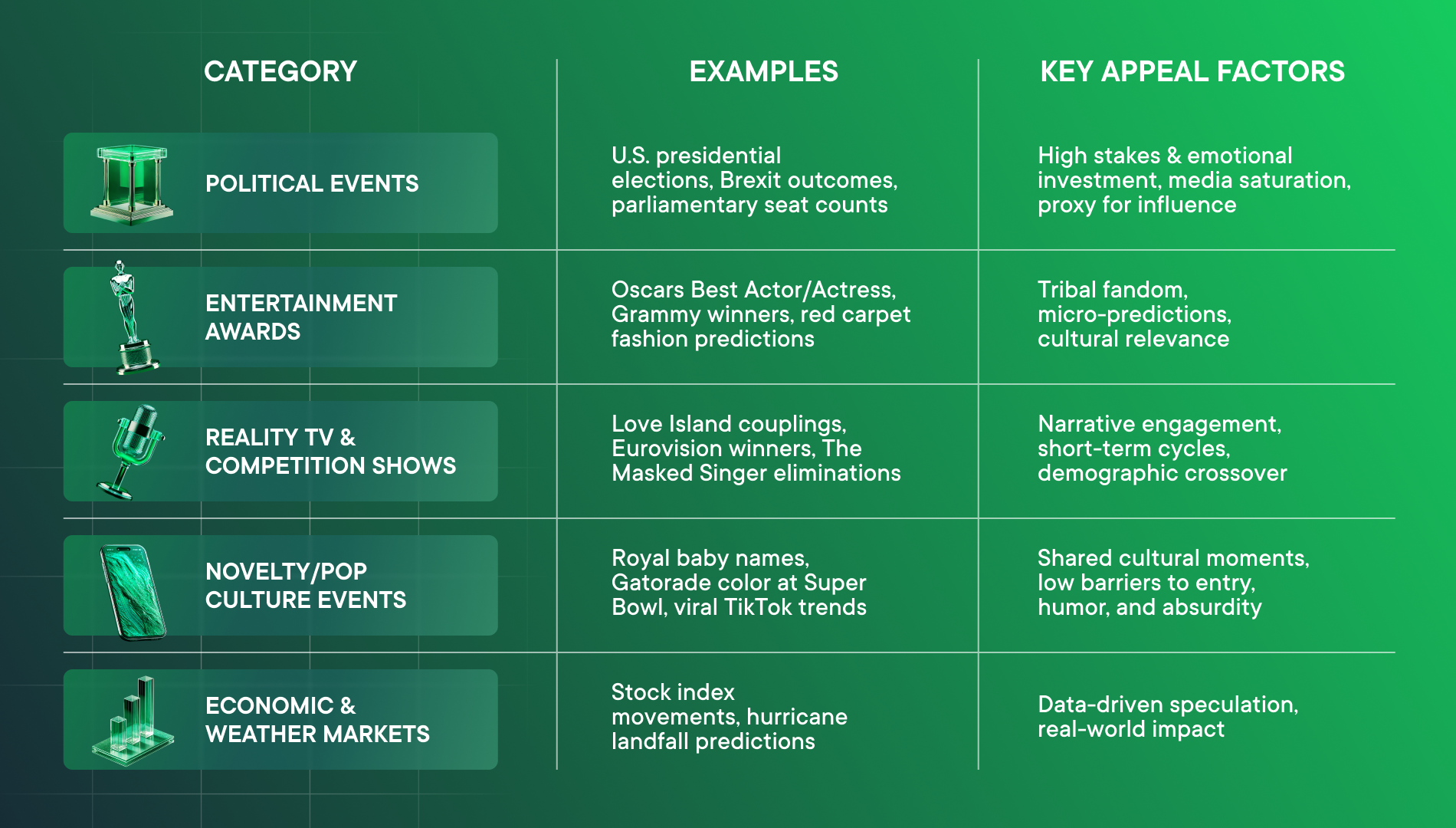
The core of non-sports betting's popularity lies in its ability to inject an element of playful chance into the shared cultural experience. We're constantly bombarded with entertainment, news, and social media trends, and these events naturally generate widespread discussion and speculation. Non-sports betting cleverly taps into this existing engagement, transforming passive observation into active participation, adding excitement and the feeling of having a stake in outcomes that already hold our attention. Below are the most popular “bet on anything” categories and drivers behind their appeal:
Most Popular Non-Betting Categories
What Are the Benefits of Non-Sports Betting for Operators?
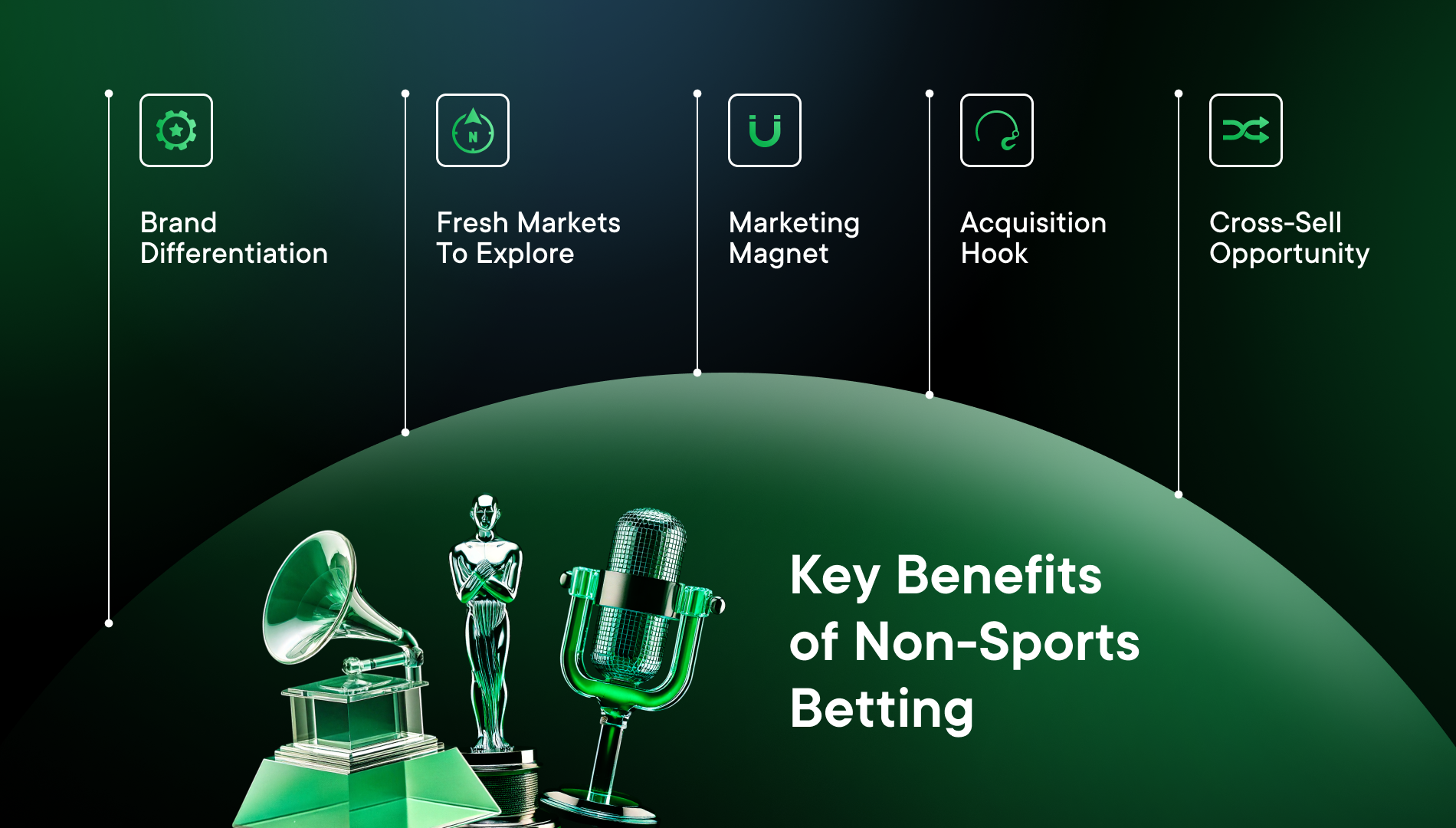
Non-sports betting isn’t as much about direct profitability as it is about visibility, engagement, and expanding the funnel. The numbers prove it: across operators, non-sports markets account for just 1–2% of total betting volume. In pure revenue terms, it’s negligible. But in marketing terms, it’s a different story.
The real value comes from positioning, publicity, and user acquisition. A sportsbook offering presidential election bets or reality TV finales isn’t trying to turn these into high-yield markets; it’s creating a hook. These bets spread organically, getting picked up on social media, forums, and news sites. The goal is simple: to generate curiosity, drive traffic, and bring in new users who might never have considered sports betting.
Take the U.S. elections as an example. When operators introduced betting markets for the recent race, over 99% of all non-sports betting volume came from this one event. It’s not a frequent occurrence, every four years at best, but when it happens, it commands global attention. Millions flow into prediction markets, and even mainstream media references sportsbook odds. This is marketing gold.
Other non-sports bets, whether on the Oscars, Eurovision, or "Will someone land on Mars by 2030?," don’t generate anywhere near the same traction. But they still serve a purpose: capturing and retaining casual users, sparking curiosity, and keeping platforms fresh while the real financial engine remains sports, where even a minor league football game can generate more wagers than an entire year of non-sports markets. But as a brand-building and engagement tool, non-sports betting punches far above its weight.
What's the Trading Process in Non-Sports Betting Events?
Trading in non-sports betting is a different beast from traditional sports trading. It’s messier, more unpredictable, and often more volatile, but when executed correctly, it allows operators to capitalize on the sheer breadth of human curiosity. The key difference comes down to data variability, event structure, and risk dynamics. Sports betting is grounded in performance metrics, structured schedules, and vast historical databases. Non-sports betting is more fluid, dependent on public sentiment, media cycles, and one-off events that don’t fit into traditional models. Political markets can stretch for months or years, while reality TV bets might be resolved in weeks. Regulatory scrutiny is higher, particularly in novelty betting, where unpredictable volatility makes liability management a constant balancing act.
Market Creation
It starts with market creation. While sportsbooks rely on scheduled fixtures and league calendars, non-sports traders must identify events with clear, verifiable outcomes that will attract bets. Political elections, award shows, and reality TV finales are big-ticket, high-profile, culturally relevant events, and with outcomes that can be priced using polling data, critic reviews, and social media sentiment analysis. Some markets are more speculative, like novelty bets on the next royal baby name or whether an A-list celebrity will shave their head in 2026. But these, too, serve a purpose: they drive engagement, even if they rarely generate substantial betting volume.
Pricing the Odds
Once an event is chosen, the real challenge begins – pricing the odds. Unlike sports, where bookmakers use decades of historical data to calculate probabilities, non-sports betting relies on hybrid modeling that blends quantitative data (polling averages, historical award trends) with qualitative insights (political analysts, industry rumors, social media sentiment). A crucial factor is the risk of market manipulation. In sports, match-fixing is rare and heavily policed. In non-sports betting, the risk is more subtle – social media hype can distort perception, leaks from award juries can swing markets, and well-connected bettors can exploit inside knowledge before traders can adjust. Operators must monitor for irregular betting patterns and adjust odds dynamically, often in real-time, to avoid heavy exposure on one side.
Risk Management
Managing risk in non-sports betting is an art form. Dynamic hedging is critical: if too much money flows onto one side of a market (e.g., Trump's impeachment), traders must either adjust odds to incentivize counter-bets or offload liability onto betting exchanges.
Stake limits are another layer of protection, particularly for high-volatility markets like reality TV, where leaks can dictate outcomes. Some operators go further, using liquidity pools that spread risk across correlated markets, ensuring that a surge in one bet (e.g., “Who will win the U.S. election?”) is balanced by smaller bets on related outcomes (e.g., cabinet resignations, Supreme Court appointments).
Compliance
Then comes the compliance challenge. Sports betting is highly regulated, but non-sports betting exists in a legal gray area, varying by jurisdiction. Some markets, like elections, are outright banned in certain regions, while others require careful outcome verification; award show results often rely on direct partnerships with TV networks or official announcements to confirm legitimacy. Anti-manipulation protocols are also more aggressive; sportsbooks monitor for insider trading signals, such as unusual spikes in betting volume before embargoed election results or last-minute wagers on an underdog Oscar nominee.
🔧 What Tools Traders Need:
To provide accurate odds, we use odds comparison services, odds management software, mathematical models, and graphic tools for visualizing fluctuations in odds for effective risk management. Additionally, traders deploy AI that monitors news and social media for sudden changes. For example, if a leading candidate drops out of a race or a surprise scandal arises, the odds need to be adjusted immediately. In parallel, live dashboards assist traders in tracking market flow and detecting behavior anomalies.
Ready to see non-sports betting functionality in action?
TEST ULTIM8
What Are the Potential Pitfalls in Non-Sports Betting?
Adding exotic betting options requires significant resources, especially when there are no odds from regional providers. In that case, traders must manually research and set odds, which involves monitoring local forums, social media, regional news outlets, and other data sources. After that, they need time to calculate the odds and monitor event betting activity 24/7.
But this is not only about setting the odds: the trader here stands against all interested bettors. Because if experienced players find a mismatch in the odds, the operator is in big trouble.
But this is not only about setting the odds: the trader here stands against all interested bettors. Because if experienced players will find a mismatch in the odds, the operator is in big trouble.
Skilled bettors and niche experts will immediately benefit from odds miscalculations. Without proper risk management, such mistakes can lead to significant financial losses for the operator.
🐔🥊 Knockout or Profit for the Operator:
Cockfighting (sabong) is massive in the Philippines. It’s not just a cultural tradition—it’s a legal industry bringing in billions of pesos yearly. Significant events like the World Slasher Cup pack arenas, with people betting huge sums on fights that last minutes and often end with one rooster dead. But you can’t treat every country the same if you’re running betting markets for cockfights. In Thailand, for example, fights are endurance tests. Roosters battle for hours, and deaths are rare. The rules, blade lengths, and even how judges score fights vary wildly by region. Setting accurate odds is nearly impossible without someone on the ground who understands these details. Bookmakers who guess wrong — misjudging local rules or fight styles — risk losing money.
What GR8 Tech Brings to the Table
Non-sports betting thrives on unpredictability. One week, it’s the Oscars. The next is a viral internet moment or a sudden political shake-up. For operators, the challenge is keeping up with the constant evolution of what people want to bet on. That’s where our trading team steps in.
When it comes to mass-market events, we ensure operators don’t miss out on the biggest cultural and political moments. Presidential elections, the Academy Awards, and Eurovision command global attention, and the betting action follows. With access to leading odds providers and real-time market data, we ensure integration without the hassle of building odds models from scratch.
But the real magic happens when things become more regional and unpredictable. Betting trends vary by market, and sometimes, a platform needs hyper-local offerings to engage more audiences. Maybe it’s a national election in Latin America, a reality TV finale in Asia, or even a viral internet challenge. If the data exists, we pull it in, adjust the odds, and make it bettable. If the data doesn’t exist—well, that’s when things get interesting.
For niche bets, we take a different approach. If no odds are provided, we analyze what small, regional bookmakers offer and determine the fairest possible odds. Sometimes, this means manually researching an event—from an obscure political vote to a regional gambling tradition—and calculating probabilities from the ground up to meet the client's marketing expectations.
Concluding the Reality of Non-Sports Betting
Non-sports betting is an odd but fascinating corner of the industry. It brings variety, unpredictability, and the kind of viral potential that sports betting rarely offers. But let’s be clear: it’s not a cash cow. It’s a marketing tool, a retention play, and an engagement driver, but it’s not going to overtake traditional sports betting in profitability anytime soon.
The numbers say it all. For some of our clients, non-sports events make up just 1–2% of total betting volume. Even in the best-case scenarios, like a high-stakes presidential election or a massive awards-season upset, it rarely exceeds 5% of overall revenue. The real value isn’t in the direct profits but in how these markets bring in new users and create buzz.
The real value isn’t in the direct profits but in how these markets bring in new users and create buzz.
That being said, it’s not a plug-and-play feature. Exotic local bets come with real risks. If an operator doesn’t have local expertise or a reliable data provider, professional bettors will find the weak spots and exploit mispriced odds. Without automation, managing these markets is resource-intensive and prone to errors.
So, should operators invest in non-sports betting? Absolutely, provided they understand what they’re getting into. It’s a way to draw attention, bring in casual bettors, and create memorable, shareable moments on the platform. But as with any trend-driven product, success depends on execution. The best operators know how to leverage novelty strategically, integrating non-sports bets seamlessly and using them as a gateway to deeper engagement with their core sportsbook and casino offerings, further expanding the possibilities of what betting can be.