If you want to try the iGaming business, an online casino is the most reliable starting point. The product comes with a rather simple logic and predictable revenue. Still, long-term profits depend on how well you understand development models, markets, costs, games, risks, payments, and…people.
We asked Lusine Khudaverdyan, Head of Casino at GR8 Tech, for advice on how to start an online casino business and avoid common mistakes. Here are her tested recommendations.
Winning Strategy Begins with the Market
Let’s admit that when it comes to market choice, the “the more, the better” rule hardly ever works for new operators. In iGaming, strategic focus is the foundation of success, as the target market defines everything, from licensing and payments to the game portfolio, marketing strategy, and even the team structure.
Still, I see how operators with no clear plan decide to go global or “target the entire Europe at once”, without understanding how fragmented the region is in terms of regulation, digital maturity, and player behavior. The approach usually results in budget overruns and abandoned projects.
In my opinion, it’s better to start a gambling business with a region you understand, hire a trusted local team that knows the audience (or at least speaks the local language), win that market first, refine the model, and only then scale.
Regional Insights
From a geographic standpoint, we can split the global casino market into several clusters:
- MENA is a fairly stable casino market, with GGR ranging from 70 to 80%. Players are accustomed to particular live casino and slot products;
- Latin America is one of the fastest-growing casino regions today that is open to bold ideas, local promotions, and viral crash games;
- Southeast Asia is a diverse region with similar yet distinct gaming preferences. The Philippines, Indonesia, and Thailand tend to favor slots and localized content, while Vietnam strikes a balance between casino and sports betting. Success here depends on brand trust and cultural adaptation;
- Africa demands lightweight, mobile-first content adjusted to lower bandwidth;
- North America is an accessible, high-value market that is rather complex in terms of regulation, with the U.S. state-by-state licensing specifics and Canada’s provincial setup;
- Europe stands apart as the most mature and tightly regulated region and accounts for 48% of global revenue share, with the UK, Spain, and Sweden serving as benchmark markets;
- Australia restricts online casinos but demonstrates strong offline preferences, with slot-style “pokies” driving player interest even under federal limitations.
Beyond geography, markets vary in economic potential, digital infrastructure, and payment ecosystems. But the growth outlook remains strong. According to Statista, the global casino market is expected to surpass USD 260 billion by 2030.
| Market Tier | GDP per Capita | Key Regions | Infrastructure & Payments | Player Behavior |
| Tier 1 | > USD 40k | U.S., Canada, Australia, Western Europe, Japan, Singapore | - Stable internet infrastructure
- Widespread credit/debit card usage
- Strong regulation and compliance
| Players have high disposable income, spend confidently online, and expect reliability and premium service |
| Tier 2 | USD 10k–40k | Eastern Europe (Poland, Czech Republic), most of Latin America, Southeast Asia (Malaysia, Thailand) | - Growing internet penetration
- Dominating local payment preferences and a mix of cash-based and digital methods
| Price-conscious users with a growing interest in online gambling and increasingly responsive to localized offers |
| Tier 3 | < USD 10k | India, Indonesia, the Philippines, most of Africa, and certain Latin American countries (Venezuela, Cuba, Nicaragua) | - High mobile dependency
- Limited banking infrastructure
- Dominating mobile wallets and cash systems
| Prefer quick, emotional, simple games (e.g., crash games) and seek entertainment over brand loyalty |
Different Licenses, Different Rules
The market you choose for opening a casino shapes your entire licensing path. Tier-1 regions typically have more compliance requirements, while Tier-2 and Tier-3 open the door faster and at a lower cost.
Malta (MGA) is the gold standard in iGaming licensing. It gives operators rock-solid credibility and unlocks a broad range of regulated markets, like Europe or the UK. The reverse side is obvious: strict checks, serious paperwork, and higher costs. That’s why many operators start with simpler alternatives, such as Curaçao (CGA), the Isle of Man (GSC), or Anjouan (AOFA). These licenses are more affordable and easier to obtain, while covering a wide set of regions. At the same time, certain countries (e.g., Brazil, Peru) demand their own local licensing.
Although every licensing path comes with extra expenses and launch delays, there’s a fully legal shortcut that reduces both cost and time (I’ll break it down in the next section).
Local Payments Matter
Payment integrations also depend on the market. While Tier-1 regions rely on Visa, Mastercard, Stripe, PayPal, Revolut, and crypto, Tier-2 and Tier-3 favor cash-based systems, local PSPs, and more active crypto usage.
I’ve witnessed how operators lose players in minutes when deposit or payout methods feel slow or unfamiliar. To create an online casino and retain the audience, you need local PSPs from day one. Yes, they’re high-risk and come with higher fees, but they are a must for conversion.
At the same time, payment diversity stabilizes deposit flows. A blend of local providers, crypto as a backup, and a few international options (where compliance allows it) gives players the payment comfort they expect and fosters brand attachment.
Casino Business Models: From Quick Launch to Full Flexibility
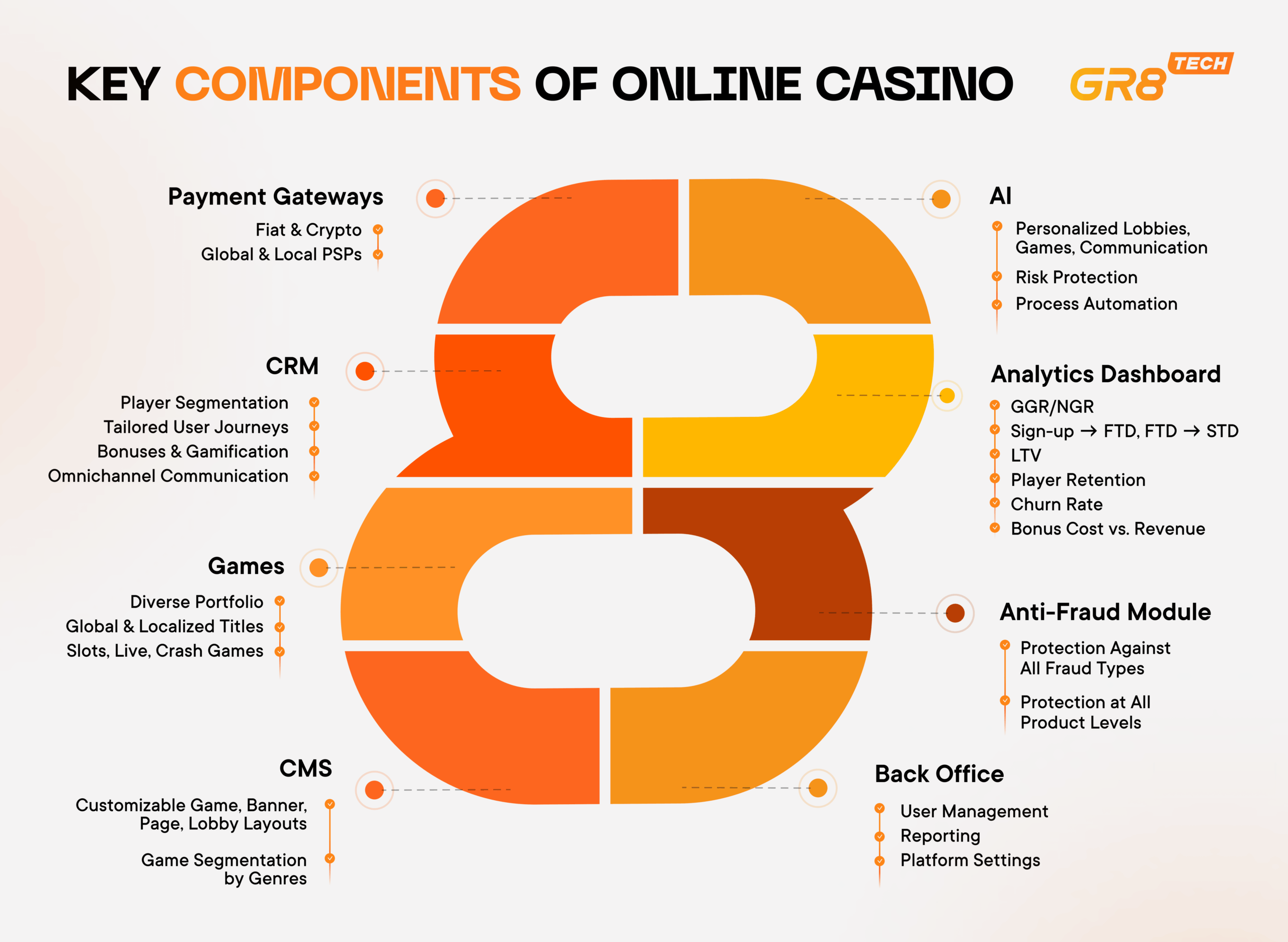
Understanding the specifics behind casino products and partnership models is just as critical as understanding the target market. From my perspective, a casino MVP setup must include a diverse game portfolio, CRM, CMS, payment gateways, analytics, AI-driven personalization, a robust back office, and an anti-fraud module that protects your margins at every level.
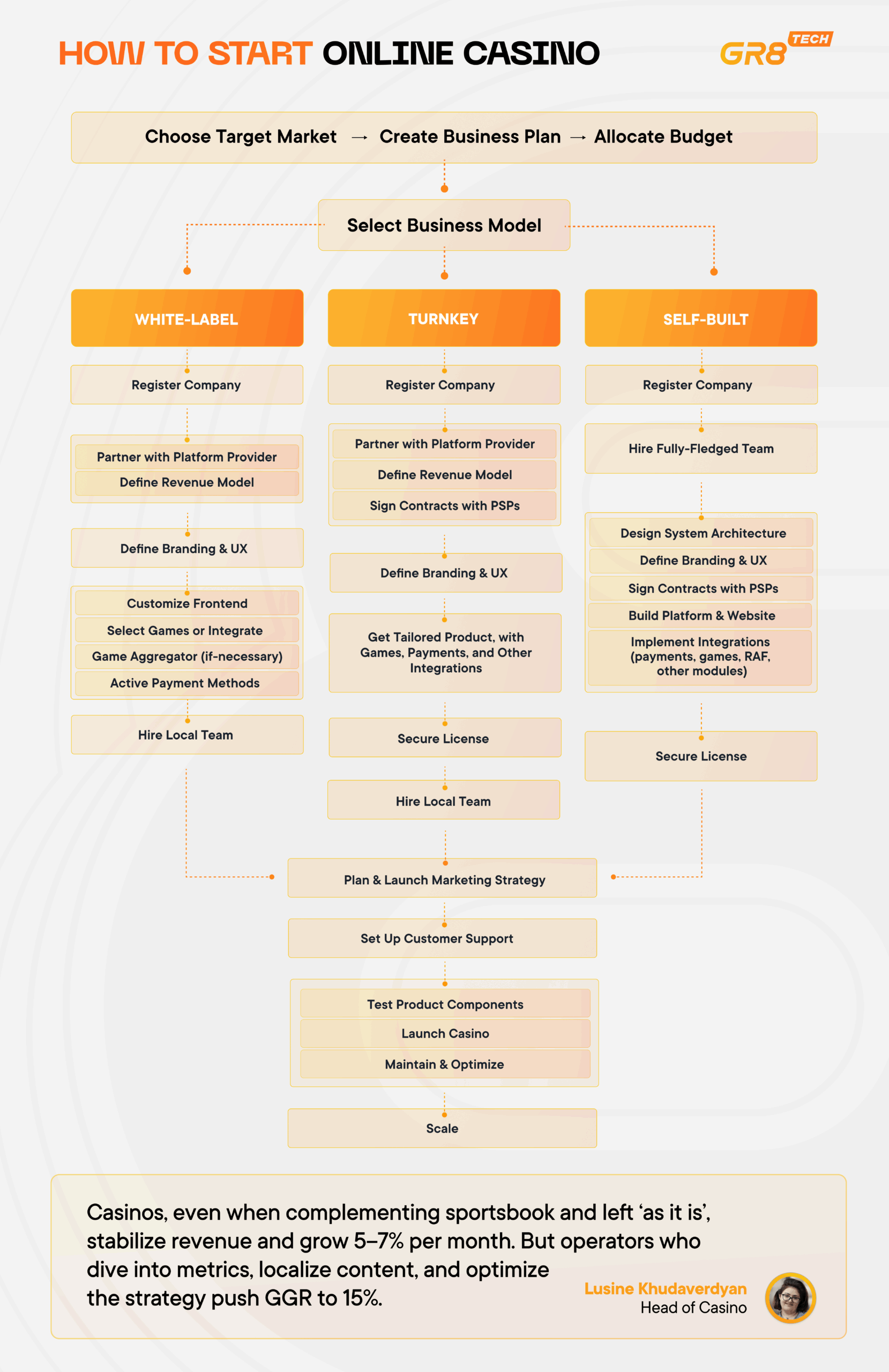
When operators build a casino, they usually follow one of three product development paths:
- White-label works best for newcomers with zero experience or teams entering a heavily regulated market. The casino platform provider handles licensing, compliance, tech, and support, while the operator focuses on marketing and player retention. The revenue share is the highest, but the speed and reduced tech load make it the easiest way to test a market. I often recommend this path for regions such as the UK, where compliance rules are highly strict;
- Turnkey attracts casino operators who already know their market and have a clear strategy. The software provider develops a platform to your vision, while you take charge of licensing. The model brings autonomy, stronger branding control, and a lower revenue share, but requires a small team and a certain level of expertise to run the business. From what I’ve seen, turnkey solutions deliver steady performance regardless of the market’s regulatory complexity;
- Self-built is the most ambitious option that presupposes a fully-fledged tech team, the longest timeframes, and a substantial budget. In return, it ensures maximum flexibility, allowing operators to test unique mechanics and stand out. From my experience, this model offers the most value to established operators with steady revenue and a clear long-term vision.
Most casino white-label and turnkey platform providers offer a hybrid business model: a USD 30k–50k setup fee, sometimes a fixed monthly fee, plus revenue share on GGR. Combined with a 2–3-month launch, these approaches remain the best-fit options for operators starting an online casino for the first time.
Building Your Game Portfolio
Games are the heart of every casino platform, and a beginner operator needs at least 500 games to enter the market. The portfolio must be diverse because each genre drives revenue differently and plays its own role in the player journey.
Thanks to RTP, slots generate the most revenue, especially when tailored to local preferences (i.e., run in the local language, contain cultural elements, and offer expected volatility). Live games fuel retention and cater to players who prefer social interaction. Crash games bring growth, attracting younger audiences with short cycles and virality. I’m absolutely sure that titles like Aviator or Chicken Crash are gaining traction due to constant excitement and traditional game mechanics.
Content localization is a revenue driver that many operators underestimate. In my experience, brands that localize their game catalogs outperform generic lobbies by around 10% per month or quarter. In the long run, that gap boosts GGR significantly.
How to Add Games?
As a rule, white-label and turnkey platforms already include a strong game portfolio. Still, if you want to change providers or you’re building a platform from scratch, you can bring games into your ecosystem via a casino aggregator or direct integrations.
With a casino aggregation platform, you add a diverse catalog through a single integration. One API unlocks thousands of titles, eliminates the need for direct contracts, and ensures compliance. It also substantially increases margins compared to direct integrations and significantly lowers your tech load, as you maintain only one integration. This model gives small and mid-sized operators the scale and flexibility of major brands without heavy costs.
Aggregators also come with updated provider catalogs, release calendars, promo hubs, and transparent RTP configurations for regulated markets. The partnership model runs under a setup/security deposit of USD 10k–50k, sometimes a monthly fee, plus revenue share.
Direct provider integrations fit operators who want exclusive content or special commercial terms. It’s more expensive, requires a tech team, and takes time, but it helps brands stand out. It brings the most value to experienced casino operators who follow the combined approach: launch with an aggregator, analyze game performance, and then sign direct contracts with top performers and key local providers.
Defining the UX Balance
I’ve noticed an interesting pattern across projects: around 80% of revenue usually comes from just three game providers, while the remaining hundreds make up the other 20%.
However, that doesn’t mean operators can feature only those top providers and expect results. A lobby with just a few games feels empty and fails to hold players long enough to convert.
The opposite tactic is just as harmful. Some operators overload their casinos with 500+ providers, offering a generic lobby and messy UX. Players drop in, spin a few rounds, get frustrated, and disappear. No attachment, no retention, no long-term revenue.
As usual, the balance lies in the middle. I recommend starting with 20–30 strong providers or a casino aggregator and then scaling based on performance. And of course, focus on segmented user journeys and tailor lobbies to each player's taste with AI. That’s a surefire way to build a habit and keep your audience coming back.
MAXIMUM GAMES, MINIMUM BOTTLENECKS.
UNLOCK 250+ PROVIDERS
No Team, No Success
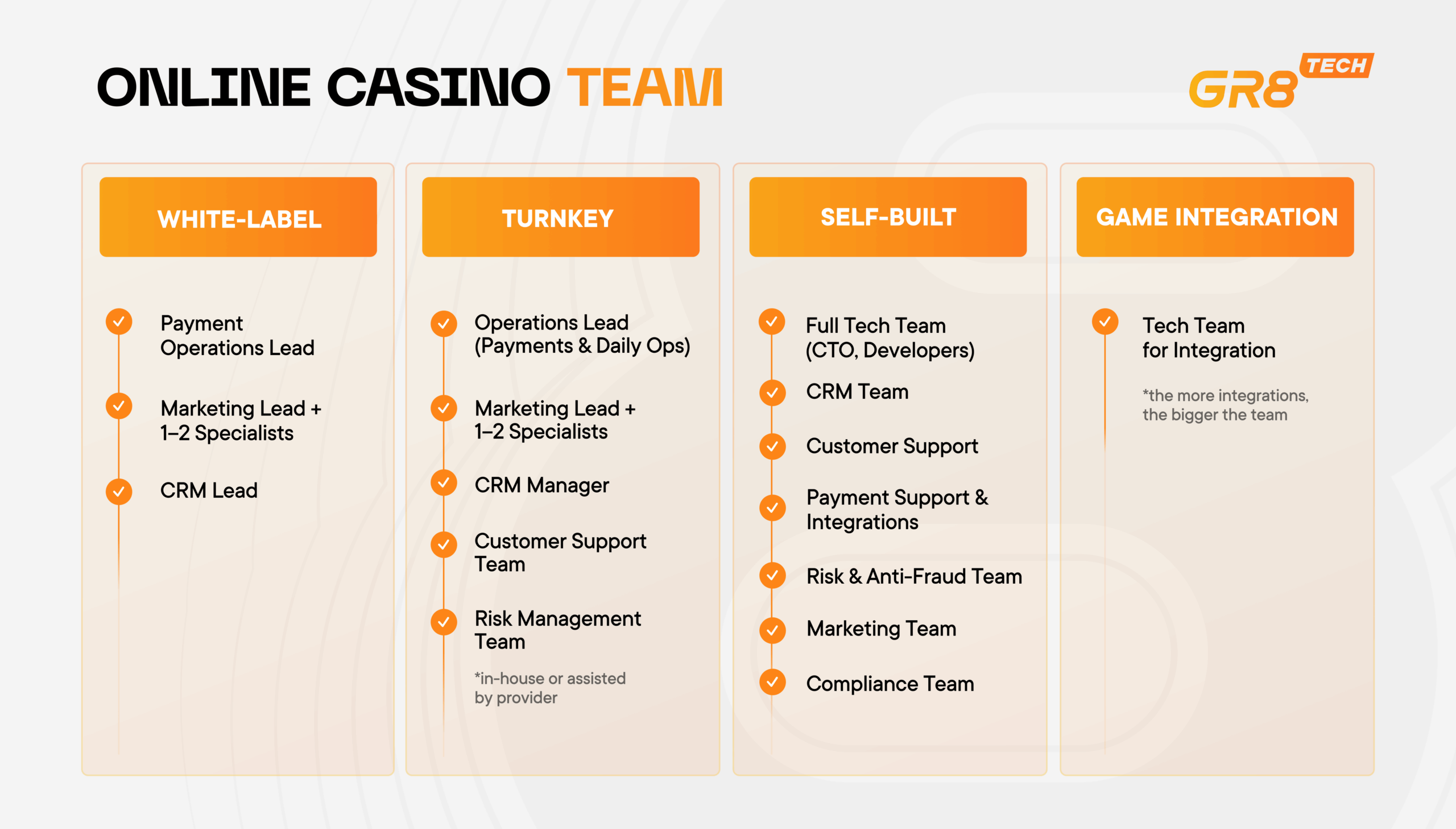
Each development model for starting an online casino business requires a team. With white-label, you only need one operational lead, a CRM lead, and a small marketing team, as the platform provider covers tech, licensing, and operations. Turnkey solutions demand a payment operations lead, 1–2 marketing experts, CRM, customer service, and a risk team. In certain cases, the casino software provider may take charge of fraud protection.
A self-built platform, however, presupposes a fully-fledged team. You’ll need an experienced CTO, a skilled development team, compliance, payments, marketing, risk, and 24/7 support. A casino aggregator or individual game provider can help you integrate their products, but all other operational processes sit completely on your shoulders.
And here’s an important note: no model can function properly without local marketing and support specialists. The closer your team is to the players, the stronger the acquisition will be.
For example, if an operator already has specialists in Latin America, Africa, and Asia, even a multi-region launch can succeed. However, when they are based in Europe and attempt to target an Asian country without local marketers, affiliates, or service partners (or at least those with expertise in the target region), this approach makes little sense from a business perspective.
So my advice stays the same: start an online casino business with one region where you can build a local team, gain experience, and expand only when you can support every new market with dedicated specialists.
Breaking Down the Real Project Cost
Project cost is one of the first questions operators bring to the table. And while the exact figure always depends on the target region and the development model, I can outline annual estimates for starting a casino in a single market.
| White-Label | Turnkey | Self-Built |
| Licensing | — | *If an operator doesn't take charge of licensing, the cost depends on the region | Depends on the region (e.g., Curaçao: ~USD 55k; Malta: ~USD 140k–300k; Brazil: ~USD 5.6m for 5 yr) |
| Other Compliance Costs (KYC, AML, Audits, Reporting) | USD 10k–30k | USD 10k–50k | USD 40k–120k |
| Platform Development/Setup | USD 30k–50k + revenue share (+fixed monthly fees) | USD 30k–50k + revenue share (+fixed monthly fees) | Up to USD 500k |
| Game Portfolio | - Aggregation: USD 10k–50k + revenue share (+fixed monthly fees)
- Direct integrations: Individual pricing
|
| Website Development | — | — | USD 20k–100k, depending on complexity and tech team location |
| Marketing | USD 50k–200k, depending on the region |
| Hiring | USD 105k–225k | USD 250k–610k | USD 820k–2.5m |
But the project budgeting doesn’t stop here. There are other unobvious costs that frequently slip away from beginning operators:
- Local PSP Fees: Unpredictable in less-regulated markets and always higher than global PSP services;
- Fraud and Risk Costs: Some operators skip proper risk management, underestimate bonus abuse and other fraud types, and run without a solid anti-fraud system, which leads to unpredictable losses;
- Marketing Burn: Not every click or lead converts, and poor targeting or a lack of market focus can drain budgets quicker than expected.
All in all, based on dozens of launches, I recommend allocating at least USD 500k per region for white-label or turnkey projects to cover setup, PSP fees, fraud-related losses, and the natural marketing burn at the start, and twice as much for a self-built approach.
How to Open an Online Casino in 10 Steps
Here is the most common and predictable strategy for launching an online casino based on my observations.
Step #1. Define Your Market & Build a Business Plan: Study local player behavior, payment habits, and game preferences, as well as global casino trends. Analyze top competitors and outline your online casino business plan, product positioning, and growth strategy.
Step #2. Choose a Business Model & Budget: Decide between a white-label, turnkey, or self-built casino platform, and allocate the budget in compliance with the estimated calculations.
Step #3. Set Up the Company Infrastructure: Register your business, open a bank account, and sign contracts with global, local, and crypto PSPs.
Step #4. Select a Software Provider or Hire a Team: Partner with a casino platform vendor or assemble an in-house development and operations team.
Step #5. Build/Customize the Platform & Integrate Games and Payments: Add casino content via an aggregator or direct integrations (if necessary) and connect the payment methods.
Step #6. Secure the Required License: Obtain local or international licensing if you’re running a self-built casino (as a rule, the license is also required for the turnkey model).
Step #7. Hire Local Specialists: Allocate the marketing and support team in the target location.
Step #8. Plan & Launch Your Marketing Strategy: Launch localized SEO, affiliates, influencers, and bonus campaigns with a focus on acquisition and retention.
Step #9. Set Up Customer Support: Establish 24/7 service via live chat, email, phone, FAQs, and helpful onboarding guides.
Step #10. Launch the Product & Maintain Compliance: Test every product layer, go live, and monitor regulatory updates and key metrics, such as FTD conversions, revenue, and retention.
What’s Next?
I see a clear pattern among successful operators: they begin small, learn quickly, and scale only when the foundation is solid. A newcomer typically enters a market with a white-label setup, operates for a year or two, learns the operations, and achieves the first sustainable results. Once the team grows and the strategy becomes sharper, switching to a turnkey model makes perfect sense. It reduces the revenue share and gives more control. But the transition takes time and requires a skilled operational team.
Some operators take it a step further and build their own platforms. This move can pay off in the long run, but only when there’s enough revenue, experience, and budget. The risk is higher, the transition is longer, and players may drop if they don’t like the new platform. But when the switch is done right, operators gain full autonomy.
Expanding into other regions or adding a sportsbook vertical is another growth path. I recommend scaling only after the casino operation is stable. Then, analyze whether the new vertical fits local demand. In MENA, sportsbook often works as an add-on, while in LATAM, it’s better to have both for balance. But keep in mind that a sportsbook is a way more complex product that thrives on real-time. Margins and risks require a trusted provider behind it.








































How much will it cost me to start this business ?
The cost of launching an online casino depends on your target market and business model. For a single market, a White-Label or Turnkey setup typically starts from USD 200k–400k annually (including platform, compliance, marketing, and team), while a Self-Built model can exceed USD 1 million due to development and hiring costs.