Speed and simplicity are game-changers in any business, but for operators looking to launch an online casino in a matter of weeks without having to build any software or secure a gaming license from scratch, that's a major win all around. White-label casino software promises exactly that kind of head start.
In this article, you’ll get a clear definition of white-label online casino solutions, what’s actually included in a package, how they differ from turnkey builds, who they fit, and where they fall short. You’ll leave with a practical decision framework (costs, control, compliance, speed), and simple visuals to map your launch path and help you ask sharper questions of vendors.
What is a White-Label Casino Solution?
A white-label casino platform is a pre-built, ready-to-launch online gambling platform that a specialized provider operates on your behalf. As the operator, you purchase or lease this platform and rebrand it as your casino, thereby avoiding the massive undertaking of developing a casino website, obtaining gambling licenses, and integrating dozens of games and payment systems from scratch.
In simple terms, you’re piggybacking on the provider’s existing infrastructure and legal permits. The provider supplies the entire backend: the gaming software, website or app, payment processing, user account management, and often customer support and licensing coverage. You, the operator, focus on the front end—your brand, your marketing strategy, and managing your players’ experience—while the provider handles the heavy lifting behind the scenes.
Crucially, a white-label gaming platform operates under the provider’s gambling license. Rather than obtaining your license (a process that can be costly and time-consuming), you operate under a sub-license of the provider’s master license. This means the provider is legally responsible for compliance with gambling regulations, and you benefit from their approvals in various jurisdictions.
For a new casino entrepreneur, it’s a bit like renting a fully furnished apartment: the framework is all there, and you just move in and decorate. You can establish your brand identity quickly without having to build a platform from scratch. The trade-off is that you do not own the platform or license outright—you are essentially leasing the technology and legal umbrella from the provider.
Benefits of White-Label Casino Solutions
We’ve already covered time-to-market, but since the longest poles in the tent are licensing and integrations, it bears repetition that mature white-label gambling software runs both under the provider’s license and exposes a platform where content, payments, KYC/AML, and RG tooling are already wired. You go live on a known runtime rather than inventing one. Basically, a white-label solution is not “less work”; it is different work, from platform building to brand building.
Second, capital efficiency: you redirect CapEx (engineering, certifications, infra) into OpEx (platform fee/rev share). You avoid parallel teams for backend, payments, and compliance, reduce burn during product-market fit, and can pilot a brand or geography before committing to a proprietary build.
Third, compliance and risk transfer: policy frameworks, transaction monitoring, PEP/sanctions screening, source-of-funds workflows, dispute handling, technical standards, incident response, and audit trails are maintained by a provider that lives under regular audits. You still own your front-line obligations, but the heavy regulatory machinery is not your first build.
Fourth, content and payments at scale: aggregated game portfolios with existing commercials and ongoing release pipelines mean you launch with depth on day one. Payment routing, risk scoring, chargeback handling, and cashier UX are proven patterns rather than greenfield experiments, which show up in conversion and fewer operational fire drills.
Fifth, operational leverage and scalability: uptime SLOs, on-call rotations, DDoS posture, data pipelines, BI, CRM, and affiliate tracking, anti-bonus-abuse rules—GR8 Tech runs these as standard, which frees your team to focus on acquisition, retention, and unit economics instead of firefighting infrastructure.
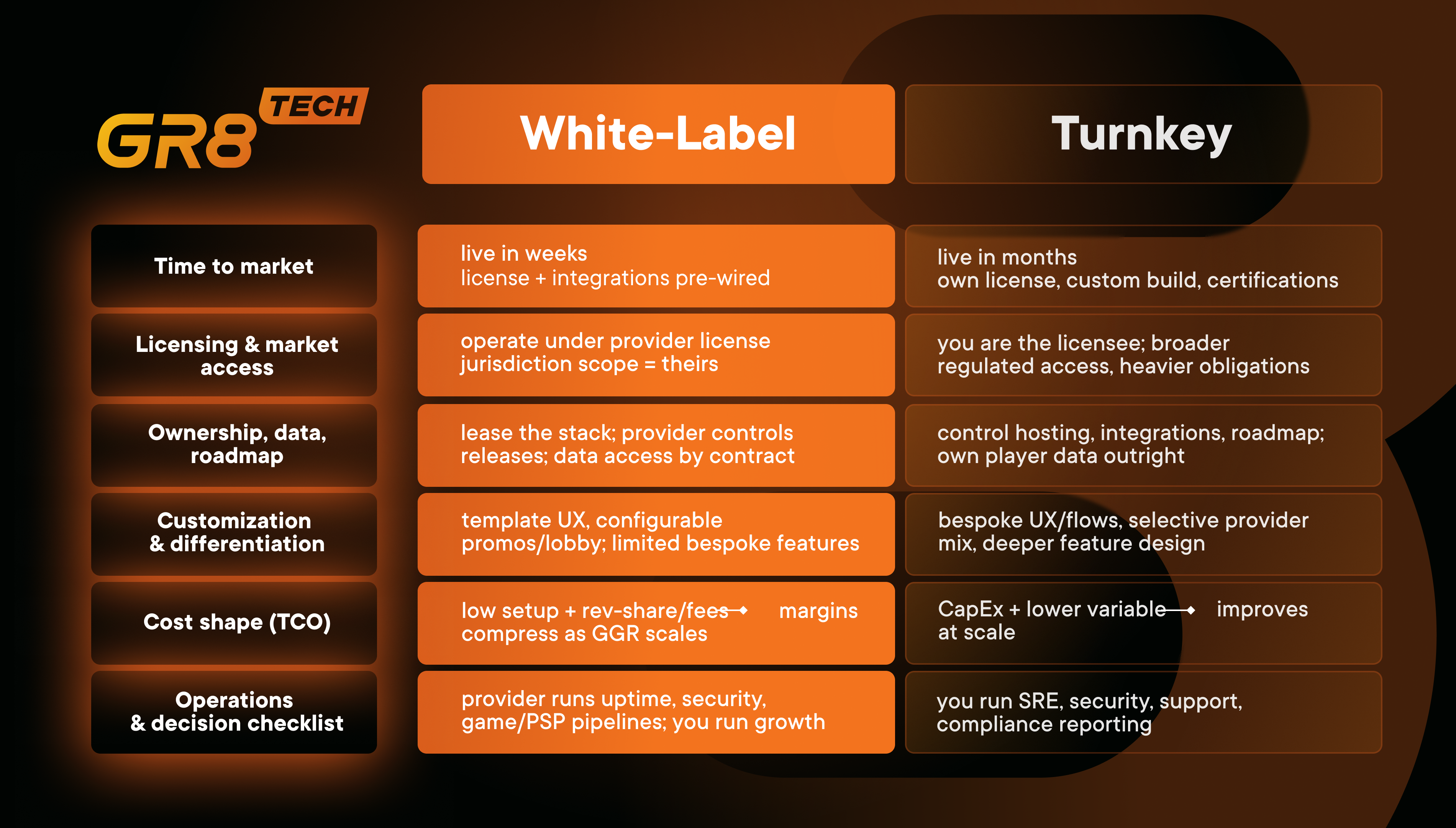
White-Label vs. Turnkey Solutions: What’s the Difference?
Choosing between a white-label casino and a turnkey may seem like a vocabulary test. It isn’t. The two are about governance and timing.
Both paths can launch a casino, but neither is one-size-fits-all, and the trade hinges on a few decisive levers. Chief among them (again, sorry to harp on that)—speed to market. If you need to be live in weeks, a white-label gaming solution compresses licensing and integrations.
However, if you need sovereignty and depth of customization, turnkey earns its keep.
Everything else flows from that choice:
- licensing model (provider umbrella vs your paper);
- ownership and control (leased stack vs owned roadmap);
- customization depth (template config vs bespoke UX and features);
- cost shape (OpEx/rev-share vs CapEx with lower variable);
- compliance scope and market access;
- operational burden (provider-run back vs your SRE, support, and audits);
- data ownership and portability;
- scalability limits;
- economic crossover;
All of the above points where turnkey becomes cheaper at scale. Keep your eye on the few variables that move P&L and timelines; Use white-label casino to test, to extend a portfolio, or to move fast in permissive jurisdictions. Use turnkey when you need product sovereignty, regulated expansion on your own paper, and a platform you can shape over the years.
Challenges and Limitations of White-Label Casinos
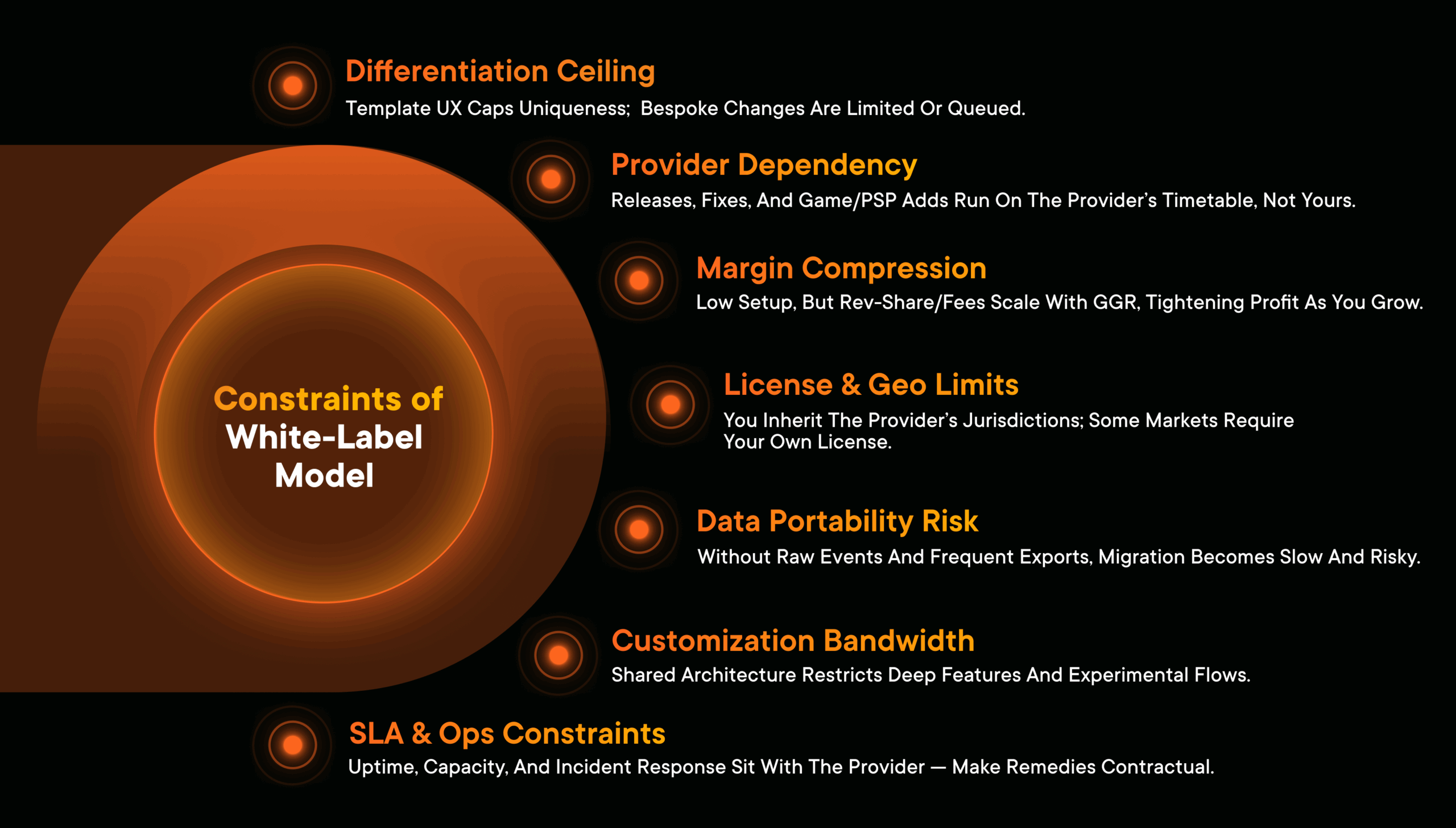
White-label casinos get you moving fast, but you’re trading depth for speed. The big constraints show up in familiar places:
- differentiation
- dependency
- economics
- scale
- licensing
Not owning the stack or the license means templates rather than bespoke UX, the provider’s roadmap and release cadence rather than yours, and a platform toll (rev-share or fee) that looks small at launch but bites harder as GGR grows. Outages, slow game rollouts, or compliance posture when the provider sneezes, your brand catches the cold.
Branding can be skinned, not rebuilt: unique flows, custom mechanics, or novel loyalty constructs are hard to push through a shared architecture.
Operationally, you inherit stability and tooling, but you also inherit limits; capacity is a ticket, not a lever. The license you operate under opens some doors and closes others; major regimes that require operator-held licenses sit out of reach until you carry your own paper. Asset value follows ownership: you can sell a brand and a player base, not the underlying platform.
👉Financial hygiene: model the crossover point where turnkey becomes cheaper at your target GGR, and revisit quarterly.
👉Strategic hygiene: set triggers for independence (e.g., licensing path validated, CAC/LTV stable, feature backlog blocked by platform limits).
👉 Bottom line: make the trade consciously and write the guardrails up front. Watch-fors inside the contract:
- data export rights (full, frequent, structured);
- SLA with remedies (uptime, incident response, game release cadence);
- change-management transparency (roadmap, deprecations), exit/migration clause (timelines, assistance, fees);
- jurisdiction roadmap (where the umbrella license does/doesn’t work);
- pricing mechanics (rev-share tiers, minimums, pass-through costs);
Used well, white-label is great for testing a brand or geography and learning operations with a focus on compliance and infrastructure. Just treat it like a lease with a move-out plan: enjoy the speed, track the toll, and know when it’s time to take the keys.
Launching a White-Label Online Casino: The Workable Playbook
There isn’t a universal manual for “how to launch a casino,” even if it’s the best white-label gambling solution: markets, payments, and regulation bend every plan. But because in the case of WL, the provider carries the license, stack, and integrations, the path reduces to a practical, step-by-step checklist you run with their team at your elbow, so what looks daunting from the outside becomes a guided process. GR8 Tech, for example, assigns a launch PM, brings a staffed playbook (licensing cover, PSP onboarding, game aggregation, KYC/AML), and owns the critical-path integrations so you’re never pushing this uphill alone. Whichever route you take, use the notes below as your field guide. They’ll help you firm up your negotiating position and keep your eye on the few levers that matter, from the first scoping call to go-live.
💡Start by picking the partner. Sit through a live demo, then judge coverage and conduct: license footprint for your target markets, game depth (incl. live), payments your players actually use, uptime/SLA history, data access/exports, and the exit clause. If one thing will save months later, it’s an explicit migration path in the contract.
💡Define targets: geos, KYC/AML posture, payment mix, languages/currencies, bonus policy, and any must-have providers; they run due diligence on you, price the setup + rev-share, and issue timelines.
💡Brand the front end. Choose a supported layout and skin it—name, logo, palette, copy for T&Cs/FAQ/bonuses, lobby curation. Unique flows are limited on shared architecture; save “clever” UX for later and focus on clarity, speed, and trust cues.
While you write and design, the provider wires the back end:
- environment
- game aggregation
- payment routing
- risk/fraud tooling
- CRM/affiliate tracking
- support channels
- BI dashboards
Your job is to answer decisively when they ask which PSPs, which studios, which KYC tiers. Indecision is the slowest dependency.
💡Rehearse before you open the doors. Run pay-in/pay-out end-to-end; trigger KYC tiers; test geo/IP blocks; sanity-check RG tools; try chargeback flows; hit mobile on poor networks. Log defects, fix, re-test. Two common stallers: late PSP credentials and half-baked bonus logic. Solve those early.
Go live, then operate the business you planned. The provider keeps the platform healthy (releases, security, new game drops); you run acquisition, CRM, affiliates, support, and promos.
The weekly cadence helps with content refresh, payment risk review, KPI reading (FTD, ARPU, churn), and incident post-mortems.
💡Keep the provider close: escalations work better with shared dashboards and named owners.
💡Costs. The figures below are approximate, in USD, and should serve only as general guidance rather than a precise financial plan. The table compares typical first-year costs (initial setup + one year of operation) for each approach. Keep in mind that pricing is a fluid concept—providers may negotiate terms, and regional regulations or business scale can greatly influence these expenses.
| Cost Category | White-Label (12 months, USD) | Turnkey (12 months, USD) | What this cost entails |
| Licensing & Regulatory | Included under provider license (operator pays minor policy/legal incidentals: $0–$25,000) | Own license application + legal + testing: $80,000–$200,000 init + $20,000–$60,000 annual fees | Jurisdiction fees, legal drafting, certification, regulator filings; WL runs under provider umbrella. |
| Compliance & Audits | Included by provider; operator policy work & advisory: $5,000–$20,000 | Framework build, external audits/testing, policy ops: $30,000–$100,000 | Policies (KYC/AML/RG), test lab/ISMS upkeep, reporting automation, ongoing reviews. |
| Platform Setup Fee | One-time setup: $10,000–$30,000 | Software/license setup or build: $30,000–$100,000 | Environment provisioning, brand skinning, initial config, aggregation enablement. |
| Platform Ongoing Fees | Rev-share 10–20% of GGR + $1,000–$5,000/mo platform fees | $0–$5,000/mo maintenance/support contracts (no rev-share) | Provider access, SLAs, updates; TK may pay fixed care contracts instead of revenue share. |
| Game Content & Aggregation | Included game library; optional premium packs $5,000–$20,000 | Aggregator integration $10,000–$50,000 + per-provider mins $1,000–$5,000/mo | Studio contracts, new game drops, certification pass-throughs, content management. |
| Payment Processing & KYC Vendors | Pre-integrated; processing 1.0–3.5% + rolling reserve $10,000–$100,000 | Processor onboarding $10,000–$30,000 + reserves $25,000–$250,000; fees 1.0–3.5% | Merchant setup, risk/chargeback handling, KYC/PEP/sanctions APIs, settlement/reconciliation. |
| Hosting & Infrastructure | Included with provider | $12,000–$120,000 | Cloud/colo, CDN, observability, backups, environments (prod/stage), bandwidth. |
| Security & Fraud | Included controls; optional tools $0–$10,000 | Setup $10,000–$30,000 + $12,000–$36,000/yr ops | WAF/DDoS, IDS, SIEM, fraud/risk engines, pentests, incident response readiness. |
| Customer Support (24/7) | $60,000–$180,000 (1–3 FTE or BPO) | $240,000–$720,000 (4–10 FTE) | Tier-1 support, escalations, multilingual coverage, QA tooling, knowledge base upkeep. |
| Operations & Staffing (Mgmt, Compliance, CRM, Finance) | $120,000–$400,000 (2–5 FTE mix) | $400,000–$1,200,000 (6–15 FTE mix) | Compliance officers, CRM managers, analysts, finance ops, vendor mgmt, product ownership. |
| Marketing & Acquisition | $60,000–$500,000+ (geo & channel dependent) | $240,000–$1,500,000+ (more scale/competition) | Affiliates, paid media, SEO/content, promos, retention, creative production. |
| Data & Analytics | Included dashboards; optional BI $5,000–$30,000 | $20,000–$100,000 | Event pipelines, warehousing, reporting, attribution, experimentation tooling. |
| Legal & Contingency | $10,000–$50,000 | $30,000–$150,000 | Contracting, dispute resolution, unforeseen regulatory changes, reserve buffers. |
| NOTE: Figures are indicative ranges; actuals vary by market, scope, provider, and negotiation. Use as a high-level guide only; not a financial plan. Ranges include setup + first-year operations where applicable. |
Final Thought: Finding the Right Fit for Your Business
You have two strong paths to launch and scale: white-label casino providers ensure speed, and turnkey for sovereignty. Map the decision to five levers: time-to-market, capital, regulatory reach, differentiation, and operational maturity. White-label software works as a fast, low-barrier incubator: go live quickly under a provider’s license and tech stack, learn operations, and accept limits on deep control and margin.
Turnkey suits longer horizons: slower start, heavier licensing and build, but ownership of roadmap, data, and unit economics at scale.
Whichever route you choose, outcomes hinge on execution and partner quality. Judge providers on license coverage, uptime/SLA history, data access and export, roadmap transparency, and exit/migration terms; set explicit triggers for when you’ll revisit the model. Treat white-label as a lease with options and turnkey as the title deed. Pick the structure that advances your P&L and timeline, then execute with discipline.