Sports betting has never been more crowded. Operators race to launch before regulators move the goalposts, developers fight technical debt across legacy systems, and markets from São Paulo to Nairobi demand different payment rails, odds formats, and compliance logic.
The industry’s obsession with speed collides daily with the realities of scale. Building everything in-house is slow; renting it all is risky. The question every operator faces is how to grow without rebuilding the platform at every turn.
Here we unpack turnkey sportsbook solutions. We’ll look at what “turnkey” actually means in business terms, how it stacks up against white-label and fully custom builds, and what features matter most across LatAm, Europe, Western Asia, and Africa. We’ll walk through some of the best examples of modern, scalable execution, then look at how to evaluate providers on support, integrations, flexibility, and roadmap. By the end, you’ll know how turnkey works, and why it makes sense to bet your growth on it.
What is a Turnkey Sportsbook Software?
A turnkey sportsbook is a fully formed betting stack you can switch on and operate under your own brand and license. Trading, feeds, risk tooling, PAM/wallet, KYC/AML hooks, PSP integrations, bonus/CRM, analytics, and back-office come pre-wired. Essentially, you’re renting a hardened machine so you can compete sooner.
💡The core trade: you give up deep platform authorship to gain speed, compliance cover, and operational leverage.
In practice, it feels like this: the provider has already solved the undifferentiated heavy engineering—bet lifecycle, settlement, data reconciliation, uptime, fraud, RG, and incident response. You focus on market selection, acquisition economics, limits, price strategy, promos, and the brand surface.
Inside a Turnkey Betting Software: Who Does What
| Provider (Platform Side) | Operator (Business Side) |
| Core platform infrastructure: sportsbook engine; bet lifecycle; settlement logic; real-time odds feeds; data integrations; risk management & trading tools; PAM & wallet | Market & brand strategy: select jurisdictions; secure local licenses; define brand & UX; localize language, currency, and odds format |
| Compliance & security framework: KYC/AML modules; fraud prevention; responsible gambling tooling; certified RNGs; audit logs; data protection; DDoS protection; uptime monitoring; backups | Commercial & risk policy: set margins; bet limits by sport/segment; configure promotions & bonuses; loyalty logic; manage trading thresholds; liability preferences |
| Payments & integrations: PSP gateway (cards; e-wallets; bank; mobile money; crypto); affiliate & content APIs; third-party integrations | Operations & growth: acquisition campaigns; affiliate program management; customer service; KYC escalations; VIP management; performance tracking via dashboards & BI |
| Support & maintenance: 24/7 technical monitoring; incident response; regular feature updates; compliance patches | Decision & optimization: adjust product mix; pricing; retention strategy; analyze data; forecast GGR; reinvest in marketing |
It’s not “cookie-cutter” if the platform is modern: you can shape the front end, configure margins and limits, choose feeds, and stitch your own BI. You just don’t start from zero.
Business Benefits of Turnkey Software Solution for Sportsbook
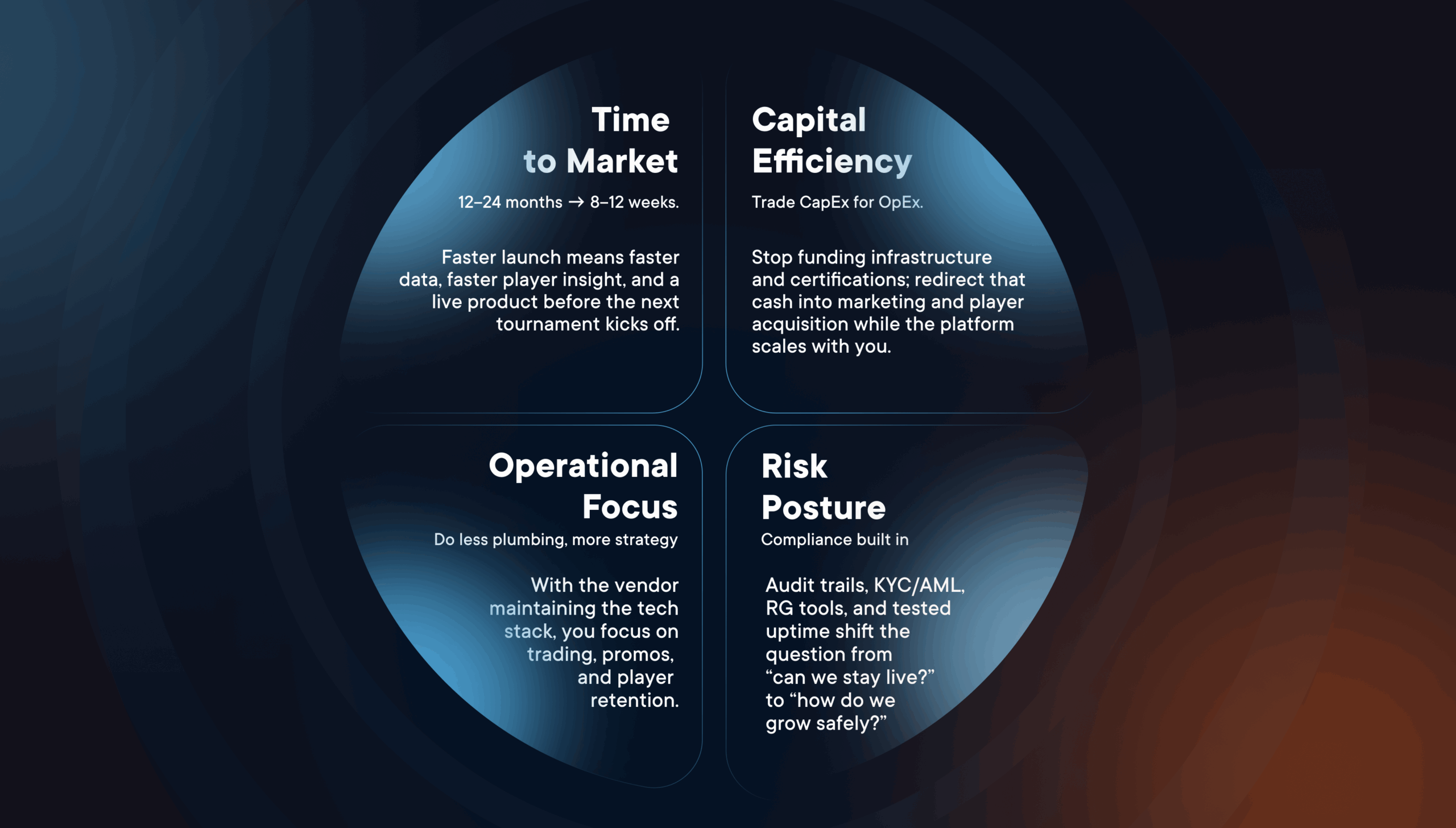
Time to market. Building a sportsbook from scratch is a 12-24-month burn before first bet. A mature turnkey compresses that to weeks or a few months. For a CEO/CPO, that’s the difference between riding a tournament cycle and missing it. Speed also compounds: earlier launch → earlier data → earlier CAC/LTV calibration.
Capital efficiency. Custom stacks front-load CapEx (engineering headcount, certifications, infra) and delay revenue. Turnkey redirects that into OpEx (setup + fee/rev-share) while you validate PMF. You’re sharing amortized R&D with every operator on the platform instead of funding it alone.
Risk posture. Regulated betting is a compliance and reliability business disguised as entertainment. A good sportsbook turnkey solution arrives with audit trails, KYC/AML hooks, RG tooling (limits, cooldowns, self-exclusion), reporting formats regulators expect, and infrastructure hardened for DDoS, spikes, and outages. Your risk shifts from “can we keep this stable and compliant?” to “can we run it well?”
Operational focus. With bespoke, your roadmap gets hijacked by plumbing: odds latency, app store updates, new PSP APIs, emergency patches at 02:00. With turnkey software, the vendor’s SREs and release trains handle most of it. Your team works on trading policy, offer design, acquisition loops, and retention mechanics.
💡Not less work—different work.
Four levels of launch success
Sportsbook Turnkey Solution vs. White-Label vs. Custom
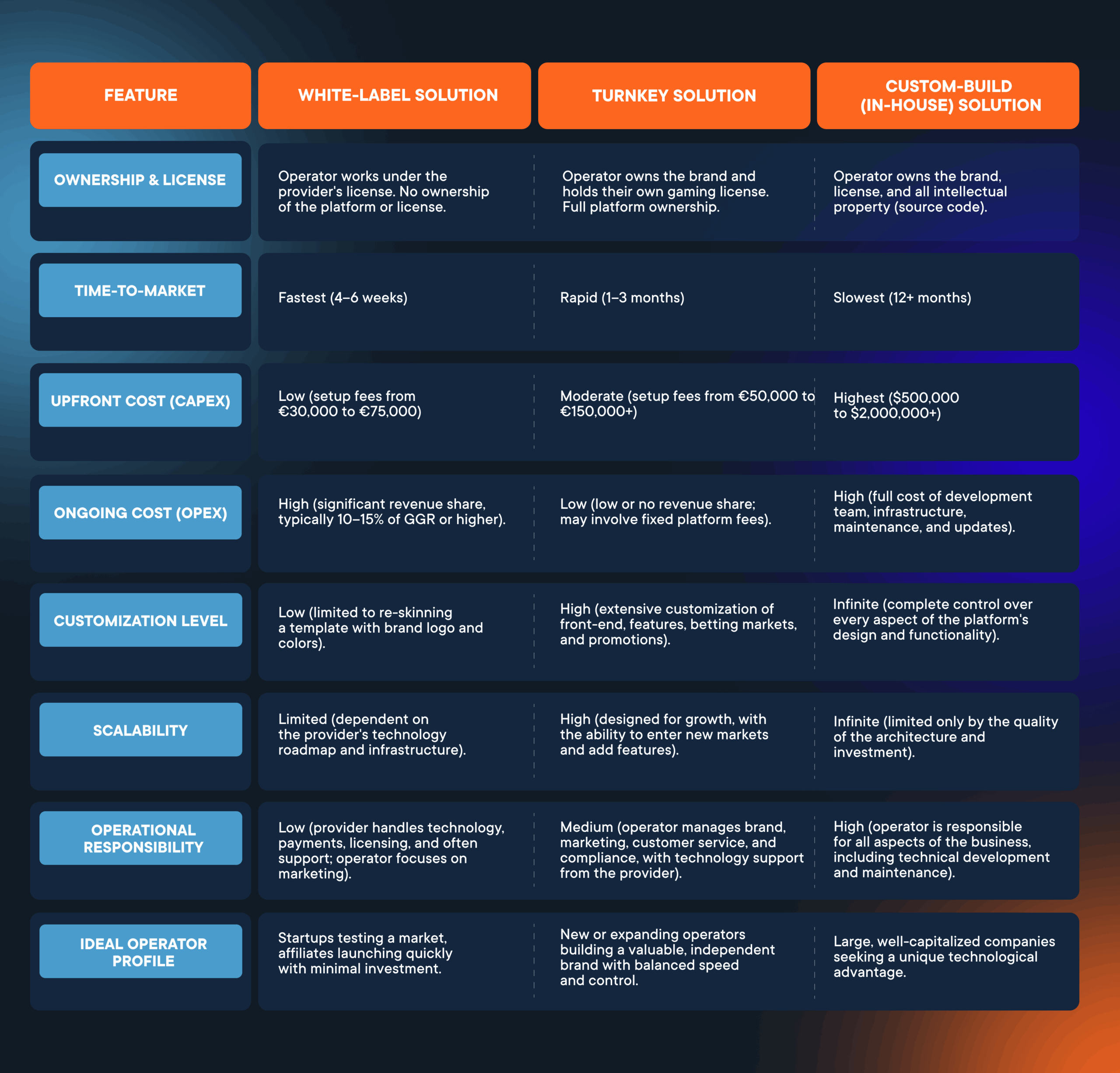
Every sportsbook model promises the same thing—control, speed, and scalability—but each delivers it differently. Some operators want the quickest route to market; others need flexibility without the drag of full-scale development; a few insist on building everything from the ground up.
To make the comparison tangible, we’ve distilled the trade-offs into the table below. In short:
- White-label buys you speed and simplicity,
- Turnkey balances autonomy with operational leverage,
- Custom build gives you total control at the cost of time and capital.
Comparison of iGaming Platform Solutions (White-Label vs Turnkey vs Custom)
💡A practical path we see: white-label sportsbook solution to test demand → turnkey sports betting to scale and differentiate → selective custom modules where ROI is clear.
Key Features for LatAm, Europe, Western Asia, and Africa
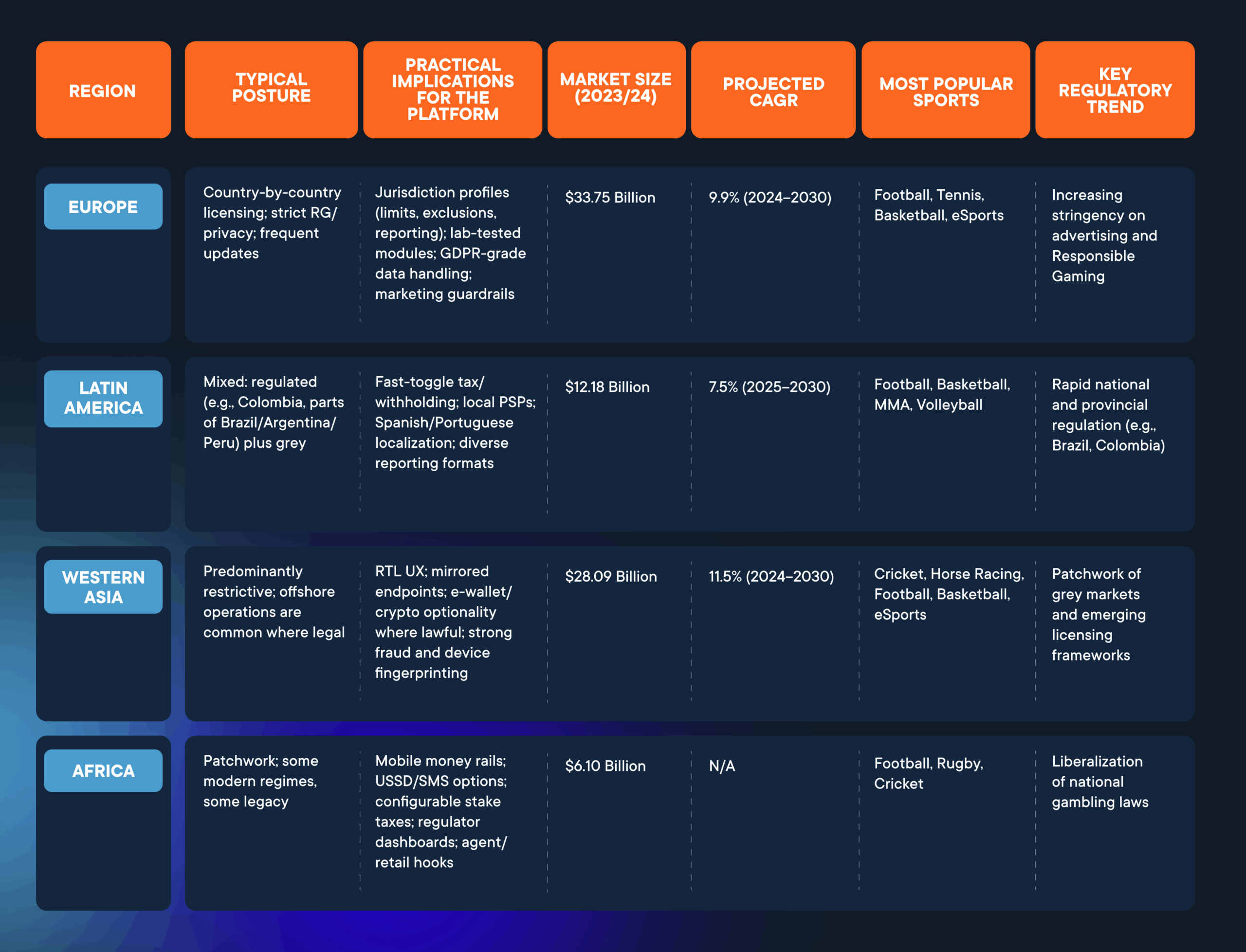
The same sportsbook lands differently by market. What travels well: localization, mobile-first UX, flexible odds display, broad payment coverage, real-time trading, and jurisdiction-level compliance toggles. How it breaks down:
iGaming Market Comparison by Region
LatAm. Mobile dominates; networks aren’t perfect. The UX must be light, resilient, and quick. Payments are local first: instant bank rails (e.g., PIX), vouchers/cash-in, regional e-wallets. Football is the spine, but volleyball, MMA, basketball matter in specific countries. Accas are cultural—make multibets fast and legible. Tax and reporting rules differ by country and state; you want switchable withholding and report templates without code changes.
Europe. Depth wins. Expect live-betting intensity, cash-out, bet-builder, streaming, and wide sport coverage (top leagues to youth divisions, plus tennis, rugby, cricket, handball, darts, F1). Decimal/fractional/American odds switching is table stakes. RG and privacy obligations (GDPR, national self-exclusion, ad rules) drive product constraints, so the platform needs native controls, audit trails, and frequent policy updates. Saturdays at 15:00 CET are load tests—auto-scaling, queue design, and settlement throughput matter.
Western Asia. Legal heterogeneity and linguistic realities define the brief. Arabic (RTL) support must be native, not patched. Where regulation is restrictive, operators rely on offshore licensing; that pushes requirements toward resilient mobile UX, mirrored domains, and payment optionality (international e-wallets, sometimes crypto, where lawful). Football is universal, cricket and basketball rise with the diaspora. Keep discretion in mind: robust fraud and geofencing, flexible KYC flows, and careful comms.
Africa. Mobile-only, often prepaid, sometimes low-bandwidth. USSD/SMS fallbacks and ultra-lean web help. Mobile money (M-Pesa, MTN MoMo, Airtel Money, Orange) is non-negotiable; instant payouts build trust. Football is king; the NBA and virtuals are powerful fillers. Be omnichannel-aware—agent networks and shop POS still matter in some countries, so a single wallet across channels is useful. Regulators focus on tax capture and minors; configurable stake taxes and ID checks per market are practical musts.
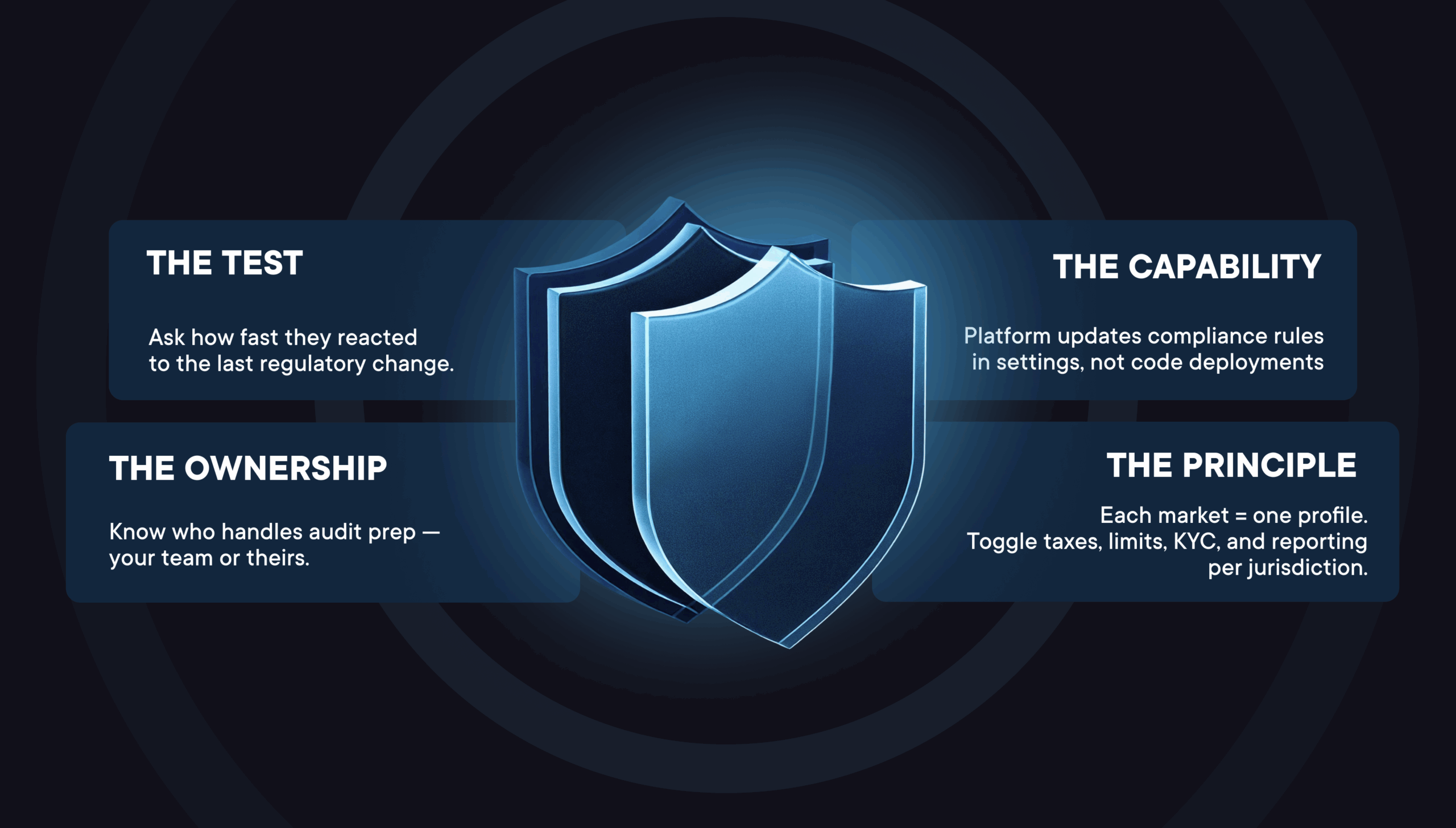
💡The common thread: regulators are moving targets. The safer bet is platforms that expose compliance as configuration.
GR8 Tech’s Hyper Turnkey: A Modern, Scalable Example
Our Hyper Turnkey performance stance is explicit: cloud-native, horizontally scalable, SLOs that withstand matchday spikes, and tight incident response (it matters when 60% of your GGR rides on weekends and live markets amplify any lag). The stack includes, but is not limited to:
- PAM/wallet
- Sportsbook engine
- Feed orchestration
- Risk tooling
- CRM
- CMS
- Advanced bonus engine
- Affiliate platform
- PSP hub
- Data exports/BI analytics
- Unified Back-Office (UBO)
You can brand from the UI layer down, set margins and limits by market/segment, choose feeds per sport, and tune cash-out/bet-builder policies.
If you want managed trading, it’s there; if you prefer an internal desk, the controls don’t vanish. Payments are global by default, with room for localizations—mobile money in Africa, instant rails in LatAm, SEPA/Open Banking where available; crypto readiness where legal. Multilingual/RTL support is built in; jurisdiction profiles flip RG/AML/reporting knobs as law changes.
The cadence matters as much as the feature list. A platform like this ships on a predictable release train, patches fast when regulators pounce, and exposes APIs so your BI isn’t hostage to the vendor. That’s the operator-centric read: stable core, open edges, and a partner that treats compliance and uptime as product features.
💡There are other capable stacks in the market. Some focused on trading depth, some on casino-first with sportsbook attached, some on ultra-light deployments for emerging regions, but the bar is clear: if a provider can’t show comparably crisp SLOs, jurisdictional switches, and payment depth, you’re inheriting their constraints.
What to Consider When Selecting a Turnkey Sportsbook Platform Provider
Selecting a turnkey provider is by all means tricky. The wrong fit can lock you into workarounds that break the moment you scale. The right one will feel like an extension of your trading floor. Before you sign anything, test them the way your players will test you: under load, across markets, and through the inevitable disruptions.
Fit to markets and motion
Ask for live references in your target countries. Watch a Saturday load curve. Confirm they already run the payment methods you’ll need (PIX, mobile money, Open Banking, card schemes) and the sports your acquisition plan relies on. If you plan omnichannel, see a single-wallet demo across web/app/retail.
Technical SLOs you can bank on
Get explicit uptime, latency, RPO/RTO, and rate limits. How do they autoscale? What’s the failover plan during a provider outage (e.g., primary odds feed dies mid-match)? Ask for a post-mortem example. If the answers are vague, you’ll be doing incident response on matchday.
Compliance as configuration
You need clear jurisdiction profiles. Can they toggle stake taxes, bet limits, KYC steps, and reporting packages per market without writing code? How fast did they adapt to the last major regulatory change in a reference market? Who owns audit prep?
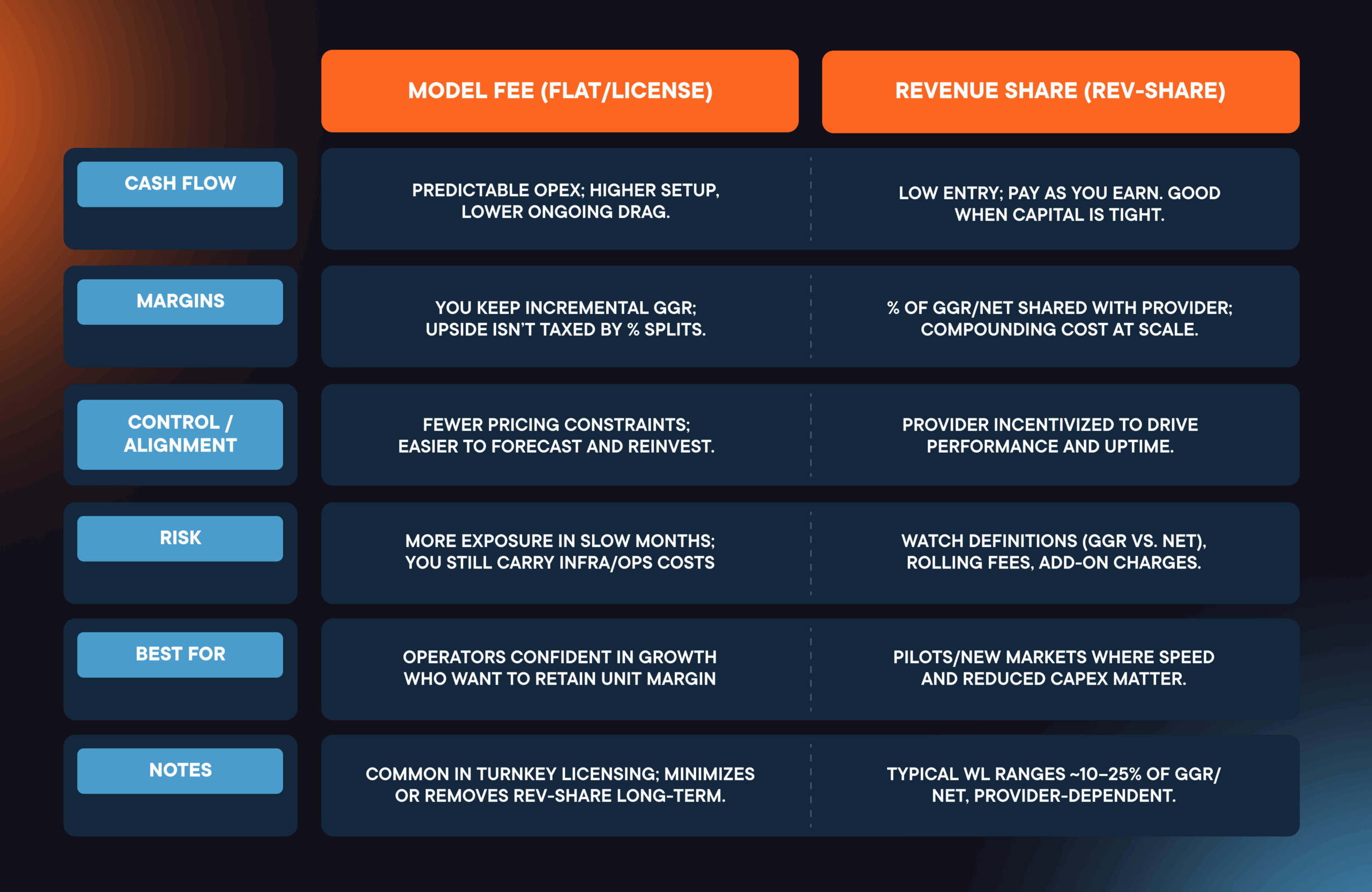
Sportsbook Pricing Models Comparison
Data access and extensibility
Will you own granular bet-level data in near-real time? Is there a robust events stream or only CSV dumps? Are APIs documented and rate-limited sanely? Can you plug your own CDP, pricing microservices, or risk models without vendor surgery?
Trading and risk options
If you want managed trading at the start and a hybrid desk later, does the model support that migration? How are margin and liability controls expressed—per market, per cohort, per channel? Can you ring-fence VIP behavior or syndicate patterns programmatically?
Payments reality, not feature list
Demos should include end-to-end deposit and withdrawal on the actual local methods you’ll use, including edge cases (partial refunds, chargebacks/recalls, failed reconciliations). Ask about payout SLAs and failure-mode handling; your NPS lives there.
Commercials that scale with you
Model fee vs. rev-share across downside/base/upside scenarios. Check minimums. Look for breakpoints that reward growth. Understand exit terms and data portability. Make sure “bespoke” integrations don’t become a tax on every roadmap item.
Closing
Your choice of a way to go is ultimately operational. A turnkey sports betting solution trades authorship for leverage: you reach the market faster, spend less up front, and inherit a compliance and uptime posture that it would take years to replicate on your own. The cost is control: you’re managing configuration and partnership dynamics rather than code.
For those considering the move, start by defining the markets you’ll enter and the payment methods and content that matter in the first six months. Seek providers already running those elements in production, and don’t accept simulations—ask to see a live environment under load with your target feeds and PSPs. Check that compliance can be adjusted per jurisdiction and that your BI tools can extract the data you need in real time. When commercial terms arrive, make sure they scale with success and allow a clean exit with your data intact.
In the end, choosing the right turnkey software for a sportsbook is all about focusing your resources on what actually moves the needle. In a low-margin, high-regulation business such as running a sportsbook, few operators need to own every layer of technology. Yet every operator must own its economics, risk posture, and player experience. A well-chosen turnkey solution lets you do precisely that, only sooner.